Baserange is a French underwear and clothing label founded in 2012 by Marie-Louise Mogensen and Blandine de Verdelhan. It began as a minimal line of women's underwear in organic cotton and bamboo, and grew into a full wardrobe of plain, ageless basics made with a small network of mills in south-west France, Portugal and Turkey. It now has its own stores in Paris, Tokyo, Kyoto, Melbourne and Seoul.
Two founders and a factory network
Baserange's own account of its beginning is short. Since 2012, it says, the brand has moved from "a minimal line of underwear for women in support of our bodies' sovereignty" to a broader collection designed for everyday wear. What the company publishes at length is not its founding myth but its suppliers. Its production pages name the mills, show the people who run them and quote them at length, which is unusual in a trade that normally treats factories as trade secrets.
Those interviews fill in the history. A Portuguese production agency near Porto, run by a woman named Maria, recalls working with de Verdelhan when she was at Surface to Air, the Paris streetwear label, on jeans, T-shirts, outerwear, bags and shoes. When de Verdelhan left to start something of her own, she went back to the same agency. Baserange still works with a cluster of factories and knitting units around Porto.
The silk mill in Odemis
The most striking supplier is in south-west Turkey. In Odemis, in rural Anatolia, a family firm started by a silk weaver in 1949 has worked with Baserange since 2012, the year the brand began. Its owners describe themselves as the only integrated silk producer left in Turkey, weaving, dyeing and sewing garments in one place. Most Turkish silk factories switched to viscose or polyester once China came to dominate the market, while this one stayed with silk and linen. The mill collects rainwater from its roof for dyeing and holds GOTS and other organic certifications. De Verdelhan, the owners note, says the area looks like a French village.
Knitwear from the Tarn
Around 2014 Baserange began working with Missegle, a family knitting mill near Castres founded in 1983 and best known for mohair socks. Its owner, Myriam Joly, a former farmer and livestock breeder, bought a closing sock factory around 2007. The mill knits Baserange socks and later sweaters on integral, seam-free knitting machines. It sells most of its output under its own name, keeping about 30 percent of capacity for clients such as Baserange.
Fibers and the Toulouse woad
The fabric list is long and specific. Organic cotton comes from Brazil, India and Egypt and carries GOTS, Oeko-Tex and OCS certificates. Bamboo appears in two forms: FSC-certified bamboo lyocell, made in a closed loop that recovers up to 99 percent of its water and solvents, and bamboo viscose from China. The Portuguese knitters use Belgian linen, Chinese silk, Mongolian yak wool, French merino and Nepalese cashmere, and recycled fabrics come from France and Portugal.
Dye gets the same treatment. Most colors come from low-impact reactive dyes, with in-house wastewater treatment at every dyehouse. A growing share is naturally dyed with woad, madder, chestnut, logwood, myrobalan fruit and the lac insect. The spring 2023 collection revived woad blue, dyed by hand in a small atelier in Toulouse. The choice has local logic. Toulouse was the center of Europe's woad trade until indigo displaced it in the sixteenth century, and the atelier grew its first plants from seeds kept by a conservatory dating to Napoleon.
What the underwear looks like
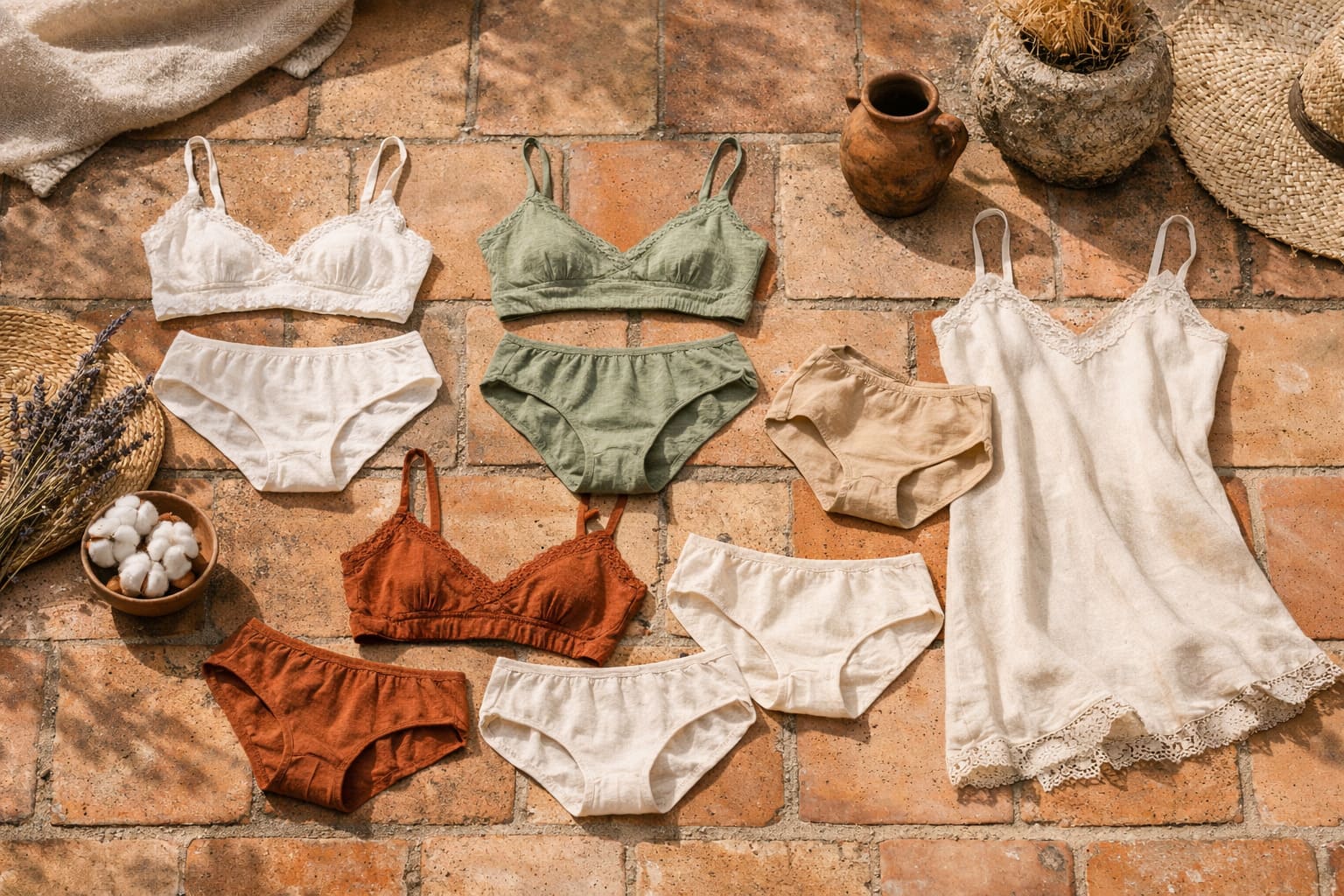
The underwear is spare to the point of austerity: unpadded triangle tops and bralettes, high-cut and high-waisted briefs, bodies and slips in rib jersey or bamboo, in muted colors that now include naturally dyed blues. Lace, underwires and molded cups play almost no part. The brand has also taken on collaborations, including one with the French sneaker brand Veja in 2026.
Stores from Paris to Seoul
Baserange sells through stockists worldwide and a small set of its own shops. In Paris it has a space on the designer floor of Galeries Lafayette Haussmann. In Japan it has stores in Tokyo's Jingumae district and in Kyoto, and in Australia a shop on Gertrude Street in Fitzroy, Melbourne. Seoul has two locations, in Jongno and Hannam. Few French brands built on plain cotton briefs have ended up with as many shops in Asia as in Europe, and the factories it works with are still named on its website.
Last updated
Sources
- baserange.com: about
- baserange.com: production
- baserange.com: stores
- fr.wikipedia.org: Missegle
- en.wikipedia.org: Veja (brand)
Members
How Baserange fits
Loading member reviews...