The Lingerie Museum - est. 2006
Snap a Photo.Know What It Is.
Upload a picture of any bra, panty, set or bodysuit. Our AI names the type, cut, fabric and color in seconds, then shows similar pieces and the brands that make them.
- AIPhoto identification
- $0Free
- OKNo signup
- AllPhone or desktop

Identified
Balconette bra + brief
See similar pieces →
The Journey
5,000 Years in the Making
Every garment tells the story of the women who wore it - and the world that shaped them.
Antiquity
The Greek Breast Band
Women in ancient Greece wrapped a band of wool or linen across the breasts and tied or pinned it at the back. The Greeks called it the apodesmos, later mastodesmos, both meaning breast-band. Roman women wore similar bands for sport, as a mosaic of athletes in bikini-like garments shows. Support came from cloth, not cups, for a very long time.

15th century
The Lengberg Castle Bras
During a 2008 rebuild of Lengberg Castle in East Tyrol, Austria, archaeologists from the University of Innsbruck opened a sealed vault packed with 15th-century debris. Inside were four linen bras with separate cups, in three different designs, one trimmed with lace. Museum of London curator Hilary Davidson called them a missing link: cupped bras existed about four centuries before Cadolle.

Late 1500s
Rise of the Corset
In the late 16th century the garment later called a corset was known as a pair of bodys. Stiffened with reed or whalebone and braced by a busk of wood, horn or ivory down the front, it pressed the torso into a flat cone. It began as aristocratic dress and spread through other classes over the 17th century.

1889
Herminie Cadolle's Corselet-Gorge
Herminie Cadolle, a friend of the Paris Commune insurrectionist Louise Michel, fled to Buenos Aires after the Commune was crushed. Back in Paris in 1889 she patented the corselet-gorge, a corset for the waist with the bust held by shoulder straps. By 1905 the top half sold on its own as a bra. Mata Hari was a client.

1914
The $1,500 Patent
Mary Phelps Jacob, a New York debutante, stitched a bra from two handkerchiefs and pink ribbon for a ball. Her patent for a backless brassiere was granted in November 1914, and she sold it to the Warner Brothers Corset Company for $1,500. Renamed Caresse Crosby in 1924, she co-founded the Black Sun Press in Paris.

1917
Corset Steel Goes to War
After the US entered the First World War, the War Industries Board asked American women to stop buying corsets so the metal in their boning could go to the war effort. The appeal is said to have saved about 28,000 tons of metal, enough for two battleships. The figure is repeated everywhere, but nobody has published the arithmetic behind it.

1935
A, B, C, D
Warner's launched its Alphabet Bra in 1935, sizing cups A through D by breast volume. It was not quite the first: in 1932 S.H. Camp and Company had already used the same letters, but to grade how far the breast hung, not how large it was. Model and Fay-Miss followed in the late 1930s, though no two makers measured alike.

July 5, 1946
The Bikini Debuts
Louis Reard showed his two-piece at the Piscine Molitor in Paris on July 5, 1946, four days after the Bikini Atoll nuclear test that gave it its name. It was modeled by Micheline Bernardini, an 18-year-old dancer from the Casino de Paris, who got 50,000 fan letters. Spain, Italy, Australia and parts of France restricted it for years.

February 12, 1947
Dior's New Look
Christian Dior's first collection, shown on February 12, 1947, offered soft shoulders, full busts, tiny waists and wide corolla skirts. The silhouette could not be had without serious foundations underneath, and Pathe News made a short film about the undergarments alone. Coming during rationing, the extravagance drew criticism, but the look put Paris back at the head of fashion.

1948
Simone Perele Opens in Paris
Simone Perele earned her corsetry diploma in 1935 and made foundations at home after the Liberation. In 1948 she and her husband Wolf registered the business at 8 rue de Montyon in the 9th arrondissement of Paris, moving to rue Rougemont two years later. The Grodner family still owns the company.

1940s-50s
The Bullet Bra Era
Lana Turner's tight knit top in the 1937 film They Won't Forget is usually credited with starting the sweater girl look, later worn by Jane Russell and Jayne Mansfield. Under the sweater went the conical bullet bra, which raised and separated the bust. Not everyone approved: a Pittsburgh police chief complained about sweater girls in 1949.

September 7, 1968
The Bra-Burning Myth
About 200 women from New York Radical Women protested the Miss America pageant in Atlantic City on September 7, 1968. They crowned a live sheep and dumped bras, girdles and high heels into a Freedom Trash Can. There was no bonfire of underwear; one local paper reported a small trash-can fire, which organizers deny. A comparison with draft-card burning made the myth.

1977
Victoria's Secret Opens
Roy and Gaye Raymond opened the first Victoria's Secret on June 12, 1977, at the Stanford Shopping Center in Palo Alto, California. Raymond wanted a lingerie store where men did not feel like intruders. In 1982 he sold the business, then five stores with $6 million in annual sales, to Leslie Wexner for $1 million.

April 13, 1990
Madonna's Cone Bra
Madonna opened the Blond Ambition World Tour at Chiba Marine Stadium in Japan on April 13, 1990, wearing Jean Paul Gaultier's conical corsets, one in peach satin and one in gold. Gaultier traced the idea to a corset he saw at an exhibition as a child. The cone bra made underwear-as-outerwear a stadium spectacle. One sold at auction in 2001 for over $21,000.

1994
Hello Boys
Eva Herzigova looked down at her own cleavage in a black Wonderbra under two words: Hello Boys. The 1994 UK poster spawned an urban legend that it caused car crashes. The bra behind it was a 1961 plunge push-up, Model 1300, designed by Louise Poirier for Canadelle. The poster went on to the Victoria and Albert Museum.

2018
Savage X Fenty
Rihanna launched Savage X Fenty online on May 11, 2018, with TechStyle Fashion Group, aiming for diversity in size and skin color. Its first runway show came at New York Fashion Week that September, with Bella and Gigi Hadid, and the 2019 show streamed on Amazon Prime Video. In November 2019 Victoria's Secret dropped its own televised show.

2020s
The Inclusive Turn
In 2021, newly split from L Brands, Victoria's Secret retired its Angels and launched the VS Collective, including Megan Rapinoe and Valentina Sampaio. When its fashion show came back on October 15, 2024, Sampaio and Alex Consani became the first transgender models to walk it. The brand soon signed contract models again, among them former Angels.

The Exhibits
Stories That Changed Everything
Deep dives into the moments, myths, and milestones that shaped intimate fashion.
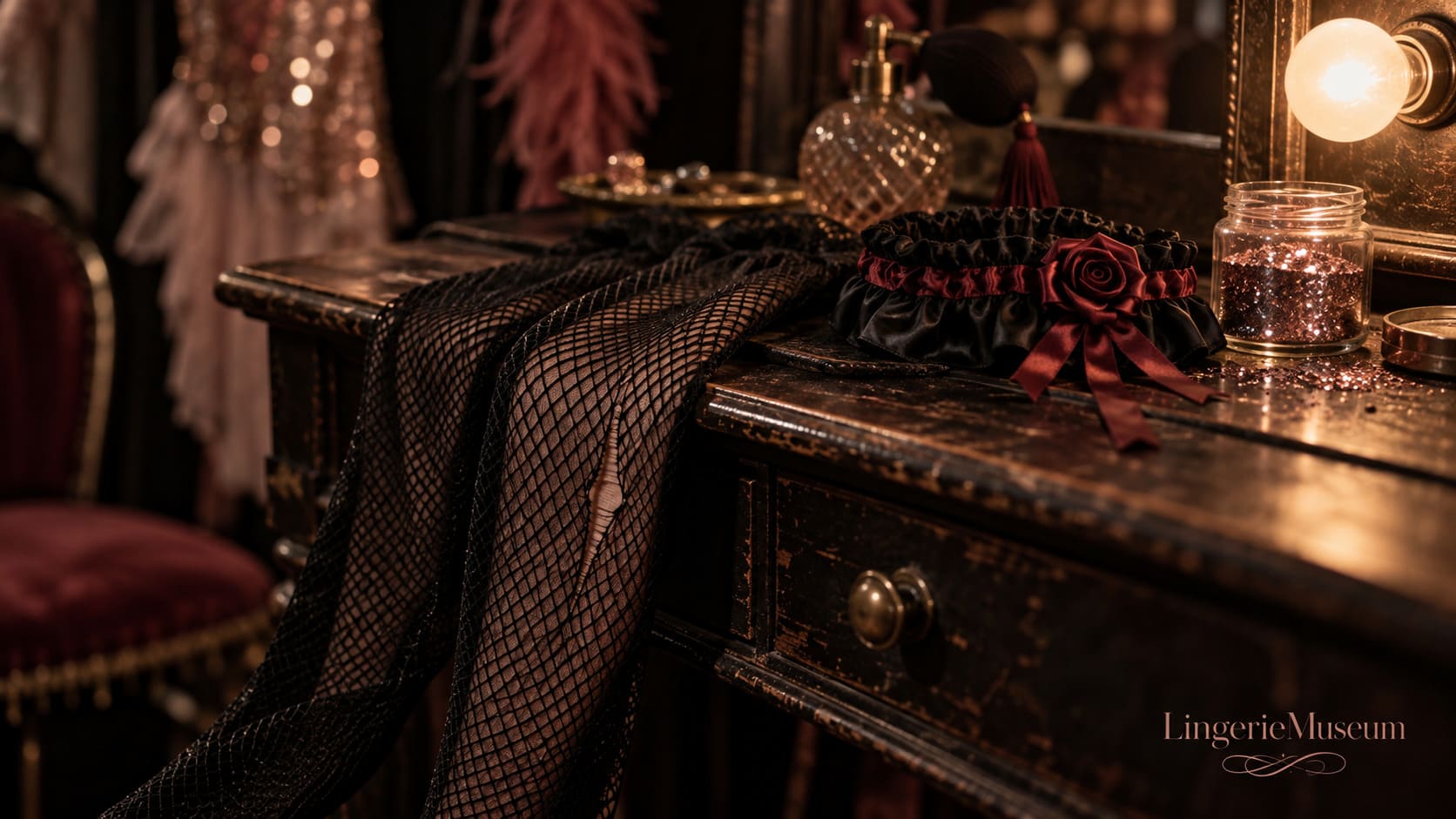
Craftsmanship
L'Art de la Dentelle
The ancient art of lace-making - where threads become poetry and cities build their identity around a single craft.

Calais

Chantilly

Burano

Nottingham

Alencon
The Visionaries
They Shaped What We Wear
Inventors, revolutionaries, designers, and disruptors - the people who changed the most intimate part of fashion.


Cultural Impact
Lingerie in Culture
How intimate garments shaped art, cinema, and the visual language of desire.
In Art
4th Century AD
The "Bikini Girls" Mosaic
Villa Romana del Casale, Sicily. Ten women exercise in bandeau bras and briefs - the most famous archaeological depiction of ancient underwear.
1940s - 1950s
Pin-Up Art
Gil Elvgren and Alberto Vargas elevate lingerie illustration to fine art. Their images appear on bomber nose art, calendars, and playing cards.
Contemporary
Feminist Reinterpretation
Tracy Emin, Cindy Sherman, and others reclaim underwear as artistic medium - challenging what intimate garments signify about power, vulnerability, and identity.
In Cinema
1946
Rita Hayworth in "Gilda"
A black satin negligee that rewrote what lingerie could communicate on screen. Hayworth made intimate clothing a character in itself.
1958 - 1960
Elizabeth Taylor's Silhouette
"Cat on a Hot Tin Roof" and "Butterfield 8" - silk slips became Taylor's signature. Lingerie as the language of desire and discontent.
1990
Madonna's Blond Ambition
Gaultier's cone bra on a world stage. Underwear becomes outerwear. The private made spectacularly public.
In Advertising
1949 - 1969
Maidenform "I Dreamed"
"I dreamed I went shopping in my Maidenform bra." A 20-year campaign showing women in bras doing everyday things - revolutionary for its era.
1994
Wonderbra "Hello Boys"
Eva Herzigova on a billboard. $50 million in free publicity. Now in the V&A Museum. Voted the most iconic outdoor ad of the last fifty years.
2018 - Present
The Savage X Fenty Shows
Rihanna redefines the lingerie fashion show. Every body type, every skin tone, every gender expression. Celebration replaces aspiration.
Le Patrimoine Francais
The Birthplace of Elegance
France didn't just create lingerie - it elevated intimate garments into an art form, built on centuries of silk and lace tradition.
"Born in the cradle of luxury, in the heart of Lyon's silk neighborhood."
Two pillars support France's dominance in lingerie: Lyon silk and Calais lace. Lyon has been the Silk Capital of the World since the 15th century, its Croix-Rousse district home to generations of silk weavers - the canuts - whose craft feeds directly into luxury lingerie to this day.
In Calais, mechanical lace looms smuggled from England in 1816 evolved into the world's most prestigious lace industry. Some Leavers looms still weaving today are over a century old, producing fabric so fine it carries a protected appellation: Dentelle de Calais-Caudry.
After World War II, France's reconstruction birthed a golden generation of lingerie houses - each founded on the conviction that intimate garments deserve the same artistry as haute couture.
The Encyclopedia
Explore Brands
12+ lingerie brands from around the world - heritage houses, modern disruptors, and everything in between.
The People
Founders, Designers, Models
12+ people who shaped the lingerie industry - from 19th-century inventors to modern icons.




The New Chapter
The Modern Revolution
An industry rewriting its own rules - from who it serves to how it's made.
Body Positivity
Aerie dropped Photoshop and sales rose 20%. Savage X Fenty put every body on the runway. The "ideal body" is now every body. What was once radical is now the baseline.
Sustainable Intimacy
Organic cotton, recycled polyester, TENCEL from sustainably sourced wood pulp. The industry is learning that what's closest to the skin should be closest to the earth.
Smart Fabrics
Embedded health sensors. Temperature regulation. Posture-correcting bras. Titanium underwire with adaptive memory foam. Lingerie is becoming technology.
AI-Powered Fitting
Virtual try-on. Cross-brand size intelligence. ThirdLove's half-cup sizing proved that one-third of women fall between standard sizes. AI is fixing that for everyone.
The Chronicle
Dispatches from the Industry
Current events in lingerie and intimate fashion - connected to the history that shaped them.