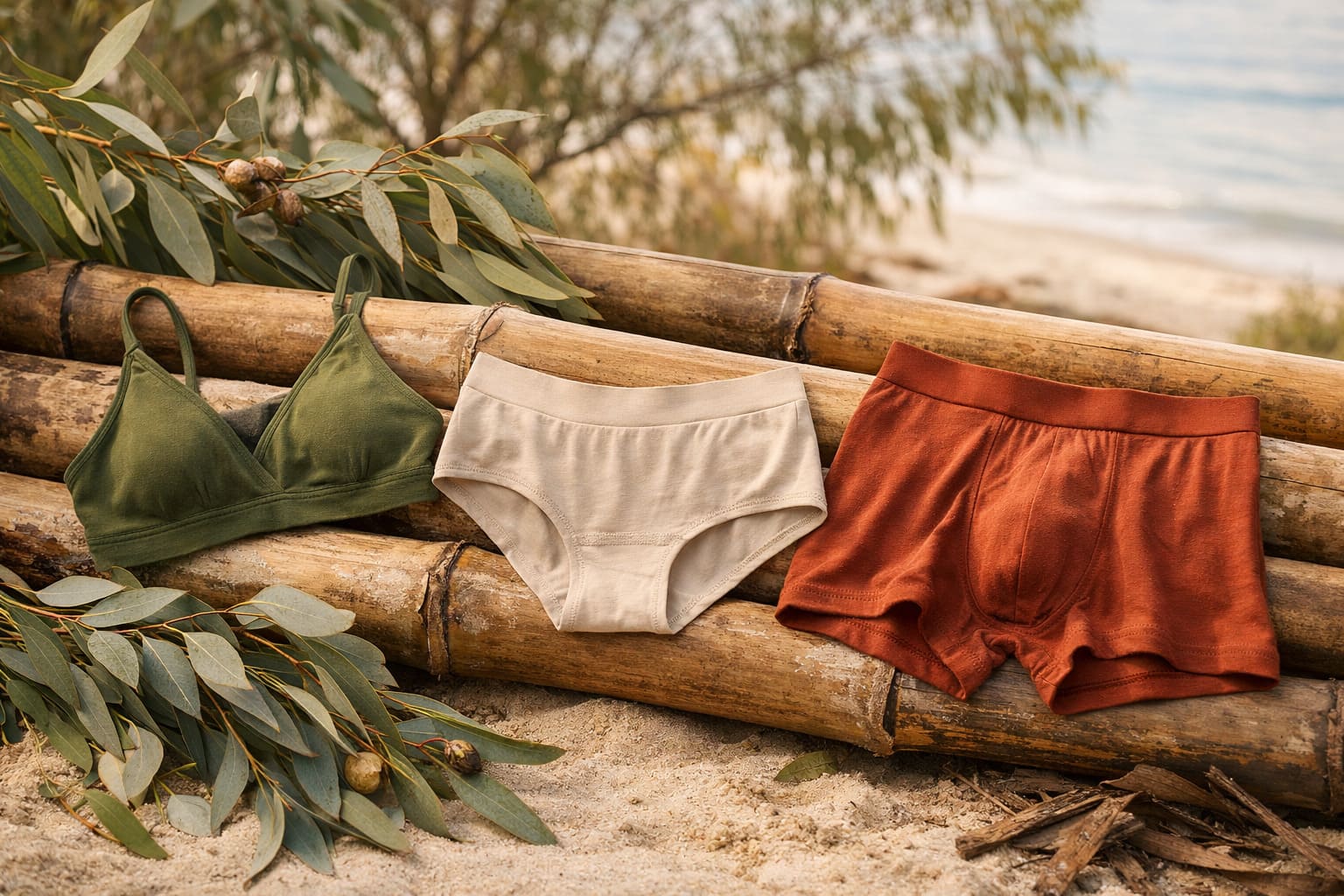
Boody is an Australian basics brand that makes underwear, wireless bras, loungewear and socks mainly from bamboo viscose. The company dates its start to 2012 in Sydney, and today it sells through regional sites for Australia, New Zealand, the United States, Canada, the United Kingdom and Europe. It is a certified B Corporation.
Bamboo viscose, explained plainly
The fabric is the whole proposition, so it deserves a careful description. Bamboo viscose is not bamboo fiber in the way linen is flax fiber. The woody stalks are broken down into cellulose pulp, dissolved, and pushed through fine nozzles to form new filaments. Chemically, the result is a regenerated cellulose fiber, in the same family as rayon and modal. In the United States it is often labeled "rayon from bamboo" for exactly that reason.
What survives the process is the hand. Viscose is smooth, cool, drapes well and takes dye evenly. Boody's own line is that its bamboo fabric is four times softer than cotton, which is a marketing comparison rather than a lab figure, but the general point holds: a fine viscose jersey feels slippery and soft in a way a basic cotton knit does not.
Two claims follow bamboo underwear around: that the finished fabric is "naturally antibacterial", and that the crop needs no pesticide. Neither appears on Boody's own pages in that form, and the first is hard to sustain for a fiber that has been dissolved and re-spun. What the brand does state is that its bamboo is Ecocert-certified organic, that its fabrics are OEKO-TEX certified, which covers harmful substances in the finished textile, and that it carries FSC certification for forest sourcing.
A short list of fabrics
Bamboo jersey in several weights is the backbone. Around it, Boody has built a family of named textiles:
- Bamboo Seamfree, a circular knit used for its tube-knitted briefs and crops
- Bamboo ribbed, for tanks and loungewear
- a bamboo and cotton jersey blend
- FreeMesh, a lighter open knit
- Lyolyte, and the newer AiraRib used in loungewear
The seamfree knit matters most for underwear. Garments knitted in the round on circular machines need few or no side seams, which is why Boody's briefs sit flat under clothes. Readers comparing fabrics can see how viscose knits differ from synthetic ones in our guide to cotton vs. microfiber.
Every bra is wireless
Boody makes a flat promise on its site: every bra it makes is wireless, and always will be. That is a real constraint. It rules out the underwired balconette, the plunge and the molded push-up, and it limits how much lift the range can give larger cups. In return the brand gets a coherent range of crop tops, shaper crops and soft triangle shapes that can be knitted on the same machines as the briefs. Anyone weighing that trade-off can read our underwire vs. wireless bra comparison.
The pricing follows the same logic. Boody sells basics in multipacks and plain colors, close enough to mainstream underwear that the step up is small. It backs that with a 30-day comfort guarantee and a money-back promise.
How Boody scores as a B Corp
B Corp certification is an outside assessment of a company's social and environmental practices, scored on a points scale and renewed every few years. Boody says it ranks in the top 1% of B Corps globally and was the third-highest-scoring clothing company in the world when it was last assessed. Those are the company's own figures, but the certification itself is public and verifiable through B Lab.
Bamboo basics are now a crowded shelf, with supermarket labels and other direct-to-consumer brands selling viscose briefs. Boody's position in that field rests on its certifications and a deliberately narrow range rather than on fashion. The brand does not publish the names of its founders on its own pages, nor where its garments are made, so this entry leaves both out. What it does publish is a catalog of plain, soft, wire-free basics, sold in six regional markets from an Australian base.