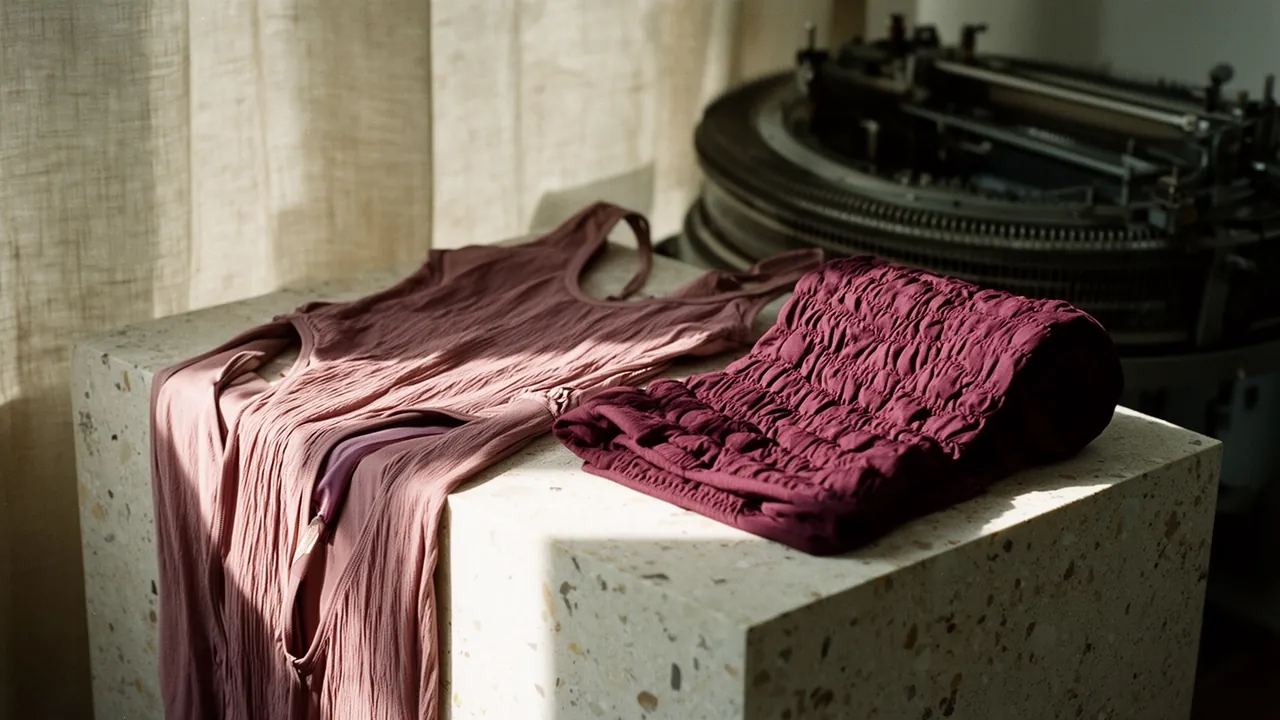
Hunza G is a London swimwear label built on one fabric: a crinkled, ultra-stretch knit first made under the name Hunza in 1984 by Peter Meadows. The brand was relaunched in 2015 by creative director Georgiana Huddart, who added the "G" and kept the original premise, that one suit should stretch to fit many bodies.
That premise is unusual in swimwear, a category that usually sells itself on precise sizing, padded cups and engineered underwire. Hunza G sells texture and elasticity instead.
Peter Meadows and the 1984 crinkle
The original Hunza was a product of mid-1980s British fashion, when high-cut legs, bright solid colors and body-conscious stretch were everywhere. Meadows's contribution was the cloth. Rather than a flat Lycra jersey, Hunza used a puckered knit that looks a little like seersucker and behaves like a spring. Relaxed, it sits in small ridges; on the body, it opens out and grips.
The result was a garment that did not need a size label in the conventional sense. One piece could cover a range of figures because the fabric, not the pattern, did the fitting. For a small label that meant fewer variants to cut and stock. For the buyer it meant fewer fitting room arguments.
The blue dress in Pretty Woman
Hunza made dresses as well as swimsuits, and one of them became the brand's best-known product. In the 1990 film Pretty Woman, Julia Roberts wears a Hunza mini dress in her first scenes. The brand's own account describes it as "electric blue and unforgettable", and for once the marketing is accurate: the cutaway dress with its metal ring at the waist is one of the most copied costumes of the decade.
The film fixed the brand in public memory just as the look it represented was going out. By the mid-1990s minimal, matte swimwear had replaced the neon high-leg, and Hunza faded from view.
Georgiana Huddart's 2015 revival
The revival was a personal project. Huddart has said she grew up watching her mother wear the crinkle fabric, and she became fixed on the material while studying art history at university. In 2015 she worked with Meadows to bring the label back as Hunza G, with herself as creative director.
The relaunch was careful not to reinvent the product. The crinkle stayed. The one-size principle stayed. What changed was the edit: a quieter palette alongside the brights, cleaner necklines, scoop backs, square necks and the occasional ring hardware that nods back to the 1990 dress. The timing was good. Retro swimwear, high-cut legs and "vintage find" styling were rising on Instagram, and a label with a genuine 1980s pedigree did not have to fake one.
Stockists and the Pretty Woman dress, again
Hunza G found its audience through fashion retailers rather than swimwear specialists, sold at shops such as Liberty London and through online luxury platforms. It also returned to its own history: a replica of the blue Pretty Woman dress was produced and covered widely in the press, closing a loop that few heritage brands get to close so neatly.
How the Hunza G crinkle is made
The fabric is the whole business, so the brand is open about how it is produced. Hunza G describes knitting it on circular looms set with thousands of individually calibrated needles, each set, checked and replaced by hand. A combination of yarns is fed through a tension system, and the blend determines how much the finished cloth stretches and how deep the crinkle sits.
Because the knit comes off the machine as a tube, many pieces need fewer seams than a cut-and-sew swimsuit. The brand says each finished suit contains about nine million stitches and that the looms produce billions of stitches a day. Technicians inspect the cloth by holding it against the light and checking stitch structure and weight along every meter. Production remains in the UK, which is rare for a swimwear brand selling at this volume.
Why one size works here
A standard one-piece or bikini bottom in flat Lycra relies on pattern grading: each size is cut differently. Hunza G's knit replaces that grading with mechanical recovery. The trade-off is that the fit is snug rather than structured. There is no underwire and no moulded cup, so support comes from compression, which suits smaller and medium busts better than larger ones. Customers who need a fitted cup are better served by a sized specialist such as Panache or Freya.
A cult label at forty
By 2024 Hunza G was marking forty years since the first crinkle suit. Forbes ran a piece arguing that refusing to chase trends had kept it in business, and the product line supports that reading. The bestsellers today are recognizably the same object Meadows sold in the 1980s: a stretchy, textured, high-leg suit that fits several sizes and can double as a bodysuit under a skirt. Few swimwear brands can show a 1984 piece and a 2024 piece side by side and have them look like the same idea.
Last updated
Sources
- hunzag.com: about
- aol.com: replica julia roberts pretty woman 211539050
- hunzag.com: inside the factory
- forbes.com: new brand to know hunza g
- forbes.com: how avoiding trends has kept hunza g swimwear in business for 40 years
- libertylondon.com: meet the maker hunza g georgiana huddart
Members
How Hunza G fits
Loading member reviews...