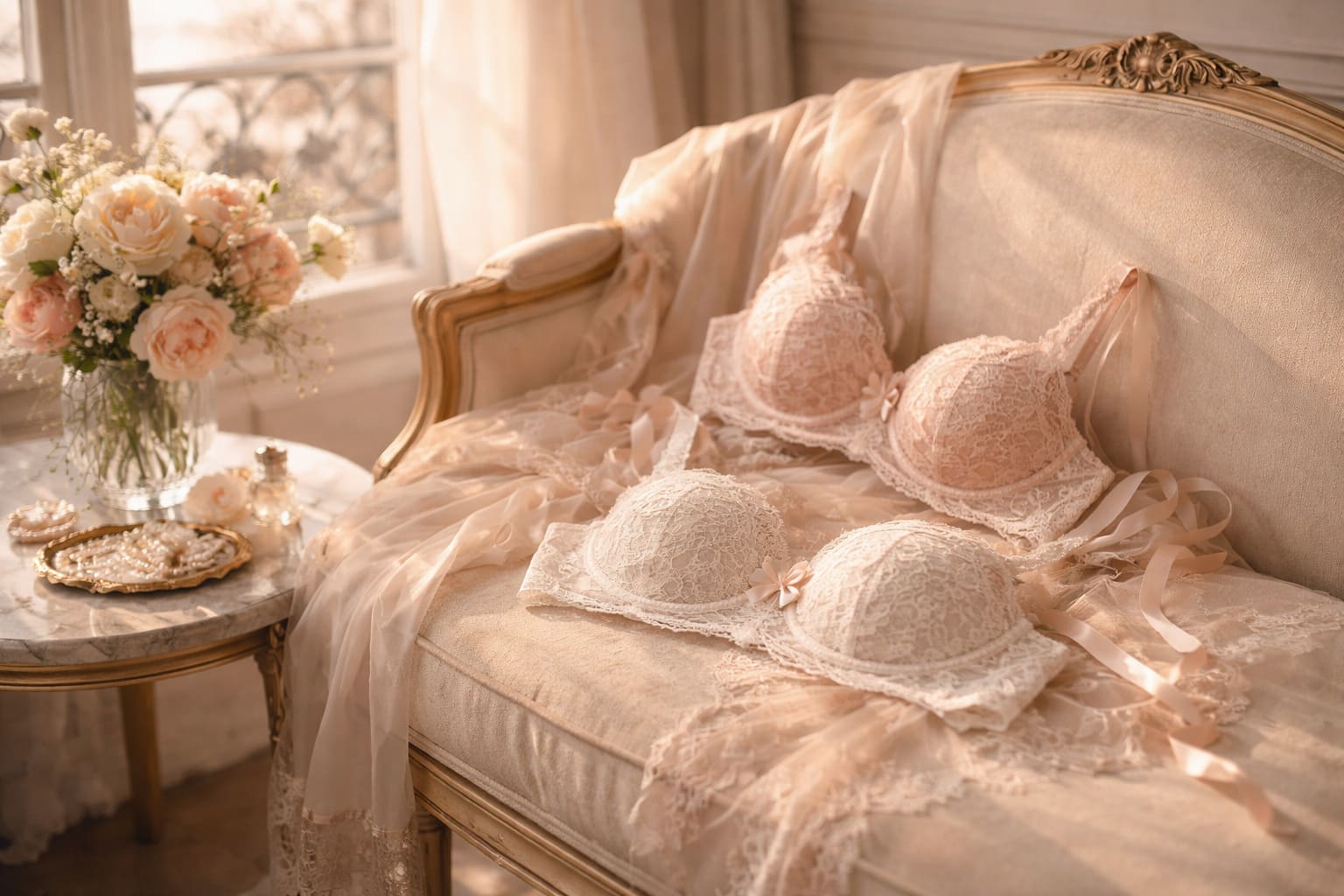
Simone Pérèle is a French lingerie house founded in Paris in 1948 by the corsetiere Simone Pérèle. It makes bras, briefs, shapewear, swimwear and loungewear, is designed in France with lace and embroidery from European mills, and is still owned and run by the founder's family, now her grandchildren Stéphanie Pérèle and Mathieu Grodner.
A corsetiere's diploma and a Paris apartment
Simone Pérèle trained as a corset maker and earned her diploma in 1935. After the Liberation she began making bras at home, in an apartment in the Opéra district of Paris, and in 1948 she registered the company at 8 rue de Montyon in the 9th arrondissement. In 1950 the business moved to 11 rue Rougemont, a few streets away, and stayed there for eighteen years.
Timing matters here. Christian Dior's New Look of 1947 had brought back cinched waists and structured busts, and the corsetry trade was busy. Pérèle's training was in that tradition, but the house she built moved steadily toward lighter, softer bras. The brand's own line on its founding idea is that women should never have to choose between being comfortable and feeling beautiful.
Department stores and a factory in Orléans
By 1956 she was selling to department stores as well as independent lingerie shops. In 1962 the company bought a factory in Orléans, south of Paris, and formalized its corporate structure.
A bra for each decade
French Wikipedia's account of the company is mostly a list of bras, which suits a house that grew by product rather than by advertising.
- 1961: Soleil, a bra shaped with darts
- 1964 to 1965: Sole Mio, the company's first bra in Lycra
- 1968: its first "invisible" bra, without an underwire
- 1973: Papillon, a coordinated bra and brief
- 1990s: Amélia, made in microfiber
The sequence tracks the industry. Elastane arrived in lingerie in the 1960s, the unstructured bra followed the cultural shifts of 1968, and microfiber became the standard smooth fabric under T-shirts in the 1990s.
The family firm
The founder's daughter, Catherine Pérèle, joined in 1971. With her brother Philippe Grodner she ran the business for more than thirty years and took it abroad. Simone Pérèle died in 1995. By 1998 the brand was sold in 80 countries, and in 2002 it opened a subsidiary in the United States. In 2007 the group launched a second label, Implicite.
In 2015 Mathieu Grodner, the founder's grandson, became a director. He and Stéphanie Pérèle now lead the house from Paris. The head office is at 1 rue de Stockholm in the 8th arrondissement, near Gare Saint-Lazare.
The business today
The company remains mid-sized by French lingerie standards. French Wikipedia records 2024 revenue of about 77.1 million euros and a loss of about 2 million euros. Its US store lists collections for Australia, Belgium, the Czech Republic, France, Luxembourg, the Netherlands, New Zealand, Slovakia, the United Kingdom and the United States, alongside a wider wholesale network.
How the house compares
In French lingerie, Simone Pérèle sits in a small group of family-founded houses that kept their names and their fitting knowledge, alongside the larger Chantelle. Its collections lean on fine lace and embroidered tulle, but the catalog's backbone is plain: smooth T-shirt bras, plunges and full cups that sell season after season.
The name on the label has belonged to the same family for more than seventy-five years. That continuity is less common in Paris lingerie than the city's reputation suggests, and it is the main reason a 1940s corsetiere's ideas about comfort still shape the bras.
Founder

Collections (18)
257 products in our archive
Use our Lingerie Identifier to find matching pieces