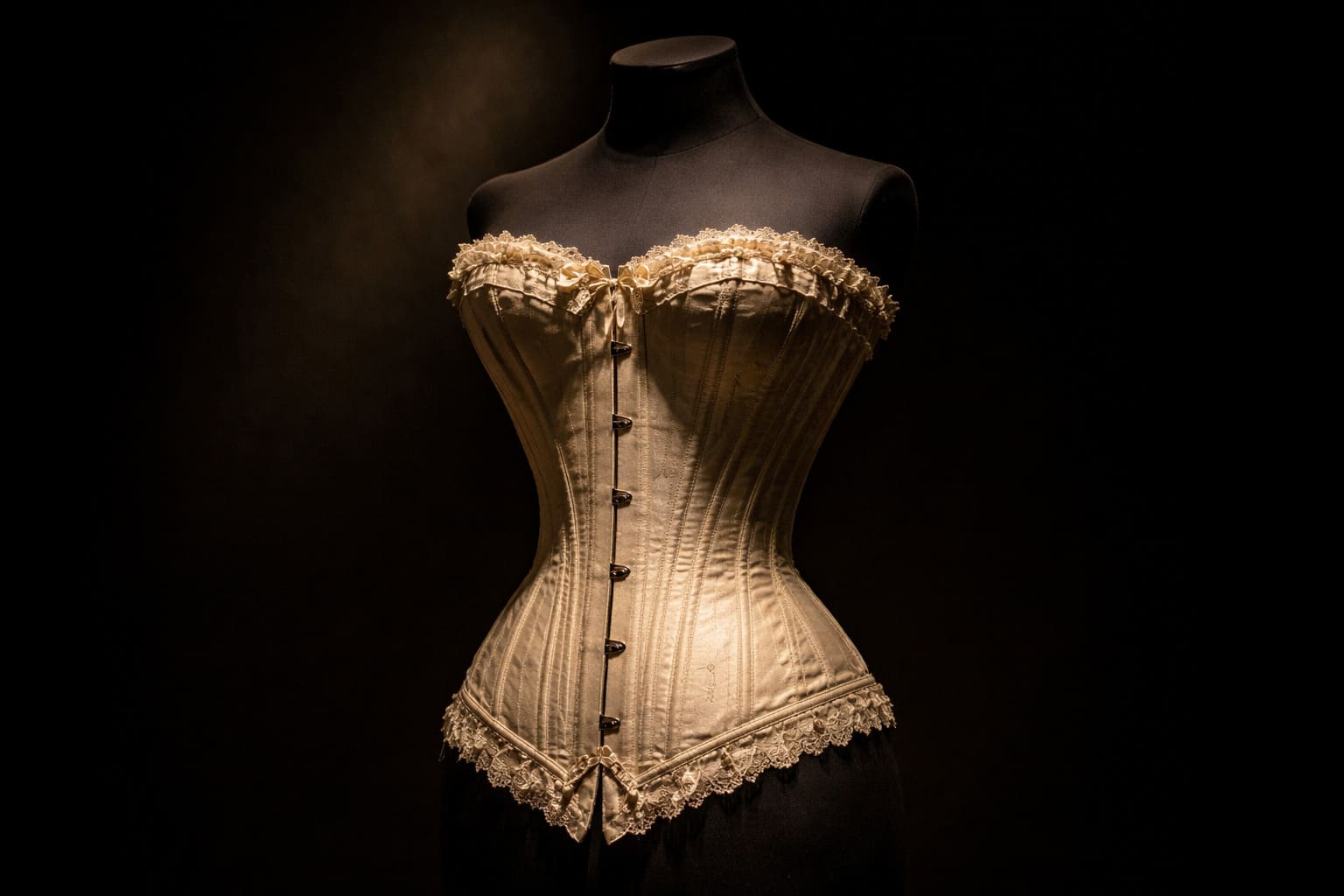
What Is the History of the Corset?
The corset dominated Western women's fashion for over 400 years, from roughly 1500 to 1920. Originally introduced to the French court by Catherine de Medici, the corset reshaped the female torso into fashionable silhouettes — flattening the bust in the Renaissance, cinching the waist to as little as 17 inches in the Victorian era, and creating the S-bend curve of the Edwardian period. The corset was finally abandoned during World War I, when women entered the workforce and the U.S. government asked them to stop buying corsets to free up 28,000 tons of steel for the war effort.
The Rise: 1500s–1700s
When Catherine de Medici arrived at the French court from Italy in the 1530s, she brought with her a taste for structured undergarments that would reshape European fashion for centuries. The early corset — called "stays" in English — was constructed from linen stiffened with whalebone, paste, or even iron.
Its purpose was total body control:
- Flatten and raise the bust into a smooth, conical shape
- Elongate the torso to create a rigid, upright posture
- Conceal the stomach and hips beneath layers of structured fabric
By the 17th century, the corset was mandatory for any woman of status across Europe. The phrase "straight-laced" — meaning rigid or morally strict — comes directly from the practice of tightly lacing a corset.
The Engineering
Early corsets were engineering marvels of their time:
- Boning: Strips of whalebone (actually baleen, from the mouths of baleen whales) provided flexible rigidity
- Busks: A flat piece of wood, ivory, or bone inserted at the front for extra stiffness
- Lacing: Cords threaded through metal eyelets at the back, pulled tight by the wearer or a servant
- Construction: Multiple panels of heavy linen, hand-stitched with reinforced seams
The Peak: Victorian Era (1830s–1900)
The Victorian era pushed corsetry to its most extreme. The introduction of steel boning, metal eyelets, and front-opening clasps in the mid-1800s allowed tighter lacing than ever before.
The "Wasp Waist" Ideal
The fashionable Victorian woman aspired to a waist circumference of 17 to 19 inches — roughly the size of a dinner plate. This practice, known as "tight-lacing," was both admired and condemned.
The Medical Debate
Doctors, journalists, and reformers waged a fierce campaign against the corset. Medical concerns included:
- Difficulty breathing and reduced lung capacity
- Bruised or fractured ribs
- Spinal distortion and chronic back pain
- Displacement of internal organs (liver, stomach, intestines)
- Digestive problems and chronic constipation
- Fainting from restricted blood flow (hence the popularity of smelling salts)
- Stunted growth in young girls who began corseting in childhood
Were Corsets Really Dangerous?
Modern historians debate this. While extreme tight-lacing certainly caused harm, many women wore corsets at moderate tightness without significant health effects. The average Victorian woman likely laced her corset to reduce her waist by 2-3 inches, not the extreme 6-8 inches depicted in fashion plates. Still, the cumulative effect of daily wear from adolescence was real.
The Dress Reform Movement (1850s–1900s)
Amelia Bloomer and the Rational Dress Movement
Amelia Bloomer (1818–1894) became the most visible advocate for dress reform when she promoted loose Turkish-style trousers as an alternative to layers of petticoats and corsets. The "Bloomer Costume" was mocked relentlessly in the press, but it planted the seed of resistance.
Other reformers followed:
- Elizabeth Cady Stanton questioned the necessity of the corset
- The Rational Dress Society (founded 1881) campaigned against "any fashion in dress that deforms the figure"
- "Health corsets" appeared — using elastic panels and cotton netting instead of rigid boning
The Fall: 1910s–1920s
World War I Kills the Corset
Two forces converged to end the corset's reign:
-
Women entered the workforce. Millions of women took factory jobs, drove ambulances, and worked farms. You cannot rivet aircraft parts in a corset.
-
The U.S. government intervened. In 1917, the War Industries Board asked American women to stop buying corsets to free up metal for the war effort. The result: an estimated 28,000 tons of steel — enough to build two battleships — was redirected to the military.
The 1920s: Liberation
The flapper era celebrated a boyish, uncorseted silhouette. The corset was replaced by the brassiere (invented by Herminie Cadolle in 1889, popularized after WWI) and the girdle — a lighter, more flexible garment. By 1930, the rigid corset was effectively dead as everyday wear.
The Modern Revival
The corset has returned — but on different terms:
- Jean Paul Gaultier made corsetry high fashion in the 1980s, creating Madonna's iconic cone bra-corset
- Dita Von Teese championed vintage corsetry as art and self-expression
- Vivienne Westwood incorporated corset elements into punk and high fashion
- Modern waist trainers (popularized by the Kardashians) echo corset principles with contemporary materials
The difference: today, corsets are chosen, not required. The garment that once imprisoned women has been reclaimed as a symbol of personal style.
Frequently Asked Questions
When did women stop wearing corsets?
Women largely stopped wearing rigid corsets during and after World War I (1914–1918). The combination of women entering the workforce and government requests to conserve steel made corsets impractical. By the 1920s, the flapper era's loose silhouette had made corsets obsolete for everyday wear.
Were corsets actually dangerous?
Extreme tight-lacing could cause real health problems including restricted breathing, broken ribs, and organ displacement. However, most women wore corsets at moderate tightness. The average Victorian woman reduced her waist by 2-3 inches, not the extreme reductions shown in fashion illustrations.
Who invented the corset?
The corset evolved gradually rather than being invented by a single person. It emerged in European fashion around the 1500s, with Catherine de Medici often credited for popularizing structured undergarments at the French court. Earlier forms of body-shaping garments existed in Minoan Crete (c. 3000 BC).
Why did women wear corsets?
Corsets served multiple purposes: they created the fashionable silhouette of each era, provided back support, and signaled social status. In many periods, appearing without a corset was considered indecent — similar to appearing without proper clothing.