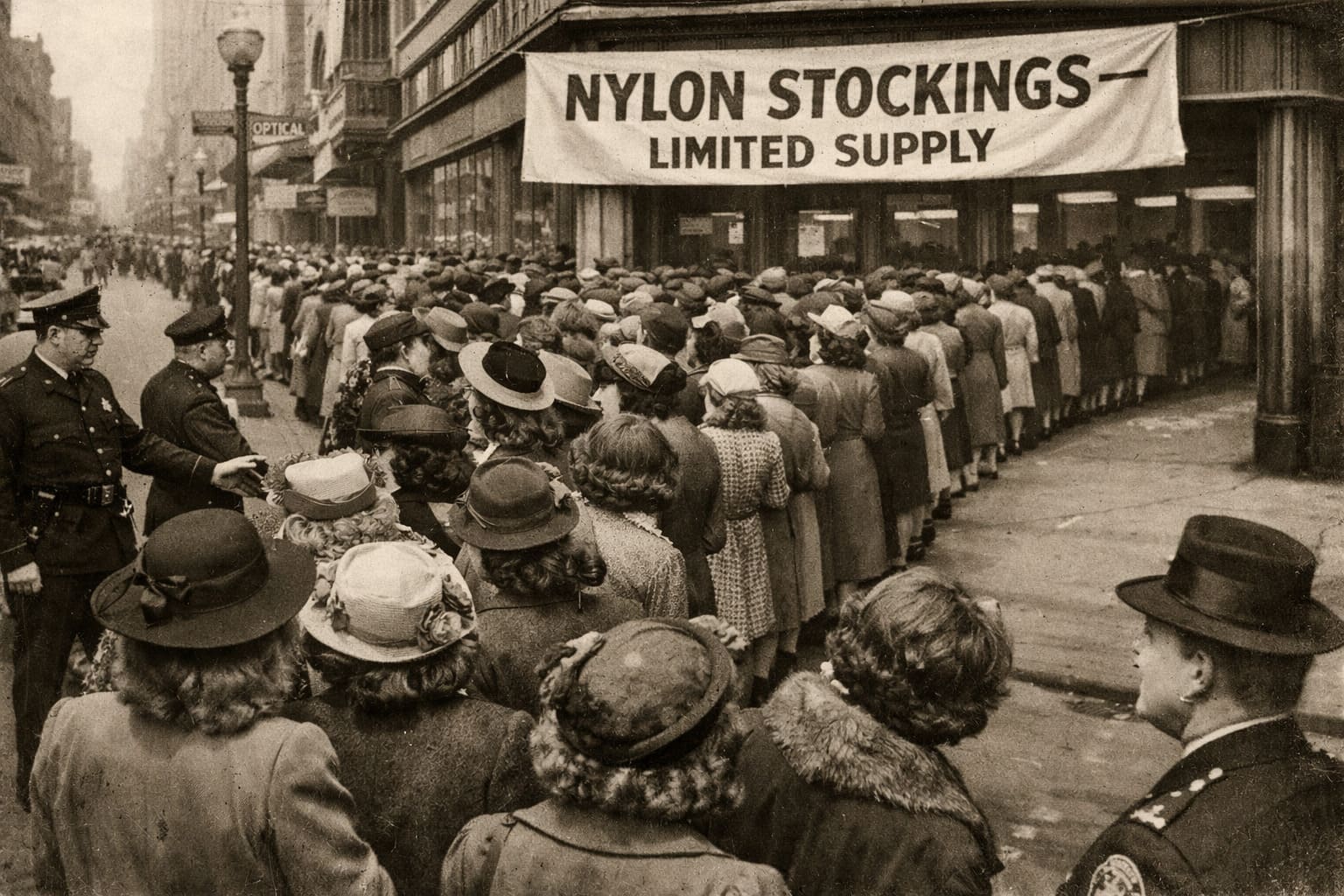
What Were the Nylon Riots?
The Nylon Riots were a series of disturbances across American cities in 1945–1946, caused by the extreme shortage of nylon stockings after World War II. When small shipments of nylon stockings reached stores after four years of wartime scarcity, tens of thousands of women stormed department stores — resulting in broken windows, crowd crushes, and police intervention in cities including Pittsburgh, New York, and San Francisco. The riots ended only when DuPont ramped nylon production to 30 million pairs per month in early 1946.
The Rise of Nylon: 1939–1941
The story begins with one of the most successful product launches in American history.
The Invention
In 1935, Wallace Hume Carothers, a chemist at DuPont, synthesized nylon — the world's first fully synthetic fiber. DuPont initially used it for toothbrush bristles, but quickly recognized its potential for hosiery.
The Launch
On May 15, 1940, nylon stockings went on sale nationally at $1.15 per pair — roughly 50% more expensive than silk stockings. They sold out by noon at most locations.
In the first year: 64 million pairs sold.
Women were ecstatic. Nylon stockings were:
- More durable than silk
- More uniform in appearance
- Resistant to runs (initially)
- Quick-drying
- Less expensive than pure silk
By 1941, nylon had captured 30% of the hosiery market, and DuPont was struggling to keep up with demand.
Then Japan bombed Pearl Harbor.
The Disappearance: 1942–1945
Military Conversion
Within weeks of America's entry into World War II, the U.S. government ordered 100% of nylon production redirected to military use. Nylon was needed for:
- Parachutes (each requiring about 36 yards of nylon fabric)
- Aircraft tow ropes
- Tire reinforcement
- Tents and ponchos
- Flak vests
- Mosquito netting
Nylon stockings disappeared from store shelves virtually overnight.
The Black Market
A thriving black market emerged. Used nylon stockings sold for up to $10 a pair — nearly ten times the retail price. Some women reported trading nylon stockings for goods and services. The phrase "I'll trade you my nylons" became a semi-serious form of currency.
Life Without Nylons
American women adapted in creative ways:
- Leg paint: Commercial products like "Leg Silque" simulated the appearance of stockings
- Eyebrow pencil seams: Women drew fake stocking seams up the backs of their bare legs
- Gravy browning: In Britain, women tinted their legs with cooking ingredients
- Rayon stockings: Available but universally disliked — they sagged, wrinkled, and dissolved in rain
The Riots: September 1945 – March 1946
The First Wave: September 1945
When Japan surrendered on August 15, 1945, DuPont announced that nylon stockings would return to civilian production. But converting factories back from military production took months. When small shipments reached stores, the result was pandemonium.
The Incidents
New York City: 30,000 women lined up outside stores for limited stocking supplies. Lines stretched for blocks. Police were called to manage crowds.
Pittsburgh: 40,000 people — the largest recorded crowd — queued for just 13,000 pairs of stockings at a single department store. The line formed the night before and stretched for over a mile.
San Francisco: Approximately 10,000 shoppers pressed against a department store attempting to buy stockings. The crowd pressure broke a plate glass store window. The sale was called off entirely.
Other cities: Similar scenes played out in Detroit, Chicago, Los Angeles, and dozens of smaller cities. Police were deployed at department stores as a standard precaution on stocking delivery days.
The Aftermath
The riots continued sporadically through early 1946 until DuPont finally achieved full civilian production capacity of 30 million pairs per month in March 1946. By mid-1946, nylon stockings were freely available again, and the crisis ended as suddenly as it had begun.
Why It Mattered
The Nylon Riots are more than a curiosity. They reveal several important truths:
1. The Power of Scarcity
A product that had existed for only two years created withdrawal symptoms severe enough to cause civil unrest when removed. This remains one of the most dramatic examples of consumer dependency in American history.
2. Women as Economic Force
The riots demonstrated — to manufacturers, retailers, and the government — that women were a powerful consumer bloc whose purchasing desires could not be ignored.
3. The Synthetic Revolution
The post-war demand for nylon accelerated the development of synthetic fibers that would transform the entire textile industry: polyester, acrylic, spandex, and dozens of others.
Frequently Asked Questions
How many people were involved in the Nylon Riots?
The largest single incident was in Pittsburgh, where 40,000 people queued for 13,000 pairs of stockings. Across all American cities, hundreds of thousands of women participated in rushes for nylon stockings between September 1945 and March 1946.
Why were nylon stockings so important?
Nylon stockings had only been available for two years before the war, but they were dramatically superior to silk — more durable, more uniform, and less expensive. Their sudden disappearance after just two years of availability created intense consumer desire.
When did nylon stockings become available again after WWII?
Small quantities reached stores in September 1945, but supply didn't meet demand until DuPont achieved production of 30 million pairs per month in March 1946.