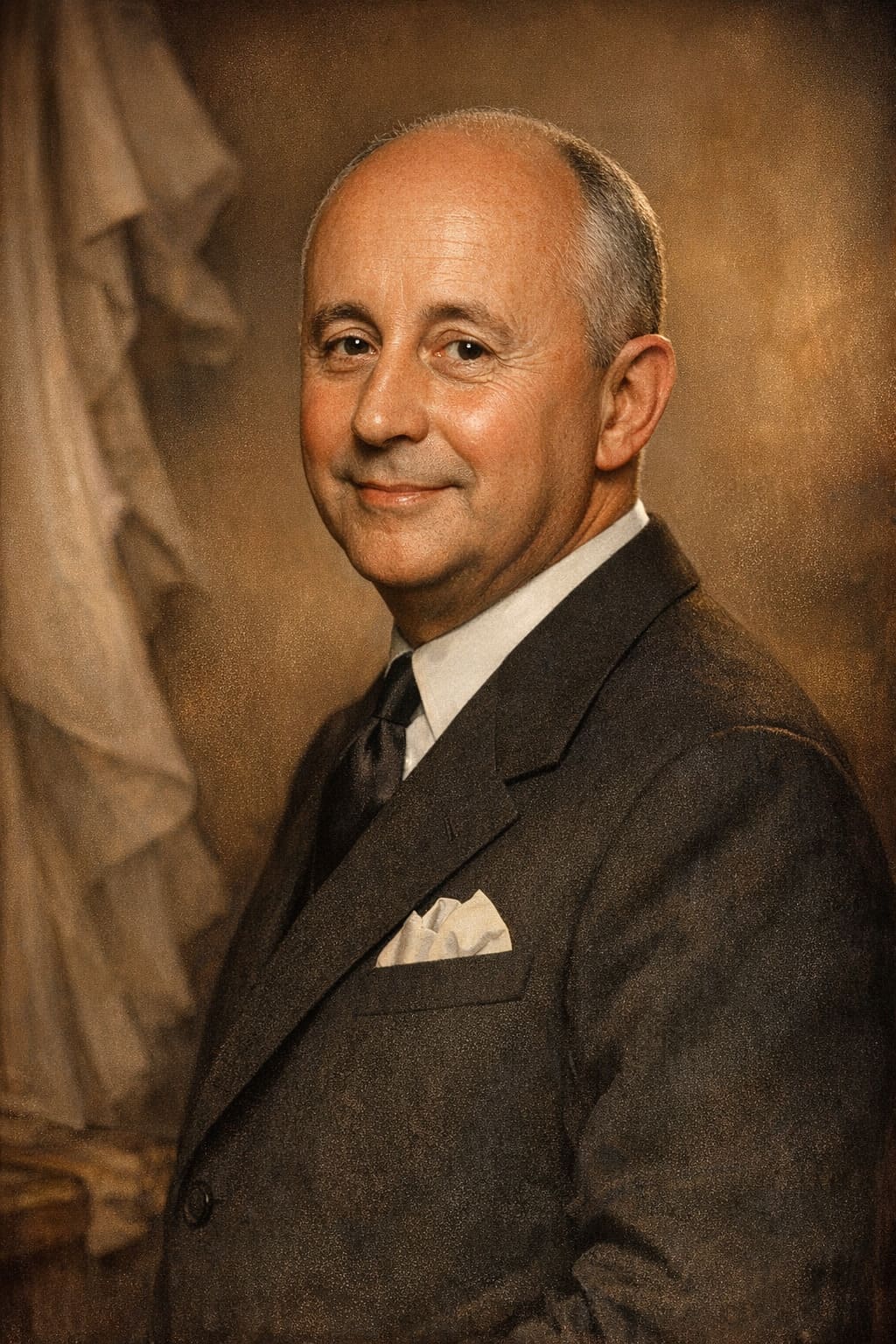
Christian Dior (1905-1957) was the French couturier whose first collection, shown in Paris on 12 February 1947, brought the narrow waist and the structured foundation garment back to the center of women's fashion. He was born in Granville on the Normandy coast and died ten years after that debut, on 24 October 1957, at Montecatini Terme in Italy.
30 Avenue Montaigne, October 1946
Dior opened his house late. The textile magnate Marcel Boussac financed it in 1946, and it opened on 8 October that year at 30 Avenue Montaigne with 85 staff. Dior was 41. Four months later he showed 90 garments in a collection he called Corolle.
Christian Dior's New Look, 1947
Carmel Snow, editor of Harper's Bazaar, gave the collection the name that stuck: the New Look. The silhouette was a small, nipped-in waist and a full skirt falling below mid-calf, with the bust and hips emphasized. The Bar suit, a fitted jacket over a pleated skirt, became its emblem. Dior described his aim in words the record preserves:
"We came from an epoch of war and uniforms, with women like soldiers with boxers' shoulders. I designed flower women, soft shoulders, full busts, waists as narrow as lianas and skirts as corollas."
What went underneath
That shape did not come from the dress alone. Women needed complex undergarments to achieve it, enough that Pathe News made a short film about the foundations under the clothes. For the lingerie trade this was the important part. After the boyish lines of the 1920s and the utility clothing of the war, the fashionable body was once again built from the inside, with a defined waist and a lifted, shaped bust.
The decade that followed is the one this museum's collection associates with the bullet bra and the longline bra: stitched, structured, engineered garments made to hold a silhouette. Dior did not design them. He set the shape they served.
The protests
Not everyone wanted it. The skirts used a great deal of cloth while rationing was still fresh, and the cost provoked organized complaint, including a group calling itself the League of Broke Husbands. In 1953 an anti-Dior "Little Below the Knee Club" protested his hemlines. Coco Chanel, whose name stood for comfort and ease, was blunt: "Only a man who never was intimate with a woman could design something that uncomfortable." Fashion divided between Dior's heavy structure and Chanel's softer line. A remark often credited to her, that Dior "upholsters" women, appeared on an earlier version of this page and has been removed for want of a source.
A new line every season
Dior's later collections came as named lines: Corolle and Figure of Eight in 1947, then a run of new shapes. The 1954 H-Line flattened the bust, and critics dismissed it as too close to the 1920s flapper look. It is a curious turn. The designer who had put the bust back at the front of fashion was, seven years later, the one asking women to flatten it.
Last updated
Sources
- en.wikipedia.org: Christian Dior
- en.wikipedia.org: New Look (style of clothing)