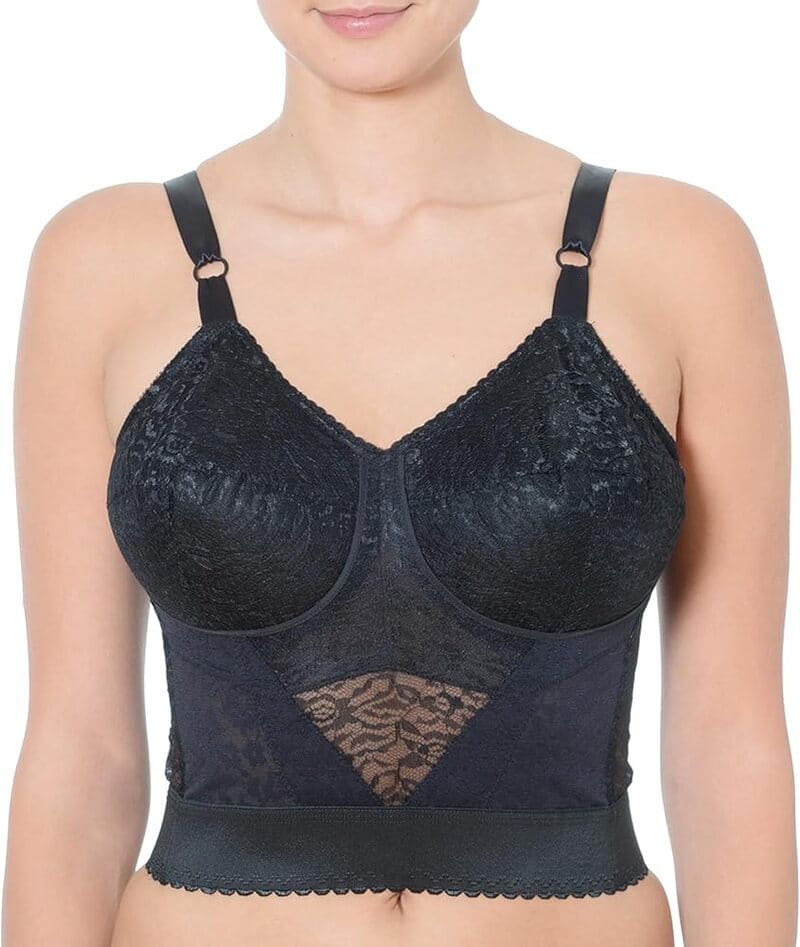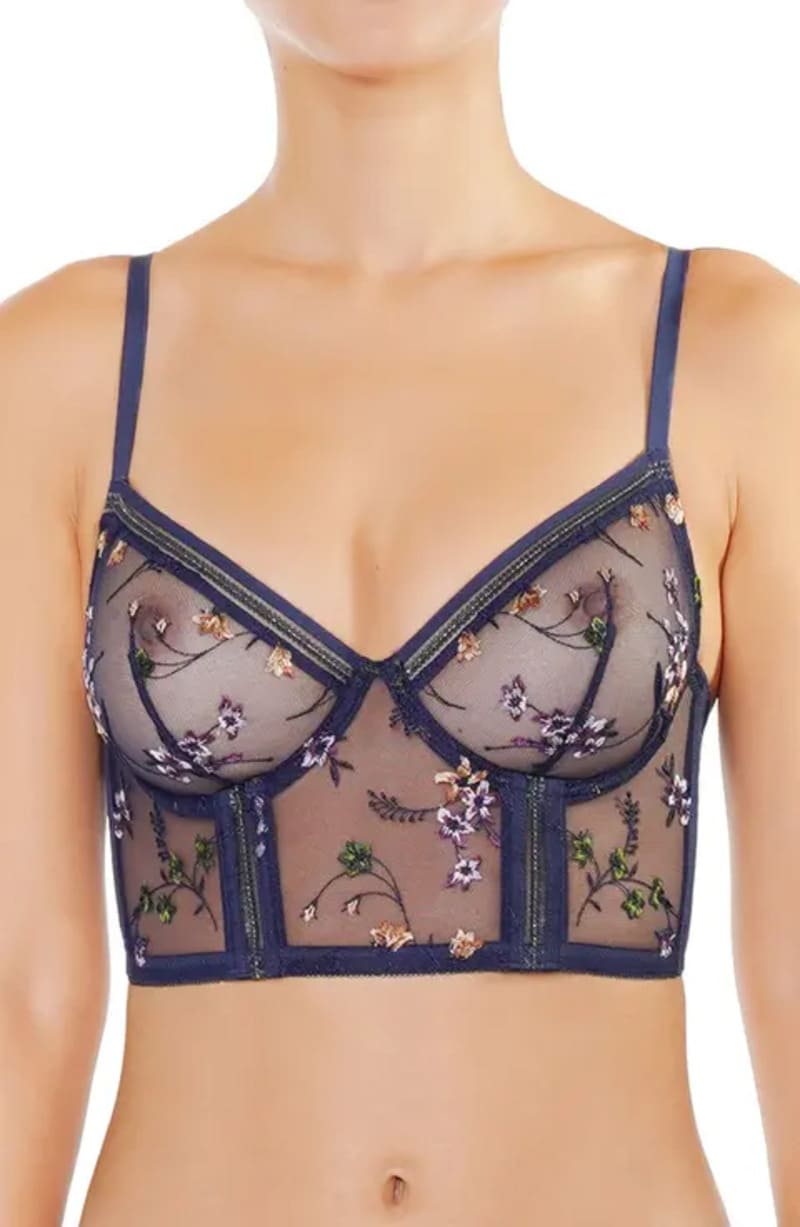
Before the bra, the corset did everything. It compressed the waist, shaped the hips and pushed up the bust in one boned garment. The corset bra and the corselet belong to the transition, when makers shortened or split the corset and handed bust support to a separate or semi-separate top.
The best-known early step is Parisian. In 1889 Herminie Cadolle presented a two- piece garment she called the corselet-gorge: a lower corset for the waist and an upper part that supported the breasts with shoulder straps. It is widely cited as a forerunner of the bra. In the United States, Mary Phelps Jacob patented her brassiere in 1914, and through the 1920s the corset lost ground fast, with sales falling by two thirds between 1920 and 1928.
Historic pieces are built from coutil, cotton twill, silk or satin, with vertical boning all round the torso, lacing at the back or a busk at the front, and cups or gussets for the bust worked into the body. Today the name is used loosely for longline bras and bustiers with decorative boning.
A true corset bra reaches at least the waist, is boned all round, and shapes the torso as well as supporting the bust. A longline bra is lighter and is built as a bra first. A bustier is closer in look but stops at the waist and is usually worn to be seen.
How to Identify
- Reaches from the bust to the waist or hips
- Vertical boning channels all round the torso
- Lacing, a front busk or a long row of hooks
- Bust cups or gussets built into the boned body
- Silk, satin, coutil or cotton twill in historic pieces
A corset bra bought today is one of three things: a mid-century original, a modern reproduction, or a bustier borrowing the name. Each needs different handling, and the first job with any piece is working out which one you are holding.
Originals, reproductions and borrowed names
Mid-century originals are the most common survivors. The corselet as women's underwear began to catch on around 1914, bust uplift cups appeared in 1933 and became common by 1943, and Warner's released its Merry Widow in 1952, named after the 1905 operetta. The original Merry Widow was usually strapless and stopped on the hips, with panels of black elastic netting, nine long spiral wires cased in black satin and a nylon voile lining. In Britain the same shape is often called a basque.
Around 1960 tights and trousers pushed the corselet out of most wardrobes, though Maidenform and other mainstream makers kept selling versions as "control slips" from about 1975.
Reproductions copy those shapes in new materials. What Katie Did, for example, sells a Merry Widow-style corselette, steel-boned corsets and a boned longline satin bra. Anything labeled a corset bra on a fast-fashion site is usually a bustier with plastic bones sewn into a bra body, and it will not shape the waist.
Sizing a garment cut for a different body
Ignore the size on a vintage label. Measure the garment instead, laid flat and fastened: bust across the cup apex, waist at the narrowest point, and hip at the bottom edge if it reaches that far. Double each figure and compare it with your own body measurements.
Waist reduction is where expectations go wrong. Historical corsets typically took 2 to 6 inches (5 to 15 cm) off the natural waist, and the average corseted waist of the 1880s was about 21 inches (53 cm) against roughly 27 inches (69 cm) uncorseted. Those wearers had often been corseted since childhood. Modern bodies rarely reduce as far, so for a first piece aim for a garment waist 2 to 4 inches (5 to 10 cm) below your own, and treat anything more as a long-term project.
The bust matters as much as the waist. Mid-century cups were often pointed or conical, and a rounded modern bust can leave the tips empty. A little padding in the point fixes that better than a bigger size.
Wearing a boned piece through an evening
New or ill-fitting corsetry is uncomfortable in the way new shoes are. Break a fresh reproduction in over several short wears, lacing it snug but not tight, before you pull it down to full reduction. Sit down in it before the event: boning that stops just above the hip will push into your thighs when you sit if the garment is too long for your torso.
Under clothes, a corselet changes how a dress fits. Bring it to every fitting if you plan to wear one under a 1950s-style dress, because the waist measurement of the dress depends on it. Over clothes, it works as outerwear in the way Jean Paul Gaultier's corset bustiers did when Madonna wore them on stage, as a top or under an open jacket.
Caring for old elastic and steel
On an original, the elastic is the weak point. Vintage rubber-based elastic perishes: if it crackles, feels crunchy or does not spring back when you stretch it gently, the garment is a display piece. Satin, coutil and cotton twill outlast the elastic by decades.
Never machine wash an original. Spot clean, or hand wash briefly in cool water with a gentle detergent, press out water in a towel, and dry flat away from heat so the steel does not rust. Store it flat in acid-free tissue rather than hanging it, which strains the shoulder straps and the top of the boning.
Where the shape lives on today
Made-to-measure corsetry still exists in Paris. Maison Cadolle, at rue Cambon since 1911, makes bespoke lingerie and corsets by hand, and the 2010s saw Poupie Cadolle launch new corset designs. For everyday wear the closest modern relative is the longline bra, which keeps a deep band and light boning but drops the waist shaping.
Shop
See corset bra / corselet styles on AmazonAs an Amazon Associate we earn from qualifying purchases. It does not change what we write.
Sources
- en.wikipedia.org: Corselette
- en.wikipedia.org: Corset
- whatkatiedid.com
- cadolle.com: notre histoire
Last updated