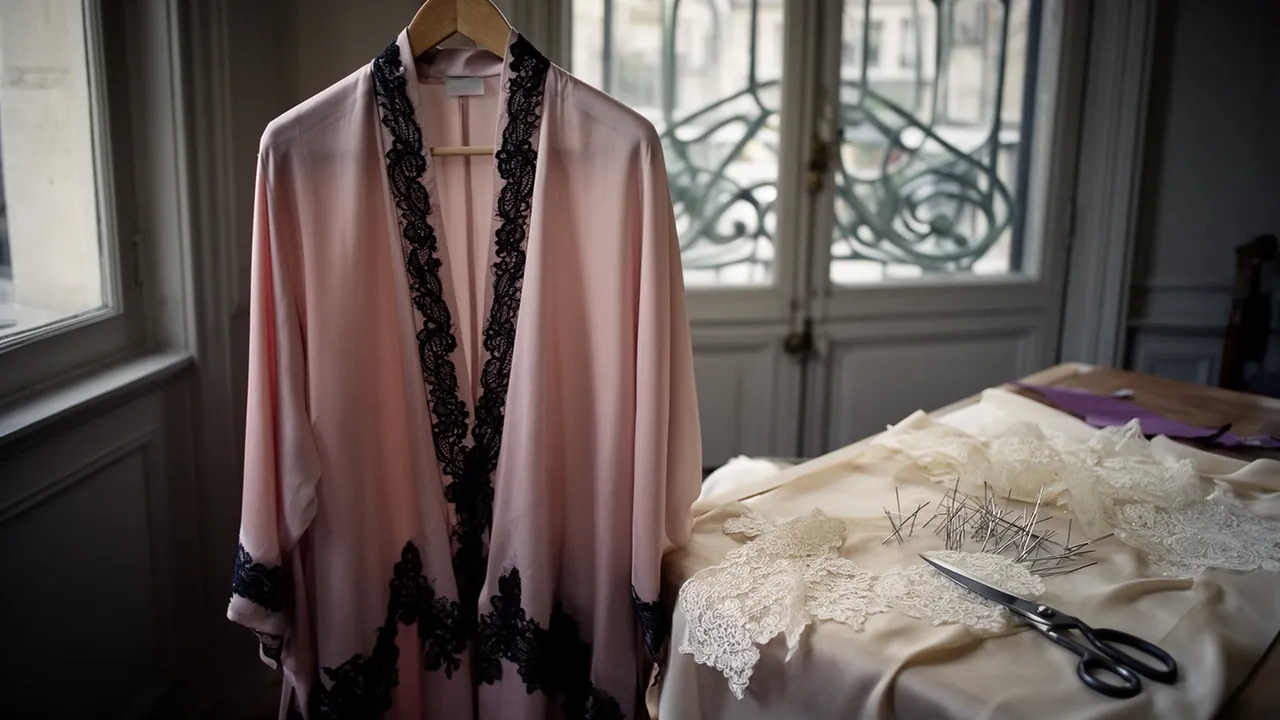
Carine Gilson is a Belgian couture lingerie house founded in Brussels around 1990 by the designer of the same name, who took over a small underslip workshop called Maille France and turned it into an atelier for silk lingerie inlaid with lace. The house makes slips, kimonos, bras, briefs and occasionwear by hand in limited runs, and its signature is Chantilly lace cut and set into silk rather than sewn on top of it.
A Brussels workshop for underslips
Carine Gilson was born in Brussels and trained in fashion at the Royal Academies of Fine Arts in Brussels and in Antwerp, the school that produced the Antwerp Six a few years earlier. Lingerie was not her plan. In the early 1990s she came across Maille France, a Brussels atelier that specialized in fine underslips, and took it over. French sources date the founding of her own atelier to 1990, and the house marked its 30th year in 2019 with an exhibition, which fits that date.
The choice of workshop explains a great deal about the house. An underslip is cut on the bias, follows the body closely and has to hang without strain. Those are dressmaking problems, not corsetry problems, and Carine Gilson's work has always looked more like couture dressmaking than like the engineered bra-and-brief sets of the big French lingerie firms.
Lace inlaid into silk
The technique the house is known for is lace incrustation. Instead of laying a lace trim along an edge, the atelier cuts the motifs of a Chantilly lace away from their net, places them on silk, stitches them down by hand, and then cuts away the silk beneath so the lace becomes part of the garment's surface. The house calls this inlaying, and it describes the hand-cut Chantilly as its DNA.
The house publishes a few figures that give a sense of the labor involved:
- about 4.8 meters of silk go into one kimono
- 484 pins are placed by hand to position the lace on a single underdress
- around 18,000 meters of lace are inlaid each year
- a design is made in at most about 100 pieces
Bias cutting follows the methods associated with Madeleine Vionnet, and the pleating draws on the work of Madame Grès, according to the house. Prototypes are made directly in silk rather than in a cotton toile, because silk drapes differently and a cotton mock-up would mislead the pattern cutter. Recurring design themes are Art Deco, Art Nouveau and Japonism, which is why the kimono has become one of the house's standard shapes.
For its 30th anniversary the house developed an exclusive lace with the French lacemaker Sophie Hallette, named Intemporelle, built around a floral motif that sits between Art Nouveau and Art Deco.
Boutiques from Saint-Germain to Taipei
Press and retailers in Japan, Britain, Italy and the United States picked up the line soon after it launched. The house then moved into its own retail:
| Year | Boutique |
|---|---|
| 2004 | Paris, Saint-Germain-des-Pres |
| 2010 | Brussels |
| 2012 | London |
| 2015 | Taipei |
| 2018 | Second Brussels location |
A Paris shop came first, before one in the founder's home city, which says something about where couture lingerie customers were to be found.
Screen work and museum shows
Two pieces reached a wide audience through film. The house made the kimono worn by Berenice Marlohe in the James Bond film Skyfall, and the pink dress on the poster for 13 Going on 30, worn by Jennifer Garner. Clients reported over the years include Madonna, Kate Moss, Rihanna and Beyonce.
Museums took an interest as well. The Victoria and Albert Museum in London showed Carine Gilson pieces in 2016. In 2019 the Brussels fashion and lace museum, the Musee Mode & Dentelle, staged "Beautiful Lace & Carine Gilson" to mark the house's three decades, a fitting venue for a designer whose work extends Belgium's long lacemaking tradition. A monograph, Garden of Lace, written by the curator Karen Van Godtsenhoven, documents the work.
How the house works today
The current offer is split into daywear, loungewear, lingerie and occasionwear, all produced in the house's own ateliers. The founder now presents herself as a master of lace incrustation on silk with more than 30 years behind her. The museum's archive holds no Carine Gilson pieces at present. For a house whose output of any one design stops at about 100, that is not surprising: most of what it makes goes straight from the atelier to a private wardrobe.
Last updated
Founder
Sources
- fr.wikipedia.org: Carine Gilson
- carinegilson.com: history
- carinegilson.com: authenticity in artisanship
- carinegilson.com: when a lace becomes a signature
Members
How Carine Gilson fits
Loading member reviews...