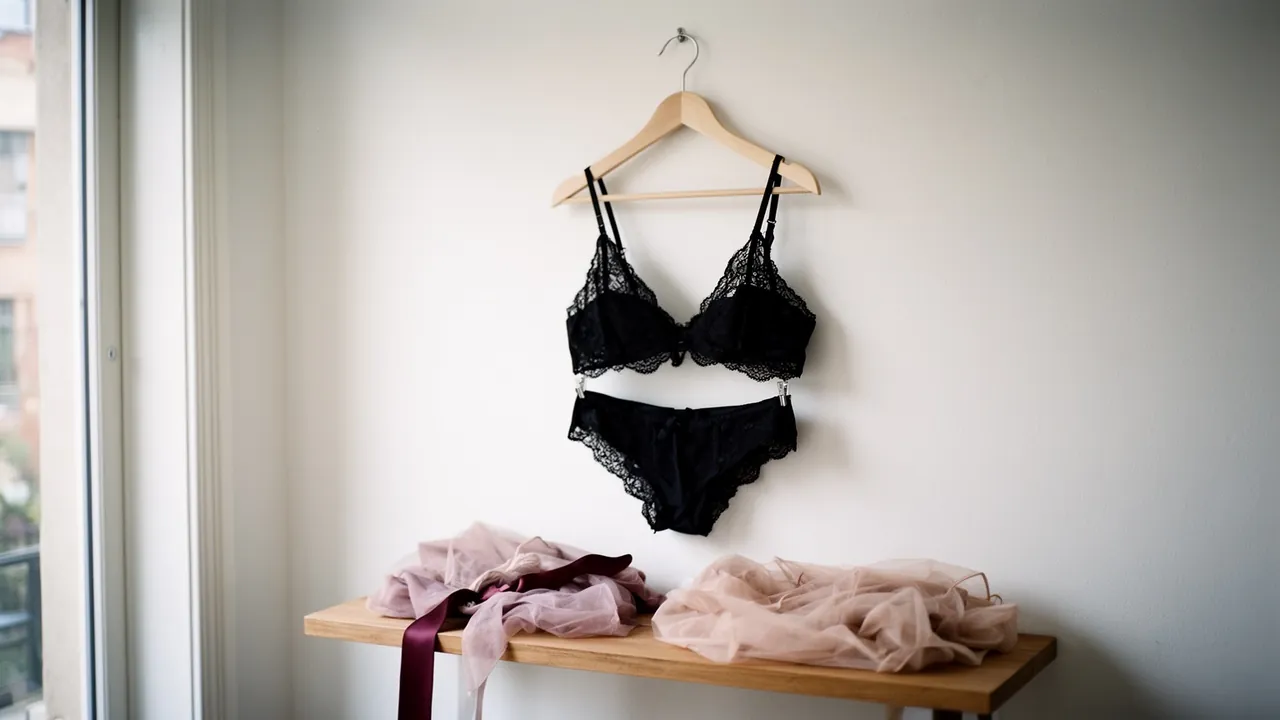
H&M is a Swedish fashion retailer founded by Erling Persson in Västerås in 1947 and headquartered today in Stockholm. With about 4,100 stores in 81 markets in 2025 and revenue of roughly 228 billion Swedish kronor, it is the second-largest international clothing retailer after Inditex. Underwear has been part of its range since 1973, and its lingerie department is one of the most widely seen in the world, even if few people think of H&M as a lingerie company.
Hennes: a shop for women in Västerås
The first store sold only women's clothing, and the name said so. Hennes is Swedish for "hers." Persson opened it in Västerås, a mid-sized industrial city west of Stockholm, and added a Stockholm shop in 1952.
In 1968 he bought Mauritz Widforss, a Stockholm retailer of hunting apparel. The business was absorbed, men's and children's clothing were added, and the company became Hennes & Mauritz, later shortened to H&M. It listed on the Stockholm Stock Exchange in 1974. Expansion went first to Norway, then Denmark, the United Kingdom and Switzerland, and in the 1980s to Germany and the Netherlands. In 1980 H&M bought the mail-order company Rowells, which gave it a catalog business long before online shopping began in Sweden in 1998.
H&M underwear and the 1990 campaigns
H&M introduced underwear in 1973, five years after menswear arrived. For two decades it was a basic category, sold on price. That changed in 1990, when the company began its annual underwear advertising campaigns built around the supermodel Elle Macpherson. The campaigns did something important for the mass market: they put lingerie from a high-street chain into the same visual language as expensive brand advertising.
The approach set a template that H&M and its rivals still use. Lingerie at H&M is sold as fashion, changed often, and priced so that a bra and brief can be bought on impulse. The range covers everyday T-shirt bras, lace bralettes, push-ups, briefs and thongs, bodysuits, shapewear and sleepwear.
The trade-off
That model has costs. A chain changing styles this quickly cannot offer the cup-size depth of a specialist fitter, and H&M's bra sizing is aimed at the middle of the size curve. Its strength is volume and trend speed. A lace or mesh look that appears at a premium house can be in H&M stores within a season at a fraction of the price. For many shoppers, an H&M lace set is their first lingerie bought as fashion rather than necessity.
Designers on the high street
In 2004 H&M sold a one-off collection designed by Karl Lagerfeld. The press reported crowds at the doors and initial stock in big cities gone within an hour. It started the guest-designer program that has run ever since. Stella McCartney followed, then Madonna in 2007, and later Isabel Marant, Versace and Alexander Wang, among others. In 2024 the company marked twenty years of these collaborations.
The group also built a family of separate brands: COS, Weekday, Monki, & Other Stories, Arket, the off-price chain Afound, the resale platform Sellpy and H&M Home. Its direct competitor in lingerie is Inditex, whose specialist chain Oysho shows what a dedicated intimates format looks like next to H&M's in-store departments.
Recycled fibers and old garments
In 2010 H&M issued its first collection made with organic and recycled materials, the forerunner of the Conscious line that later appeared across the store, lingerie included. In 2013 it launched a worldwide garment-collecting program, taking back used textiles of any brand in its shops. Critics have argued that a business built on fast turnover cannot be made sustainable by recycling programs, and H&M has faced scrutiny over factory safety in Bangladesh and allegations about forced labor in its supply chain. In 2018 it apologized after a children's hoodie printed "Coolest Monkey in the Jungle" was advertised on a Black child model.
Who runs H&M
H&M is still controlled by the founding family. Erling Persson's son Stefan Persson led the company for decades and holds a large stake, and his son Karl-Johan Persson is chairman. Daniel Erver became chief executive in January 2024, replacing Helena Helmersson. The first American store opened on Fifth Avenue in New York on March 31, 2000, and the company reached Shanghai and Hong Kong in 2007. Nearly eighty years after Persson's women-only shop in Västerås, lingerie remains one of the categories H&M sells in almost every one of those markets.
Last updated
Sources
- en.wikipedia.org: H&M
- hmgroup.com: history
Collections (3)
Members
How H&M fits
Loading member reviews...
325 products in our archive
Use our Lingerie Identifier to find matching pieces