The Short Answer
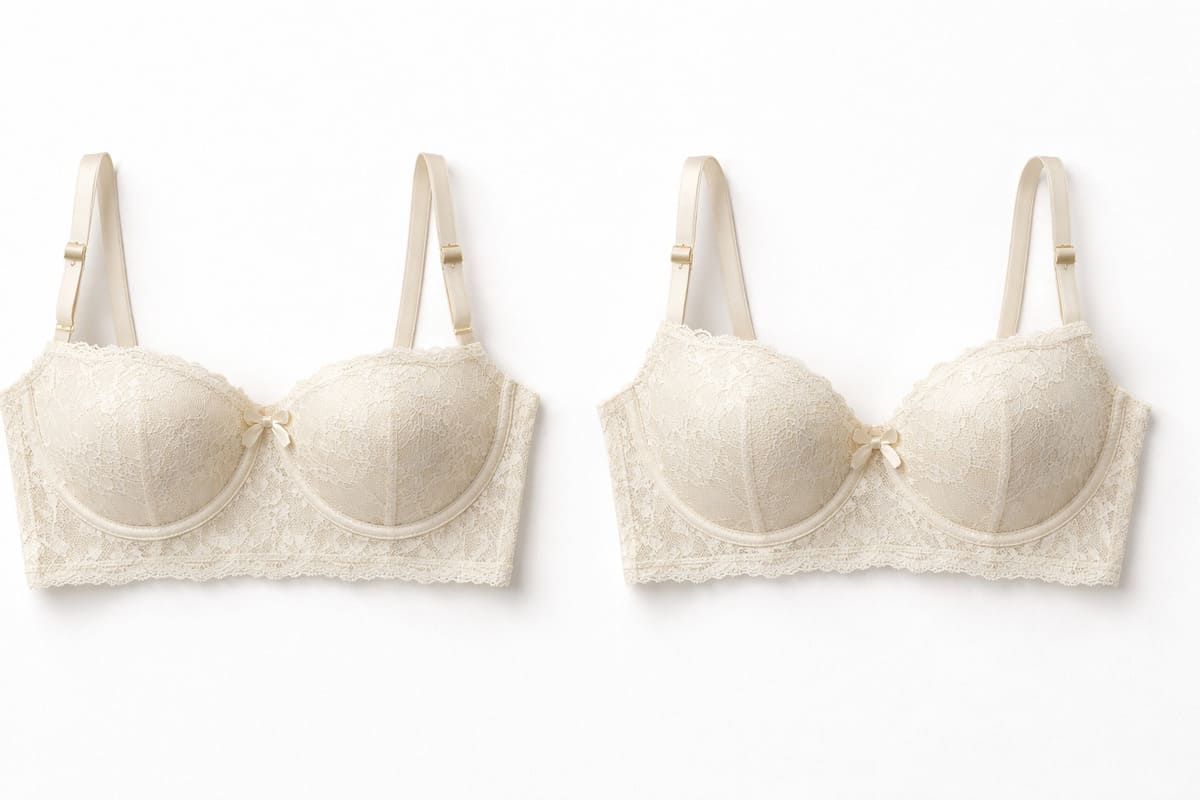
A balconette has a horizontal, straight-cut upper cup edge with straps set at the far outer corners — like a shelf or balcony. A demi cup has a rounded, curved upper edge with straps set outward but not as extreme. Both cover roughly the lower half of the breast, but they create different neckline shapes.
Construction Side by Side
| Feature | Balconette | Demi Cup |
|---|---|---|
| Upper cup edge | Horizontal / straight | Rounded / curved |
| Strap placement | Far outer cup corners | Outward, but not extreme |
| Neckline created | Square-ish | Gently rounded |
| Coverage | Lower half to two-thirds | Lower half |
| Center gore | Short | Moderate |
| Origin | European (French/Italian) tradition | American/general market |
How to Tell Them Apart
Lay them flat and look at the top edge of the cup. If the edge is essentially a straight horizontal line — that's a balconette. If the edge curves gently upward toward the center — that's a demi cup. The strap placement confirms it: balconette straps attach at the very edge of each cup, demi straps attach slightly inward from the edge.
When to Wear Each
Balconette: Under square necklines, off-shoulder tops, and boat necks. The horizontal cup edge mirrors the straight neckline beautifully. Also the classic choice for European lingerie sets where the bra is meant to be seen — the shelf silhouette is inherently elegant.
Demi cup: Under scoop necks and sweetheart necklines. The rounded edge blends with curved necklines. More versatile for everyday wear because the shape is less specialized.
History
The balconette traces to 1950s French and Italian lingerie houses, where it was called the "balcon" — literally a balcony for the bust. The demi cup is a more generalized American market adaptation that emerged in the 1970s and 1980s as a middle ground between full cup and balconette.