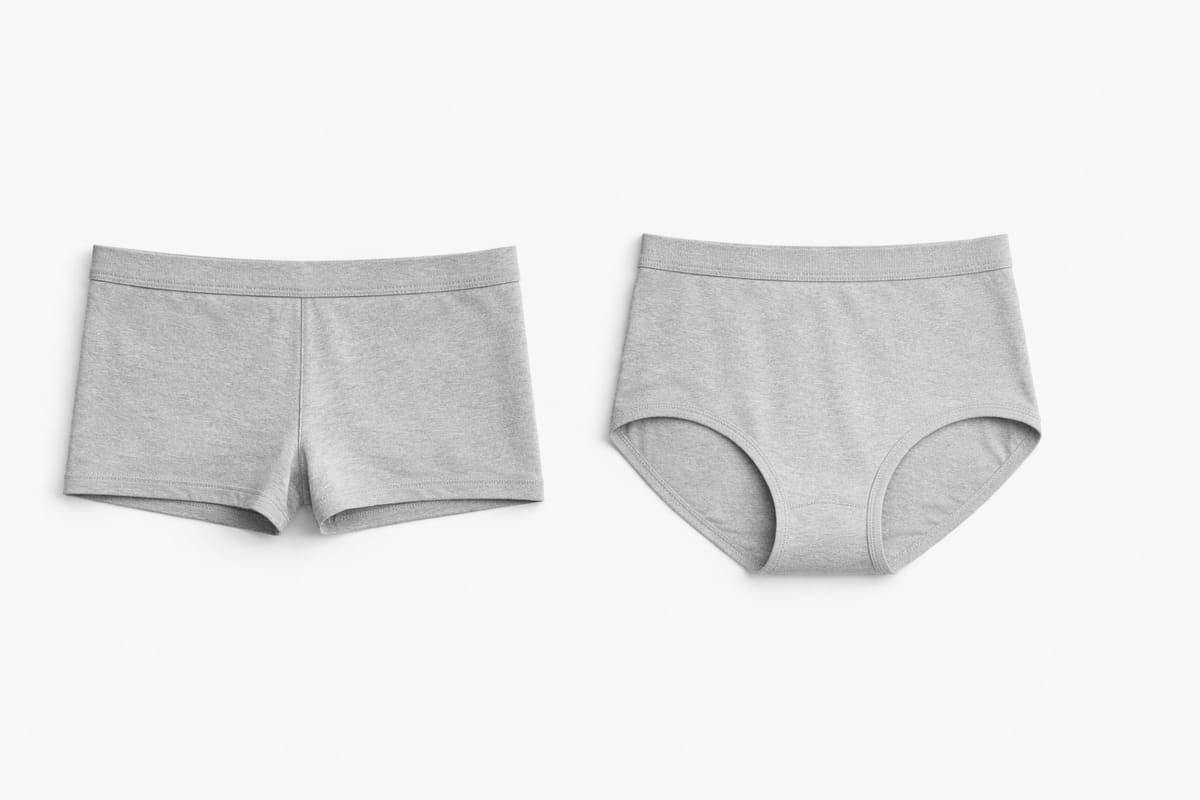
Direction settles boyshort vs full brief: these are the two most covered styles in the drawer, and they get their coverage from opposite ends. A boyshort extends down: it sits low to mid on the hips and its straight leg hem crosses the top of the thigh, like very short shorts. A full brief extends up: its waistband sits at the natural waist and its leg opening follows the usual curved panty line. Both cover the whole seat. Only one covers the thigh, and only one covers the stomach.
Down or up
The easiest way to picture the pair is to draw them over a bikini brief.
The boyshort keeps the bikini's hip-level waistband, or drops it a little, and adds fabric below: a straight-cut leg that reaches past the crease under the seat and onto the thigh. Wikipedia's panty glossary says the style is named for its similarity to boxer briefs, and the resemblance is in that short leg.
The full brief keeps the bikini's curved leg opening and adds fabric above: a taller front and back that bring the waistband up to the natural waist. Wikipedia notes the classic brief's high waistband and its nickname, "granny panties". The nickname is unfair, but it does show how long the shape has been around.
Old shape, new shape
The full brief is the older design by most of a century. Wikipedia's history of panties dates underwear resembling modern panties to the 1920s, when long drawers were shortened, and records that between 1930 and 1947 they were shortened further and made in cotton rather than linen. For decades a waist-high brief was simply what women's underwear looked like.
The boyshort is a newcomer. The same history lists boyshorts, along with hipsters and seamless styles, as introductions of the 2000s. Its roots are in menswear, and borrowing from the men's drawer was nothing new by then: Jockey, a name built on men's briefs, had launched its Jockey for Her line of women's cotton panties in 1982.
Five situations, one winner each
1. A summer skirt or dress. Boyshort. Its leg covers the inner thigh and stops skin rubbing on skin when walking. A full brief leaves the thighs bare.
2. Fitted pants or jeans. Full brief. The curved leg opening sits in the body's natural crease and hides there. A boyshort's straight hem crosses the thigh where fitted fabric is tight, and it can print a horizontal line or ride up and bunch.
3. High-rise pants. Full brief. Its waistband sits at roughly the same height as the pants, so neither shows. A boyshort's lower band may sit below the pants waistband and leave a gap where a top can ride up.
4. Sleep and lounging. Boyshort, for many people. It reads as sleepwear in its own right and often comes in sets with a matching top. A full brief is just as comfortable but looks more like underwear.
5. Long days, periods and sport. Close. The full brief offers more stomach coverage and a more secure waist; the boyshort stays in place well if the thigh band fits. Choose by which edge, waist or thigh, bothers you more.
Fit points that decide comfort
The boyshort's thigh band
This is the boyshort's make-or-break detail. If it is too tight it digs in and creates a bulge that shows through clothes. Too loose and it rides up within an hour. Good versions use a bonded edge or a flat, wide band that grips without cutting. Size by hip measurement where the brand allows it.
The full brief's waistband
On a full brief the waistband takes the load. A narrow elastic can roll when sitting. A wider, flatter or knitted band avoids that, and many modern full briefs in modal or microfiber use one.
Fabric and finish
Both styles come in everyday cotton, which suits them, since both are mainly chosen for comfort. Beyond that they split. Boyshorts often appear in lace, because the straight leg makes a long, even edge for a scalloped border; a lace boyshort is a common bridal choice. Full briefs more often appear in smooth microfiber and in shaping versions, which lead into control briefs. Our full brief vs control brief comparison covers that step.
Neither will win a contest for the smallest garment in the drawer, and neither was designed to. Between them, though, they cover most of what everyday underwear has to do: one protects the thighs, the other the waist.
Last updated
Questions
Which covers more, a boyshort or a full brief?
They cover about the same amount, just in different places. Both cover the whole seat. A boyshort extends down, with a straight hem that crosses the top of the thigh, while sitting low to mid on the hips. A full brief extends up, with its waistband at the natural waist and a curved leg opening. Only one covers the thigh, and only one the stomach.
What underwear is best under high-rise pants?
A full brief works well, because its waistband sits at about the same height as high-rise pants, so neither shows. A boyshort's lower band can sit below the pants waistband and leave a gap where a top rides up. Under fitted high-rise jeans the full brief's curved leg also hides in the body's natural crease, while a boyshort hem can print.
Are boyshorts good for sleeping?
For many people, yes. Boyshorts read as sleepwear in their own right and often come in sets with a matching top. A full brief is just as comfortable for sleep and lounging, but it looks more like underwear. The choice mostly comes down to whether you want something that doubles as a pair of sleep shorts.
Why are boyshorts popular for bridal lingerie?
Because the straight leg makes a long, even edge, which suits a scalloped lace border. That is why a lace boyshort is a common bridal choice. Full briefs, by contrast, show up more often in smooth microfiber and in shaping versions that lead into control briefs. Both styles also come in everyday cotton, since both are mainly chosen for comfort.
Sources
- en.wikipedia.org: Panties
- blog.jockey.com: jockey for her
Discussion
Loading...