The Short Answer
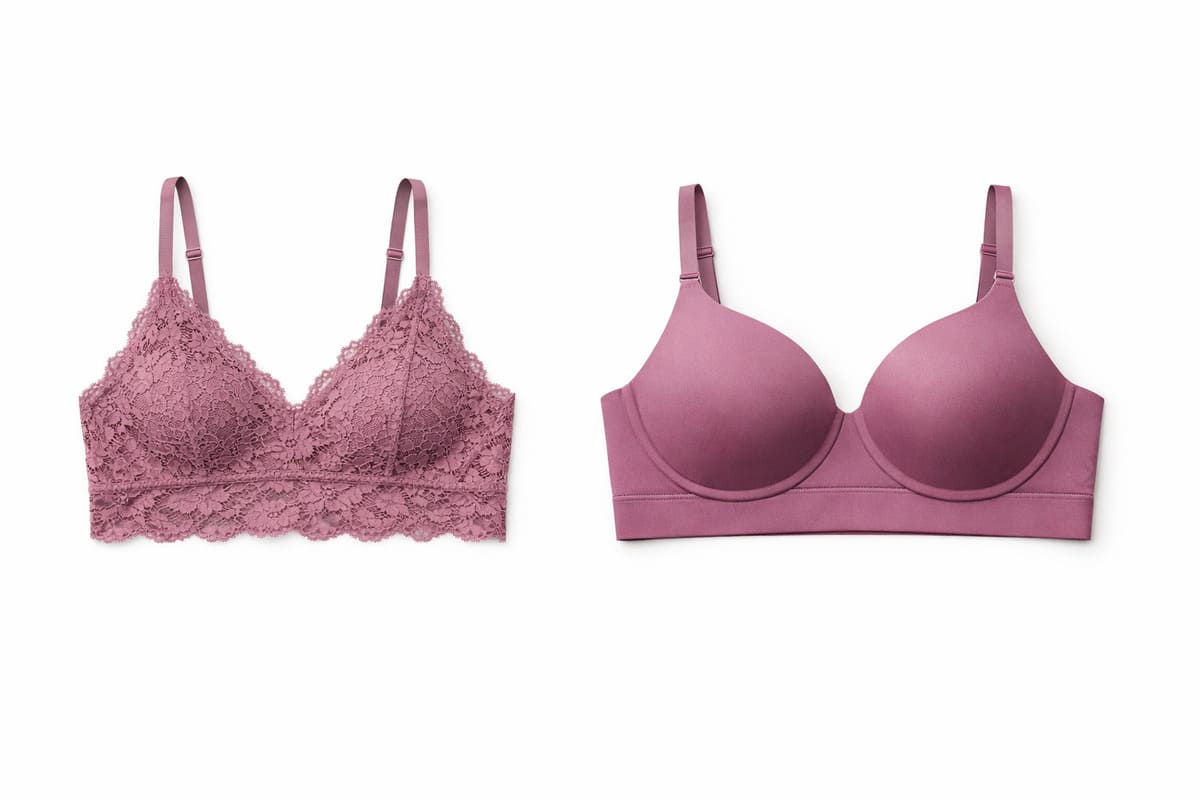
A bralette has no underwire, no molded padding, and no structural engineering — just soft fabric draped over the bust. A wireless bra also lacks underwire but compensates with molded foam cups, reinforced side panels, and a wider underband to provide cup shape and support without wire. The bralette is unstructured; the wireless bra is structured-without-wire.
Construction Side by Side
| Feature | Bralette | Wireless Bra |
|---|---|---|
| Underwire | No | No |
| Cup structure | None — soft fabric drapes | Defined — molded foam or seamed panels |
| Padding | None | Light foam molding |
| Underband | Thin, soft elastic | Wide, reinforced elastic |
| Shape retention | Lies flat when not worn | Holds cup shape off the body |
| Support | Minimal | Moderate |
| Best for | A–B cups, lounging | A–D cups, everyday wear |
How to Tell Them Apart
Take it off and set it on a table. If it lies flat — bralette. If it holds the cup shape on its own, sitting up like a regular bra — wireless bra. The molded foam or panel construction in a wireless bra gives it dimensional structure that a bralette lacks.
The Spectrum
Think of it as a support spectrum: bralette (least support) → wireless bra (moderate support) → underwire bra (most support). The wireless bra occupies the middle ground — more structure than a bralette, more comfort than an underwire.
When to Wear Each
Bralette: When support is optional — lounging, sleeping, under loose tops, or as a visible layering piece. The aesthetic choice.
Wireless bra: When you want real support without wire discomfort. Work-from-home days, travel, post-surgery recovery, or as an everyday bra for A–C cups. The practical wire-free choice.