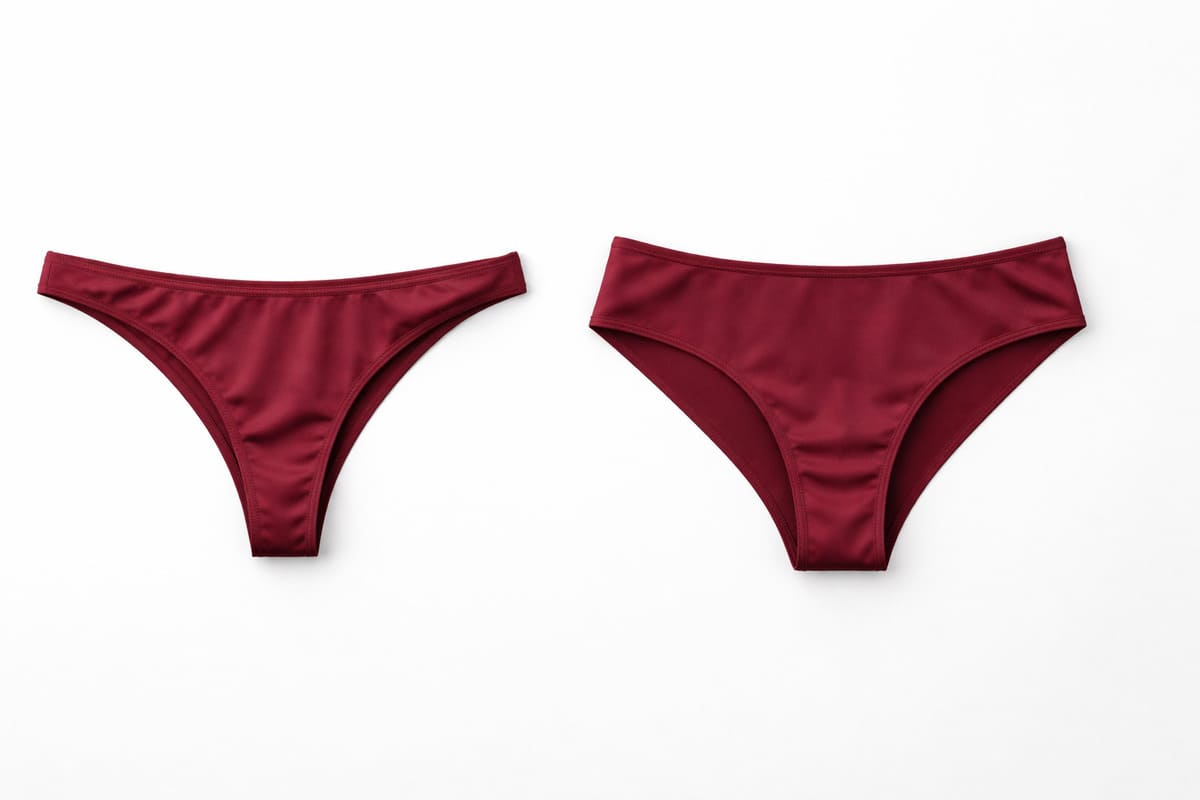
Same amount of skin, different scissors: that is Brazilian vs cheeky in one line, two garments that show a similar view from behind but take fabric away from different places. A Brazilian cuts the sides down, often to a narrow band at the hip bone, and keeps a moderate back. A cheeky keeps full-width sides and a full waistband, and scoops the bottom of the back panel instead. In a photo of the seat alone they can be hard to tell apart. Turn the model sideways, or lay the garments flat, and they are not close at all.
A pattern cutter's view
Start both from the same basic bikini brief pattern and the difference becomes a matter of where the scissors go.
The Brazilian is altered at the side seam. The cutter lowers the waist at the hip and raises the leg opening until the side is a fraction of its original height. The back panel is reshaped to follow, usually with a V or a gentle point at the center, and often a seam or ruched channel that lifts the seat. The front may be lowered slightly too.
The cheeky is altered at the back leg line. The side seam stays where it was. The lower edge of the back panel is curved upward and inward, which bares the lower part of each cheek, often with ruching at the center to help the fabric sit.
The result is two different silhouettes. The Brazilian gives a high-cut leg line and a long-legged look. The cheeky gives a fuller hip with a short, curved back.
Brazilian vs cheeky, piece by piece
| Feature | Brazilian | Cheeky |
|---|---|---|
| Where fabric is removed | Sides | Lower back |
| Side height | Very narrow, sometimes a strap | Full width |
| Waistband | Often interrupted at the hip | Continuous, full width |
| Back panel | Moderate, often V-shaped or ruched | Scooped at the bottom edge |
| Leg line | High cut, lengthens the leg | Standard bikini height at the front |
| Typical setting | Swimwear and lingerie | Everyday underwear and sets |
Rio on the label
The Brazilian name is borrowed from the beach. Brazilian swimwear of the 1970s and 1980s pushed bikini bottoms smaller and higher at the leg, and Soul Brasil magazine notes that the high-cut style became known abroad simply as the "Brazilian bottom". The late 1980s fio dental, or "dental floss", bikini took the idea as far as it could go.
Lingerie brands kept the high leg and the lifted back, and gave the garment enough fabric to be worn all day under clothes. That beach heritage is why the cut still crosses easily between swim and underwear ranges.
"Cheeky" has no such backstory. It is a plain English retail word built on the slang for buttocks, and it is used heavily by American mass-market labels such as Aerie and Victoria's Secret, which sell entire ranges under the name.
How they behave once worn
The construction differences show up in a few predictable ways.
At the hip
A Brazilian's narrow side concentrates pressure on a small strip at the hip bone. On a straight hip that is barely noticed. On a softer hip the band can dig in and create a small bulge above it, which can show under a fitted dress. The cheeky's full side spreads the pressure out.
Under pants
The cheeky's continuous waistband sits evenly and tends to stay where it was put. The Brazilian has more edges near the hip that can print through tight pants. Under jeans, neither is likely to show; under thin jersey, the edge finish matters more than the cut.
During the day
A Brazilian's ruched back tends to keep its position. A cheeky can creep inward if it is slightly small, which some wearers like and others do not.
Picking one
- Choose the Brazilian for a high-cut leg, for swimwear-style sets, and for low-rise bottoms where a full side would show.
- Choose the cheeky for daily wear under pants, for wider hips where a narrow band digs, and for sets where a full waistband looks more finished.
- Choose by photograph, not label. Many brands use both names loosely. Check the side from the profile shot and the back from the rear shot.
For the Brazilian's other close neighbor, see tanga vs Brazilian. For the cheeky against its parent cut, see cheeky vs bikini brief.
When a garment could go either way, our catalog settles it at the side seam: a strap or slim band at the hip files it as a Brazilian, a full side panel as a cheeky, whatever the swing tag says.
Last updated
Questions
Do Brazilian and cheeky panties show the same amount of skin?
From behind they can look very similar, but they remove fabric from different places. A Brazilian cuts the sides down, often to a narrow band at the hip bone, and keeps a moderate back. A cheeky keeps full-width sides and a continuous waistband, and scoops the bottom of the back panel. Seen from the side or laid flat, they look nothing alike.
Which is better for everyday wear, Brazilian or cheeky?
The cheeky usually suits daily wear better. Its continuous waistband sits evenly under pants and stays where it was put, and its full sides spread pressure on wider hips. The Brazilian is the pick for a high-cut leg, swimwear-style sets and low-rise bottoms where a full side would show. Under jeans, neither is likely to show a line.
Why does the Brazilian cut make legs look longer?
Because of where the fabric is removed. The pattern cutter lowers the waist at the hip and raises the leg opening until the side is a fraction of its original height. That high-cut leg line lengthens the leg, which is the same reason the cut works so well in swimwear. A cheeky keeps a standard bikini leg height at the front.
Where does the name cheeky come from?
It is a plain English retail word built on the slang for buttocks, with no beach or design backstory. American mass-market labels such as Aerie and Victoria's Secret use it heavily and sell entire ranges under the name. The Brazilian, by contrast, takes its name from the high-cut bikini bottoms of 1970s and 1980s Brazilian beachwear.
Sources
- soulbrasil.com: bikini over 70 years of revolution and sensuality
- en.wikipedia.org: Panties
- ae.com: cat6150142
- victoriassecret.com: cheekster underwear
Discussion
Loading...