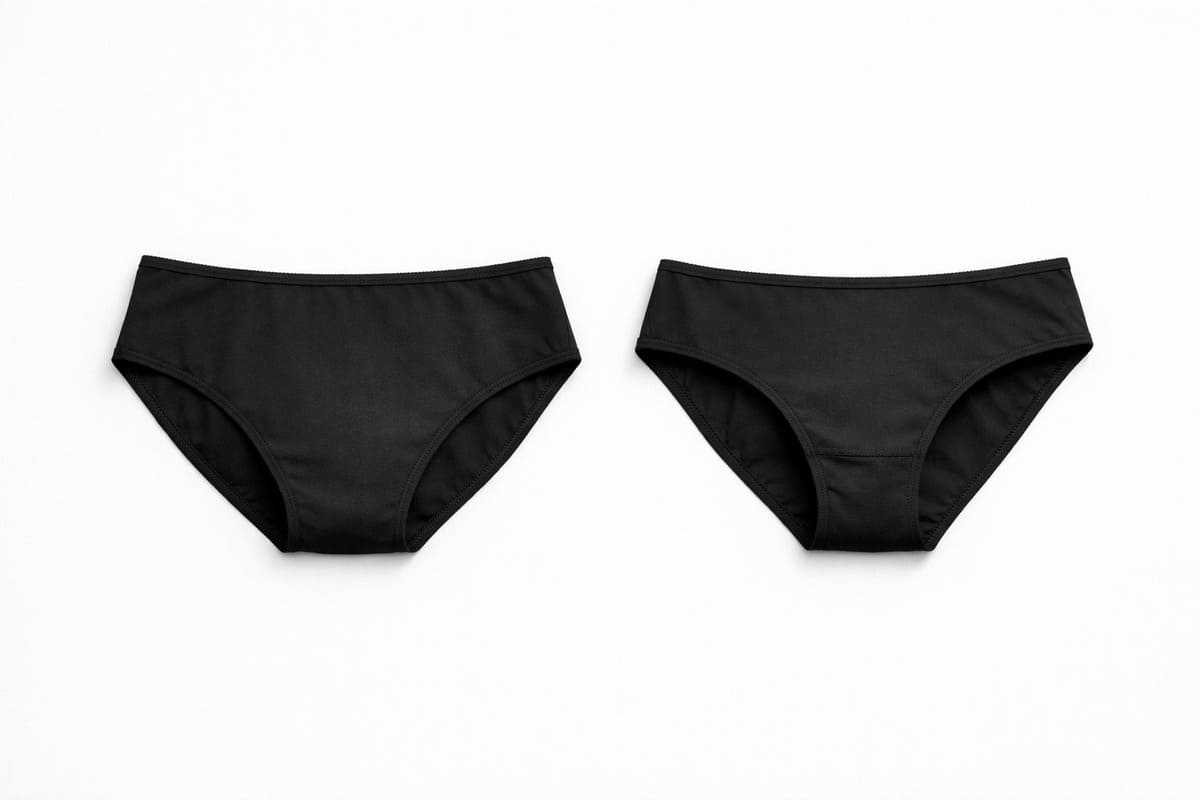
The cheeky vs bikini brief question is settled by turning the garment around. From the front the two are often identical: same mid rise, same leg opening, same waistband. A bikini brief has a back panel that covers the whole seat. A cheeky cuts that panel shorter and shapes it so the lower part of each cheek is left bare, usually about a third to a half.
Everything else in this comparison follows from that one cut.
What the cheeky back is doing
A bikini brief's back is a broad, nearly flat panel. Its lower edge runs from hip to gusset in a gentle curve, roughly mirroring the front.
A cheeky's back is built to hug rather than cover. Wikipedia's panty glossary describes the style as "designed to hug the buttocks", often with a seam or ruching that makes the fabric sit partially between the cheeks. In practice that means three construction changes:
- A shorter back panel, cut higher at the leg
- A center-back seam or gathered channel on many versions
- A leg edge that angles up and inward instead of following the crease under the seat
Lay the two flat and the difference is plain. The bikini back is roughly as wide at the bottom as the front; the cheeky back narrows sharply towards the gusset.
Named after a swimsuit
Bikini underwear takes its name from beachwear, and beachwear took its name from a nuclear test site. The French engineer Louis Réard presented his two-piece in Paris on 5 July 1946, naming it after Bikini Atoll, where the United States had run a weapons test four days earlier. Model Micheline Bernardini wore it at the Piscine Molitor. Jacques Heim had released his own two-piece, the Atome, a few weeks earlier, but his still covered the navel, and Réard's name is the one that stuck.
The name crossed over to underwear for a brief cut at the hip rather than the waist. Wikipedia's history of panties notes that close-fitting styles in stretch fabrics became common in the 1970s, and the hip-height bikini cut has been a default shape in lingerie drawers for decades.
The cheeky label is much newer, a retail term built on the slang sense of "cheeks". Today it is a standard category at mass-market labels such as Aerie and Victoria's Secret, which both sell whole ranges under the name.
Cheeky vs bikini brief under clothing
Both garments put an edge across the seat, so neither is truly invisible. The difference lies in where that edge falls.
The bikini brief's edge sits at the crease under the buttocks, which is exactly where fitted pants pull tight. That is the classic visible panty line.
The cheeky moves the edge higher and angles it, so the line crosses the seat diagonally. Under most jeans and thicker skirts it vanishes. Under thin jersey or bias-cut satin it can still show, though usually less sharply than a bikini line. If no line at all is the goal, look at our bikini brief vs seamless comparison instead.
Comfort and movement
The bikini brief is the easier garment to forget about. Full coverage means nothing migrates, and that matters for long days, sport, sleep and periods.
The cheeky trades a little of that for looks. Some wearers find the back stays put better than a bikini's, because the shaped panel sits in place rather than sliding down. Others find it creeps inward over a day. Fabric decides a lot: a cheeky in stretch lace or modal usually behaves better than one in rigid cotton.
Which one to buy
Choose the bikini brief if you want:
- Full rear coverage for loose skirts, dresses and pants
- The widest choice of fabrics, prints and multipacks
- Something reliable for sleep or exercise
Choose the cheeky if you want:
- A shorter, less visible line under fitted clothing
- A matching brief for a lingerie set that looks finished from behind
- More coverage than a thong without the full seat of a brief
Sizing between the two
Cheeky backs are less forgiving of size. A cheeky one size too small cuts into the seat and rides up; one size too large bags at the center seam. With bikini briefs, a size either way mostly changes the waistband pressure. If a brand's cheeky feels wrong in your usual size, try the next one up before deciding the cut does not suit you.
In our catalog, the test is simple and repeatable: if the back panel is shaped to leave the lower seat exposed, it is a cheeky; if it covers the seat edge to edge, it is a bikini brief, whatever the swing tag calls it.