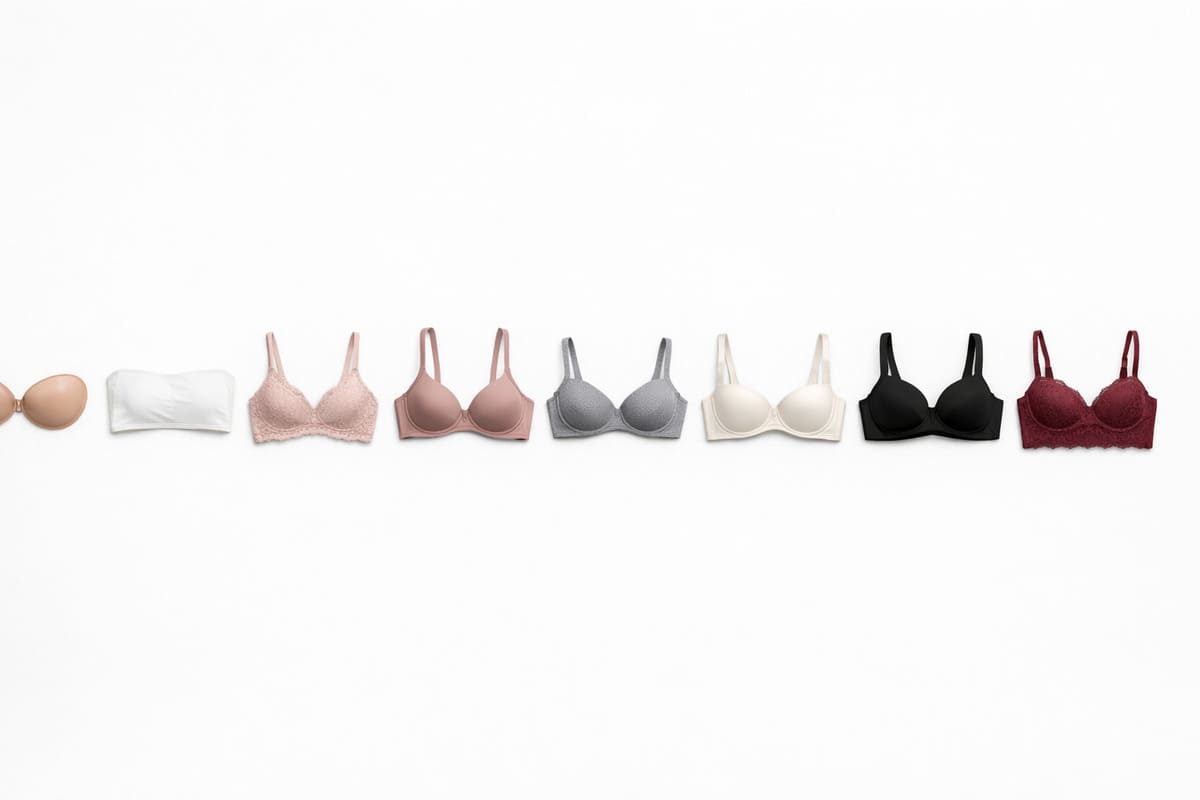
The Structure Spectrum
Every bra sits somewhere on a line from "barely there" to "architectural engineering." Here's the full spectrum, from least structure to most:
1. Adhesive / Stick-On
Two silicone cups, no band, no straps. Shape only, zero support. For fully backless and strapless garments.
2. Bandeau
A tube of fabric across the chest. No cups, no wire, no straps. Minimal coverage and support. The simplest bra form — ancient Romans wore a version of this.
3. Triangle Bra
Two geometric triangle panels on straps and a band. No wire, no padding. Clean geometric silhouette popular in both lingerie and swimwear.
4. Bralette
Soft, unlined, wireless — lace, mesh, or knit. The 2010s comfort revolution made this a wardrobe staple. Best for A–C cups who want something pretty without structure.
5. Wireless Bra
Structured cups without wire — molded foam or seamed panels provide shape. The middle ground between bralette comfort and underwire support.
6. Sports Bra
Compression and/or encapsulation for physical activity. Wide straps, thick underband, athletic fabric. The only bra engineered for movement.
7. T-Shirt Bra
Smooth, seamless, molded cups. The daily invisible bra — designed to disappear under fitted clothing. The world's best-selling bra category.
8. Demi Cup
Half-coverage with a rounded upper edge and outward-set straps. The versatile middle ground between full coverage and low-cut styles.
9. Balconette
Half-coverage with a horizontal upper edge and wide-set straps. The shelf silhouette — elegant under square and off-shoulder necklines.
10. Push-Up
Angled padding lifts and pushes tissue inward. Cleavage creation is the point. Wonderbra's 1994 "Hello Boys" campaign made this a cultural icon.
11. Plunge
Deep V-shaped center gore for low-cut necklines. Can be padded or unpadded — the plunge describes the gore shape, not the lift.
12. Full Cup
Maximum coverage from underbust to above the nipple line. Multi-panel seamed construction. The workhorse for D+ cup sizes.
13. Minimizer
Full coverage with redistribution engineering. Reduces projection by 1+ inch. For wearers who want a lower-profile bust under professional clothing.
14. Strapless
Full bra engineering minus straps. Silicone grip strips and rigid underband keep it in place. The solution for strapless necklines.
15. Convertible
A strapless bra with detachable, re-routable straps. The Swiss Army knife — standard, halter, crossback, one-shoulder, and strapless in one piece.
16. Longline
Extended underband reaching 4–8 inches below the bust. 1950s torso-smoothing meets modern lingerie. Multiple hook rows up the back.
17. Bustier
Bust-to-waist garment with moderate boning. Worn as underwear or outerwear. The bridge between bra and corset.
18. Corset
Bust-to-hip garment with steel boning and lacing. 400 years of Western fashion history. Today worn as fashion, costume, or for waist training.
How to Choose
Under fitted clothing: T-shirt bra, seamless wireless, or demi cup — invisibility is the goal.
Under low necklines: Plunge (V-necks), balconette (square necks), strapless (strapless necklines), adhesive (backless).
For support (D+ cups): Full cup, minimizer, or longline — seamed panels handle weight better than molded cups.
For comfort: Bralette, wireless bra, or soft triangle bra — let your body breathe.
For a lingerie set: Match the bra style to the occasion — plunge for date night, balconette for elegant, bralette for casual intimacy.
For exercise: Sports bra, always. Nothing else is designed for impact.