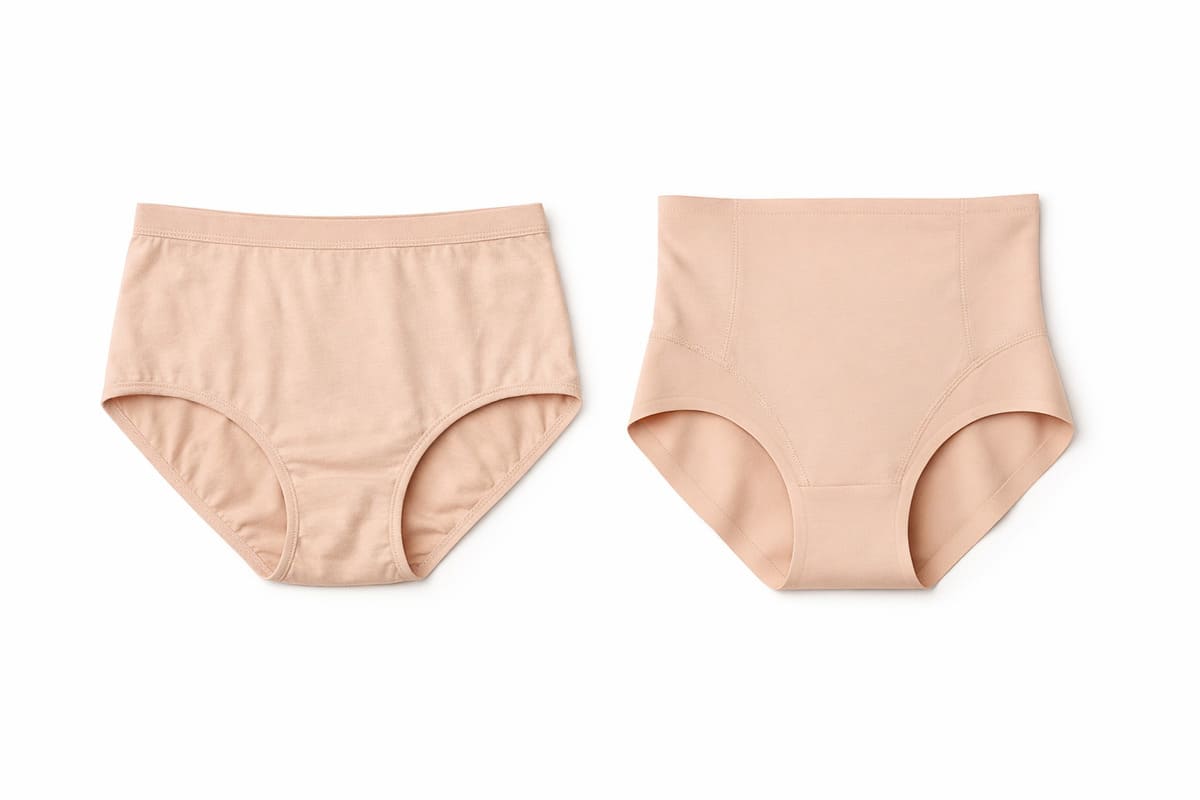
Full brief vs control brief is a choice between underwear and shapewear that happen to share an outline. A full brief covers the seat, hips and lower stomach in soft fabric and is meant to be forgotten once it is on. A control brief covers much the same area but in compression fabric, usually power mesh or a dense elastane knit, often with double-layered panels, built to smooth and flatten the stomach, hips and sometimes the upper thighs.
From across the room they can look identical. In the hand they are different objects.
Same outline, different fabric
| Full brief | Control brief | |
|---|---|---|
| Job | Coverage and comfort | Smoothing and shaping |
| Typical fabric | Cotton, modal, soft microfiber | Power mesh, nylon and elastane blends, bonded panels |
| Layers | One, plus a gusset | Often two over the stomach |
| Stretch | Gives easily | Resists, then snaps back |
| Edges | Elastic binding | Often bonded or laser-cut |
| Rise | Natural waist | Natural waist to high waist, sometimes higher |
The edges deserve a note. A control brief compresses the body, so any sewn elastic at the leg or waist would cut in and create a ridge. Bonded and laser-cut edges spread the pressure and lie flat, which is why so much shapewear has them.
The hand test
Pick both up. A full brief is light and drapes over your fingers. A control brief is heavier for its size and springs back when you pull it. Stretch the front panel sideways: a full brief gives with almost no effort, a control brief pushes back. If the stomach panel has a second layer you can feel between your fingers, it is a control brief, whatever the label says.
Rubber, Lycra and the girdle
Control briefs are descendants of the girdle, and the girdle's story turns on one fiber. In 1958 Joseph Shivers, a chemist at DuPont, developed an elastic synthetic fiber that could handle heat far better than rubber. DuPont sold it as Lycra, and its first target market was women's girdles and foundation garments, where it was meant to replace rubber.
Spandex, or elastane as it is called in Europe, spread far beyond the girdle: by 2010 an estimated 80% of clothing sold in the United States contained some. But the control brief is its first and most direct heir. Every one on sale today is built on that 1950s substitution of a synthetic fiber for rubber.
Spanx and the footless tights
The control brief's modern revival has a well-documented starting point. In 1998, Sara Blakely wanted the smooth line of pantyhose under white pants without the feet showing in open shoes, so she cut the feet off her own pair. Hosiery mills turned down her idea of a footless shaper at first. She founded Spanx in Atlanta in 2000 with about $5,000 of her own savings, and the product appeared on Oprah Winfrey's "favorite things" list that year.
Spanx grew into a market leader, and in 2021 Blackstone bought a majority stake that valued the business at about $1.2 billion. Its Higher Power panties, a high-waisted shaping brief, are still on department store shelves.
Others followed with their own angles. Commando, founded by Kerry O'Brien, launched its raw-cut underwear line in 2005. Skims, co-founded by Kim Kardashian and Jens Grede, launched on 10 September 2019 with shapewear in a wide spread of sizes and skin tones. The shared idea was shapewear that looked and felt more like underwear.
When a control brief earns its place
Compression is a tool, not a default. It helps most under:
- Bias-cut satin, fine jersey and other fabrics that cling and show every edge
- Fitted dresses and pencil skirts, where a smooth line from waist to thigh matters
- Formal occasions where a garment has been fitted closely
It helps least on a long day at a desk, in hot weather, or for sleep. Firm compression can feel restrictive when sitting for hours, and some wearers find it warm. Choosing a light or medium control level, rather than the firmest, makes a big difference to all-day comfort.
When a full brief is the better choice
For daily wear, sleep, exercise and periods, the full brief wins. It breathes better, washes more easily, lasts well in a hot wash if it is cotton, and costs less. It also leaves the stomach free to move. Modern full briefs in modal or smooth microfiber can be nearly as discreet as shapewear under ordinary clothes.
A middle route
There is a growing group of "light control" or "smoothing" briefs that use one layer of firmer microfiber without power-mesh panels. They sit between the two categories and suit people who want a smoother line without the grip. For how compression relates to height, see our high-waist vs control brief comparison.
The test we use for our records stays the same: if the fabric is engineered to compress, it is a control brief, even when it is cut like a plain full brief.