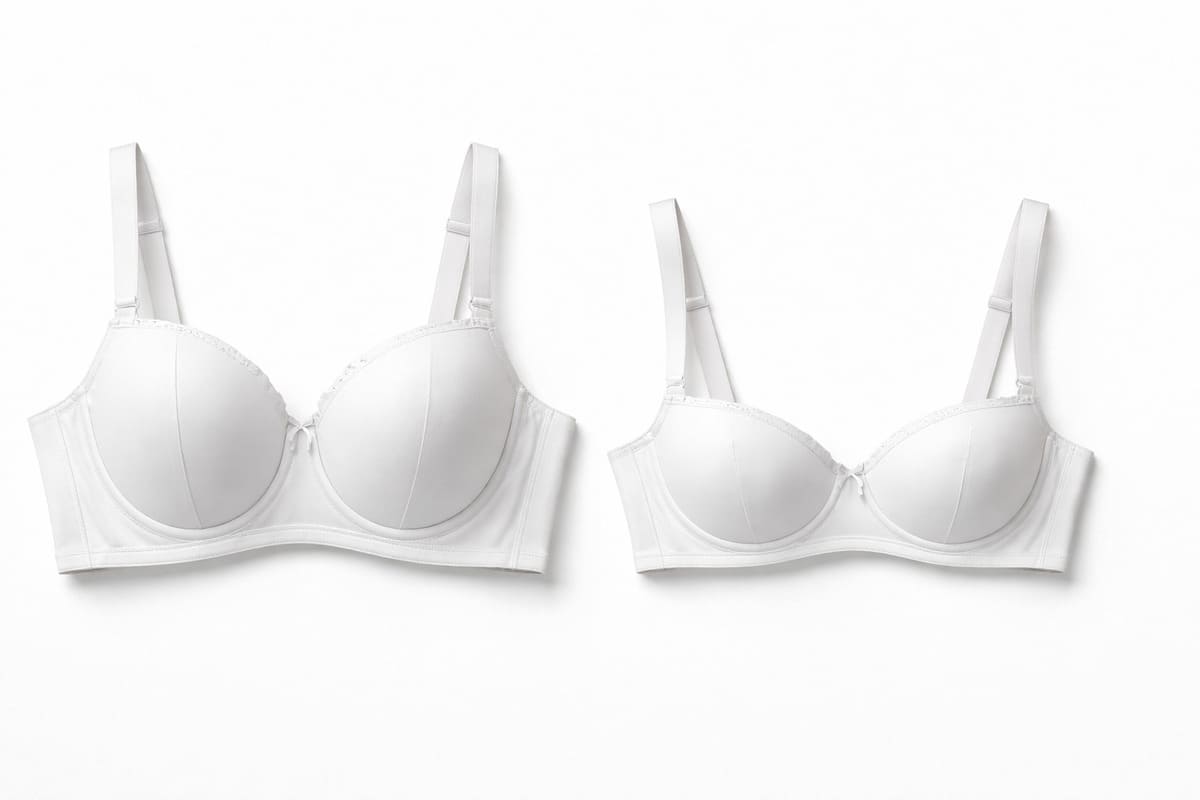
The Short Answer
A full cup bra covers nearly the entire breast up to and above the nipple line, offering maximum support and containment. A demi cup covers roughly the lower half, leaving the upper breast exposed and creating a more open neckline. They're opposite ends of the coverage spectrum within structured bras.
Construction Side by Side
| Feature | Full Cup | Demi Cup |
|---|---|---|
| Coverage | Entire breast | Lower half of the breast |
| Upper cup edge | High — above nipple line | Low — at or below nipple line |
| Strap placement | Standard (closer to center) | Outward from center |
| Support level | Maximum | Moderate |
| Side wings | Wide for lateral support | Standard width |
| Best cup sizes | D+ (designed for larger sizes) | A–D (works best on smaller/medium) |
| Back closure | 3–4 hooks | 2 hooks typically |
How to Tell Them Apart
The height of the cup is unmistakable. A full cup bra has tall cups that visibly extend well above where the nipple would sit. A demi cup has noticeably shorter cups — you can see that the upper third of the breast area would be uncovered.
When to Wear Each
Full cup: When support is the priority. Larger cup sizes (D+), high-activity days, professional settings where you want zero movement. Also the best choice when a bra needs to do serious lifting work — the full cup has more fabric and structure to distribute weight.
Demi cup: Under lower necklines, V-necks, and scoop necks where a full cup would peek out. Also for smaller cup sizes where maximum support isn't necessary and you want a more flattering, open silhouette.
History
Full cup bras have been the default since the modern bra emerged in the 1920s — early bras were all full coverage by necessity. The demi cup appeared in the 1960s and 1970s as necklines dropped and women wanted bras that didn't show under more revealing fashion.