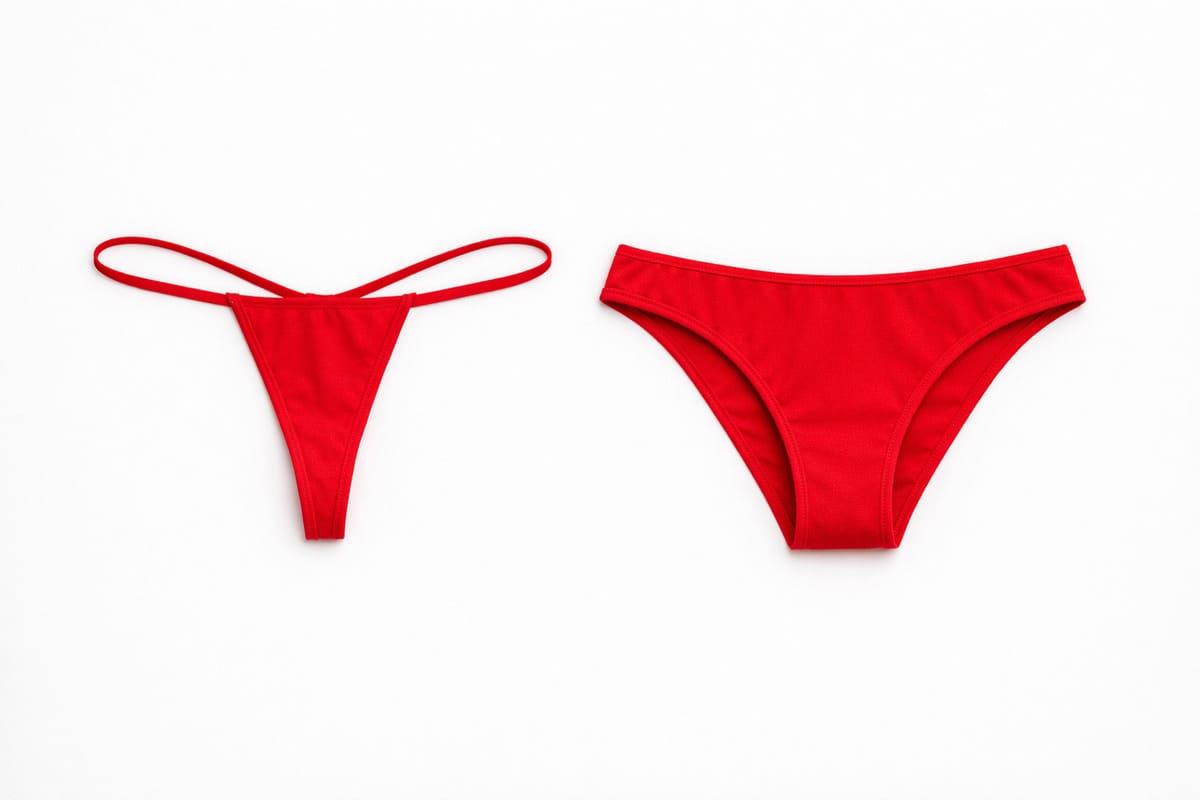
G-string vs tanga sounds like a close contest, but in English-language lingerie the two sit two full steps apart on the coverage scale, with the thong between them. A G-string is the minimum: a small front panel, a string or cord at the back and usually a string or very thin band at the hips. A tanga is a small brief with a real back panel that covers part of the seat, joined to the front by narrow, high-cut sides. One is mostly string. The other is mostly fabric, just not very much of it.
Where each sits on the scale
From least to most rear coverage, the reduced-coverage end of the panty spectrum runs like this:
- G-string. String or cord at the back.
- Thong. A narrow fabric strip at the back.
- Tanga. A small back panel covering part of the seat.
- Brazilian. Narrow sides, slightly more back coverage.
- Cheeky. Full sides, scooped back.
So the G-string and the tanga are neighbors once removed. The thong sits between them, and our thong vs G-string and thong vs tanga comparisons cover each half of the gap in detail.
In Paris, they share a name
Here is the catch. In Spanish and in French, the word "tanga" means a thong or a G-string. A French label that says tanga may well be selling the garment this article sets against it. Wiktionary traces the clothing sense back through Portuguese, where tanga means a loincloth or a very small bikini, to the Kimbundu word for a loincloth.
English and particularly British retail settled on tanga for the small brief instead. That is the meaning used on this site, but any imported product deserves a look at the back photo before the name is trusted.
Construction compared
| G-string | Tanga | |
|---|---|---|
| Back | String, cord or thin elastic | Small fabric panel |
| Sides | String or very thin band | Narrow fabric, cut high |
| Front | Small triangle | Small to standard bikini front |
| Rear coverage | Almost none | Partial |
| Surface for lace or print | Front only | Front and back |
| All-day comfort | Varies; many find it a short-wear piece | Generally easier |
Two very different family trees
The G-string's history is theatrical. The word is first recorded in 1878 for a loincloth worn by some Native Americans, and moved to women's costume in the 1920s through Earl Carroll's revues. In the 1930s Chicago became a center of G-string making and burlesque, and Gypsy Rose Lee became the performer most associated with the garment. It reached ordinary Western shops in the late 1980s and became widely popular through the 1990s.
The tanga's history runs through beachwear. Brazilian swimwear of the 1970s and 1980s cut bikini bottoms smaller and higher at the leg, and lingerie borrowed both the reduced shape and the Portuguese word. Unlike the G-string, it has no single stage or performer attached to it.
Wearing each one
Under clothes
Both are good at hiding lines, but in different ways. The G-string leaves almost nothing to show anywhere; its weak point is the waistband, which on cheap versions can be a firm elastic that prints. The tanga leaves a short line across the seat. Under jeans or thick skirts that line disappears; under thin jersey it may show unless the edge is bonded or laser-cut.
Comfort
Most people who try both find the tanga easier for long days. The back panel spreads pressure, and there is no string to shift. The G-string concentrates everything on a narrow cord. Many wearers keep it for specific outfits or for lingerie meant to be seen.
In a lingerie set
The tanga gives a designer more room: lace across the back, a scalloped edge at the leg, a print that reads from behind. The G-string's appeal is the bare line itself.
Choosing quickly
- Sheer, clingy dress and nothing else will do: G-string.
- Fitted skirt or pants for a full workday: tanga.
- Matching set to be seen: either, depending on how much back you want the lace to cover.
- Shopping from a French or Spanish site: check the photo, because the word tanga will not tell you which one is coming.
Of the two, the G-string is the one with a documented starting date, 1878, and the tanga is the one whose name changes meaning when the garment crosses a border.