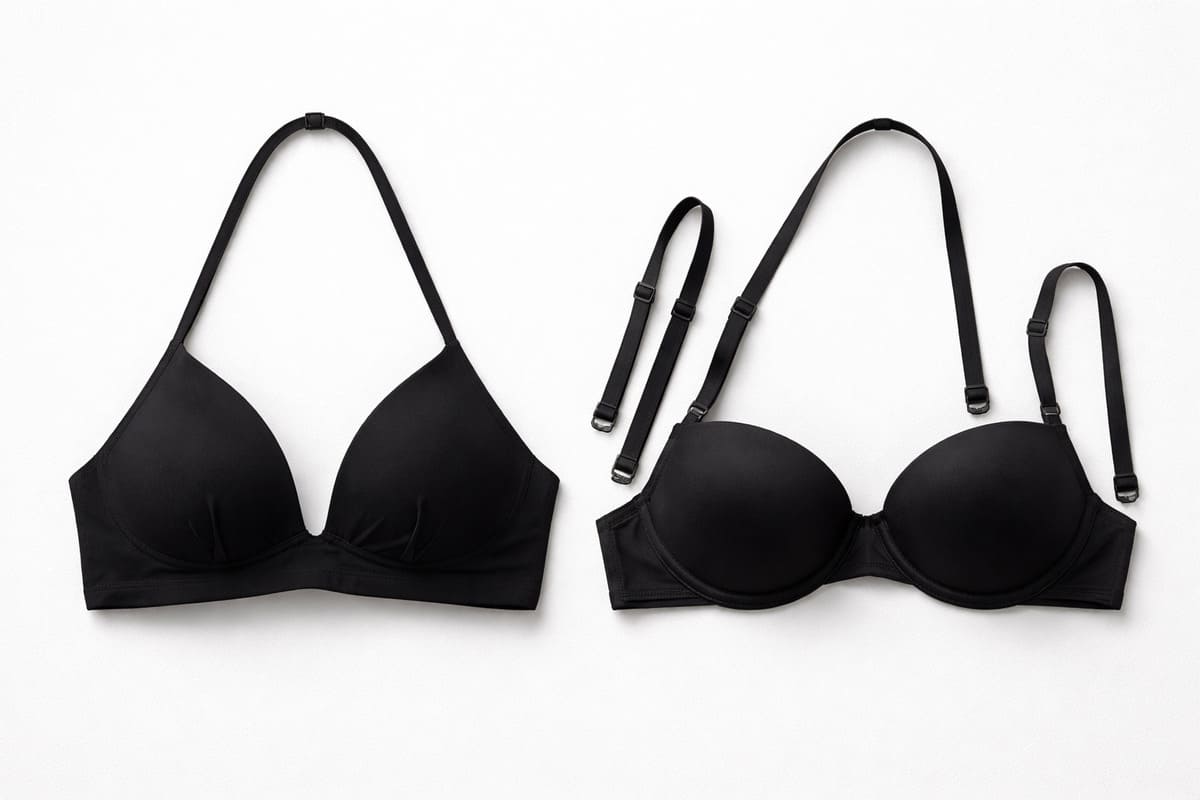
The halter bra vs convertible bra choice is between a specialist and a generalist. A halter bra has straps that run up the front of the chest and fasten around the back of the neck, so the bra hangs from the neck instead of the shoulders. A convertible bra, also sold as a multiway, has detachable straps on hooks that can be clipped on as standard straps, as a halter, crossed at the back, over one shoulder, or left off for strapless wear. One does a single thing. The other does several things passably.
How each one carries the weight
Halter
In a halter bra the strap or straps leave the top of each cup, rise toward the neck and fasten behind it with a hook, clasp or tie. Some use a single loop. The back of the shoulders and much of the upper back stay bare, which is the whole point under a halter dress. The weight that normally rests on two shoulder points now hangs from the back of the neck, so the band has to take as much as possible, and the neck strap needs to be wide enough not to cut.
Convertible
A convertible bra starts as a strapless bra. It has a wide, firm band and usually silicone grip along its edges, because in at least one of its modes it has to stay up with no straps at all. The straps attach with small hooks to loops at the top of the cups and on the back band. Rearranging them changes the bra's back from ordinary to crossback, halter or one-shoulder. Some makers, Pepper among them, sell the style specifically as a multiway strapless bra, which is a fair description of where its engineering lies.
A comparison of the two designs
| Halter bra | Convertible bra | |
|---|---|---|
| Strap layout | Fixed, around the neck | Detachable and movable |
| Base design | Ordinary bra with re-routed straps | Strapless bra with optional straps |
| Band | Standard to firm | Wide and firm |
| Hardware | One fastening at the neck | Several hooks and loops |
| Best at | One neckline | Wardrobe flexibility |
Why the specialist often wins
Every convertible is a compromise. Its band is built to work without straps, so it is often stiffer and tighter than a halter wearer needs. Its strap hooks and loops are placed to suit several routes rather than one, so in halter mode the straps can sit at a slightly awkward angle and the hooks can show. A purpose-built halter places the straps exactly where a halter neckline wants them, and it has no spare hardware.
The convertible wins on everything else. One bra covers a strapless dress, a halter top, a racer-cut tank and an ordinary T-shirt, which is why it is the standard advice for packing light.
The neckline that created the demand
The halter as a fashion statement dates to the 1930s, when bare backs were the point of evening dress. In 1936 Madeleine Vionnet showed a Carnival Dress with a halter neck, bare over the shoulders and open to the waist. The most famous halter dress of all followed two decades later: the pleated white dress William Travilla designed for Marilyn Monroe in The Seven Year Itch, filmed in 1954 and released in 1955, with a halter bodice and bare back. It sold at auction in 2011 for 5.6 million dollars.
Both dresses expose the problem the halter bra solves. A normal strap would show at the shoulder, and a strapless bra would show at a deep back.
Choosing for the dress
A halter dress worn often: buy a dedicated halter bra. It will be more comfortable over a long evening.
A halter worn once, among many other necklines: a convertible in halter mode is good enough.
A halter with a very low back: neither works, because both have a band. Look at adhesive or backless options instead.
Neck strain: if a halter strap aches after an hour, the band is too loose and the neck is doing the band's job. Go down a band size, or try a convertible crossed at the back, which spreads the load across both shoulders.