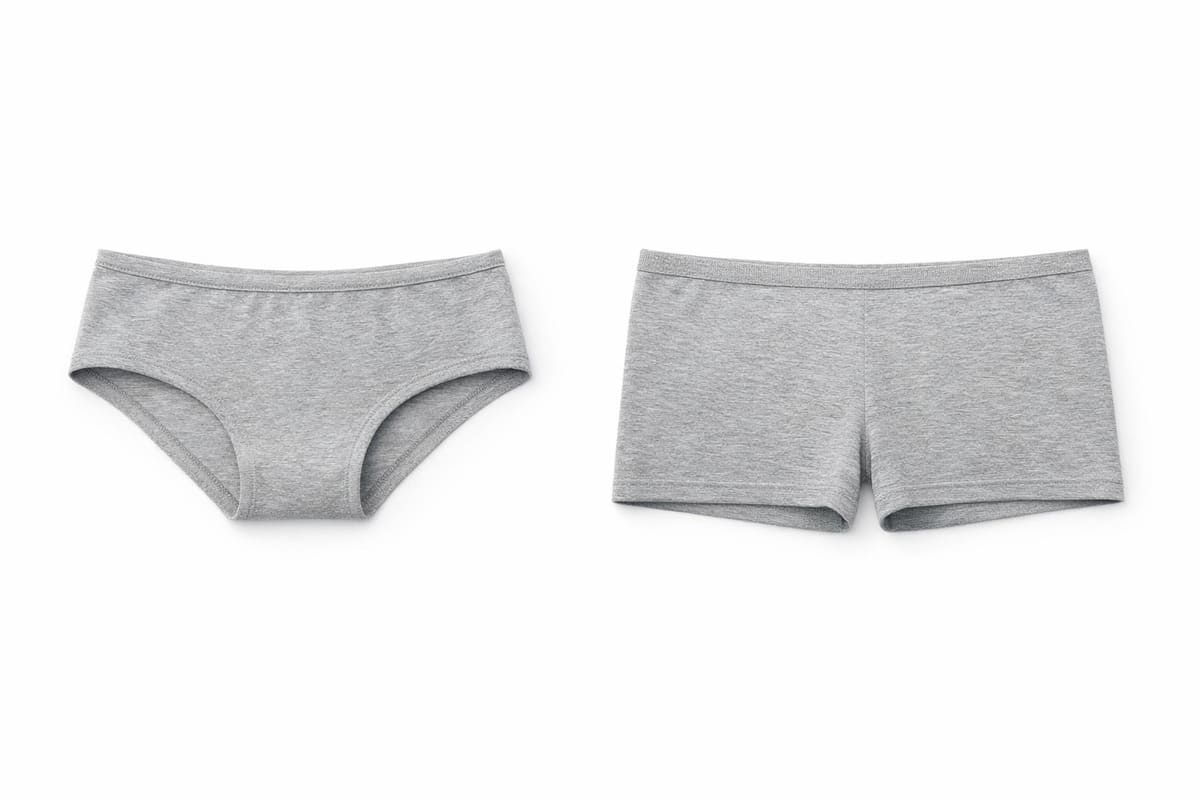
Look at the leg opening and the hipster vs boyshort question answers itself. A hipster has a curved leg opening that rises towards the hip, the shape every panty has had since briefs replaced drawers. A boyshort cuts the leg straight across, horizontally, so the garment extends onto the top of the thigh and looks like a very short pair of shorts. Both sit low on the hips and both cover the seat fully.
Everything about how they wear, where they show and what they are good for follows from that straight hem.
Borrowed from the men's drawer
Wikipedia's panty glossary says boyshorts are "named for their similarity to boxer briefs", and the resemblance is the point. The style takes the short-leg shape of men's trunks and recuts it for a woman's hip and seat: a lower rise, no fly, a shaped back seam, softer fabrics.
The habit of borrowing from menswear has a longer run than the boyshort itself. In 1982 Jockey, a company known for men's briefs, launched Jockey for Her, a line of women's cotton panties introduced at a fashion show in New York. Its chief executive at the time, Donna Steigerwaldt, bet that women wanted plain, well-made cotton underwear from a familiar name. The line started with three styles.
The boyshort as a named category arrived later. Wikipedia's history of panties lists boyshorts and hipsters together as introductions of the 2000s, which makes these two styles near-twins in age as well as in rise.
What the straight hem changes
A straight hem across the thigh means a few things a curved one does not.
Thigh coverage. The boyshort covers the top of the inner thigh, where skin rubs against skin when walking in a skirt or dress. This anti-chafe effect is the single biggest reason people choose it. A hipster's curved leg leaves that area bare.
Line under pants. A curved leg opening runs along the crease where the seat meets the leg, and a hipster's edge often hides in that natural fold. A boyshort's straight hem crosses the thigh where nothing hides it. Under fitted pants it can print a horizontal line or ride up and bunch. This is the boyshort's main weakness.
Movement. A short leg can ride up when walking, particularly in cotton without much stretch. Better boyshorts use a bonded or silicone-lined hem to hold the edge in place. The hipster has nothing to ride up.
Look. A hipster reads unmistakably as underwear. A boyshort reads halfway to loungewear, and many are sold that way, in sets with a matching vest or bralette.
Matching the cut to the occasion
A short checklist, from the wardrobe outward:
- Fitted pants, jeans, leggings. Hipster. The curved leg follows the body's own crease.
- Skirts and dresses in warm weather. Boyshort. The thigh coverage prevents chafing and adds a layer of modesty in a breeze.
- Sleep. Either, depending on preference. Boyshorts are often bought as sleep shorts in their own right.
- Under a short skirt or for dancing. Boyshort, which works much like a dancer's shorts.
- Lingerie sets. Both exist in lace. A lace boyshort is a common bridal and boudoir choice because the straight hem shows off a deep scalloped border.
The lace edge test
Lace is where the two styles look most alike, because many lace hipsters have a fairly straight leg too. Check whether the edge travels up towards the waist at the side seam. If it does, it is a hipster with a lace finish. If it stays parallel to the waistband all the way around, it is a boyshort.
Fit details worth knowing
The boyshort's thigh band has to fit as well as its waist. Too tight and it cuts into the thigh, creating the bulge that makes the line show. Too loose and it rides up within an hour. Brands that size by hip rather than waist usually get this right more often.
The hipster is more forgiving. Its main fit point is the wide waistband, and most will tolerate a size either way. If a hipster digs in, look for one with a knitted or bonded waistband rather than sewn elastic.
For the comparison one rung down, with the bikini brief, see bikini brief vs hipster. For the full-coverage cousin that gets its coverage by rising to the waist rather than dropping to the thigh, see boyshort vs full brief.
A useful rule of thumb from the cataloguing side: if a garment's leg opening is level with its waistband, it goes in the boyshort drawer, no matter how small it is.
Last updated
Questions
What is the difference between hipster and boyshort underwear?
The leg opening. A hipster's leg curves up toward the hip, like most panties. A boyshort's leg is cut straight across, so the garment extends onto the top of the thigh and looks like very short shorts. Both sit low on the hips and fully cover the seat, so that straight hem is what changes how they wear.
Do boyshorts stop thigh chafing?
Yes, that is the main reason people buy them. A boyshort's straight hem covers the top of the inner thigh, where skin rubs against skin when walking in a skirt or dress. A hipster's curved leg leaves that area bare. The extra layer also adds some modesty under a short skirt, which is why boyshorts work much like dancer's shorts.
Why do boyshorts ride up?
A short leg can creep up when walking, especially in cotton without much stretch, and a thigh band that is too loose will ride up within an hour. A band that is too tight digs in and creates a visible bulge instead. Better boyshorts use a bonded or silicone-lined hem, and brands that size by hip measurement tend to fit better.
Are boyshorts good under leggings or jeans?
Not usually. A boyshort's straight hem crosses the thigh where nothing hides it, so under fitted pants it can print a horizontal line or ride up and bunch. A hipster is the better choice for jeans, leggings and fitted pants, because its curved leg edge follows the natural crease where the seat meets the leg and tends to hide there.
Sources
- en.wikipedia.org: Panties
- blog.jockey.com: jockey for her
Discussion
Loading...