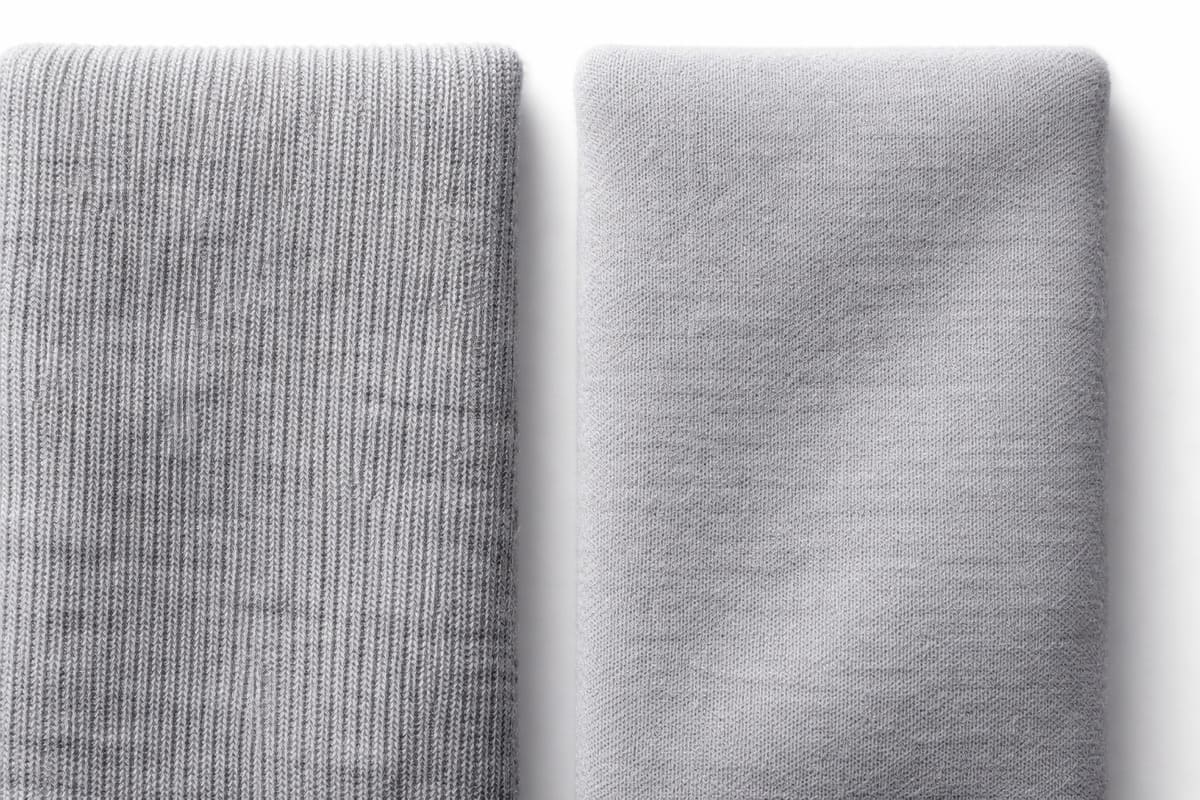
The jersey knit vs microfiber comparison sets two stretchy knits against each other, and the most useful difference is one shoppers never see on a label. Jersey knit is a weft knit: a single yarn loops back and forth across the fabric, as in a T-shirt, and it is usually cotton, modal or a blend with a little elastane. Lingerie microfiber is usually a warp knit called tricot: many ultra-fine nylon or polyester yarns loop lengthwise in zigzags, almost always with elastane. Jersey feels like a soft T-shirt. Microfiber feels like a smooth second skin.
Weft knit, warp knit
The two knitting families behave differently in ways that matter for underwear.
In a weft knit such as jersey, each row is built from one continuous yarn running across the width. That makes jersey soft and easy to stretch sideways, but it also means a broken loop can run, like a ladder in tights, and cut edges tend to curl.
In a warp knit, the yarns are fed lengthwise, parallel to the edge of the fabric, and each one zigzags to interlock with its neighbors. A single broken thread will not unravel the fabric, which gives warp knits their run resistance. Tricot machines dominate lingerie production because they turn out soft, drapey fabric with good stretch.
The warp knitting idea is old: it is credited to Josiah Crane around 1775, refined by Richard March in 1778 and by John Heathcoat in 1808 and 1809. Microfiber is recent by comparison. Miyoshi Okamoto at Toray Industries worked on ultra-fine fibers in the 1960s, and the first commercial successes arrived in the 1970s. A microfiber filament is finer than one denier, under ten micrometers across.
Jersey knit vs microfiber in the drawer
| Jersey knit | Microfiber tricot | |
|---|---|---|
| Knit family | Weft knit | Warp knit |
| Usual fibers | Cotton, modal, viscose, with some elastane | Nylon or polyester, with elastane |
| Surface | Visible columns of small V stitches | Almost featureless, soft sheen |
| Edges | Curl, so finished with elastic or binding | Can be laser cut and left raw |
| Runs | Can ladder from a broken loop | Run-resistant |
| Moisture | Cotton and modal absorb it | Synthetic filaments shed it and dry fast |
| Under clothes | Thicker, edges can show | Thin, flat, nearly invisible |
How to tell them apart
Look at the face under good light. Jersey shows neat vertical columns of tiny V shapes; the back shows small horizontal loops. Microfiber tricot looks almost blank, with a faint sheen, and the back may show a fine diagonal texture.
Then stretch a corner. Jersey stretches most across its width and relaxes slowly. Microfiber tricot with elastane stretches in more directions and snaps back faster.
Finally, look at the edges. Raw edges on a brief usually mean microfiber, since a knit that does not curl or run can be left unfinished. Jersey nearly always has an elastic or folded band.
Living with each one
Hot weather and long days
Cotton and modal jersey absorb sweat and feel cool on dry heat. Microfiber does not absorb much, so it can feel clammy in still, humid air, but it dries quickly after exercise. That is why sports underwear leans synthetic and sleep underwear leans toward cotton or modal jersey. For intimate wear, gynecologists commonly recommend cotton, or at least a cotton gusset.
Washing and wear
Microfiber holds its shape and color well through many washes. Cotton jersey can bag and fade over time, though elastane slows the bagging. Cotton also pills where it rubs.
Fit
Jersey is forgiving and relaxed, good for bralettes, sleep sets and lounge briefs. Microfiber holds closer and smoother, good for T-shirt bras, invisible briefs and shapewear.
The overlap
The lines are not hard. Modal jersey is very fine and smooth, and some is close to microfiber in hand. There are also weft-knit microfiber jerseys. When labels and touch disagree, trust the structure: V columns mean jersey, a blank face with a fine diagonal back means tricot.
This museum compares each fabric against cotton too: cotton vs jersey knit separates fiber from structure, and cotton vs microfiber weighs breathability against invisibility. Heathcoat is the name that ties these fabric pages together: the man whose bobbinet machine made modern tulle is also credited with refining warp knitting, the family that lingerie tricot belongs to.