The Short Answer
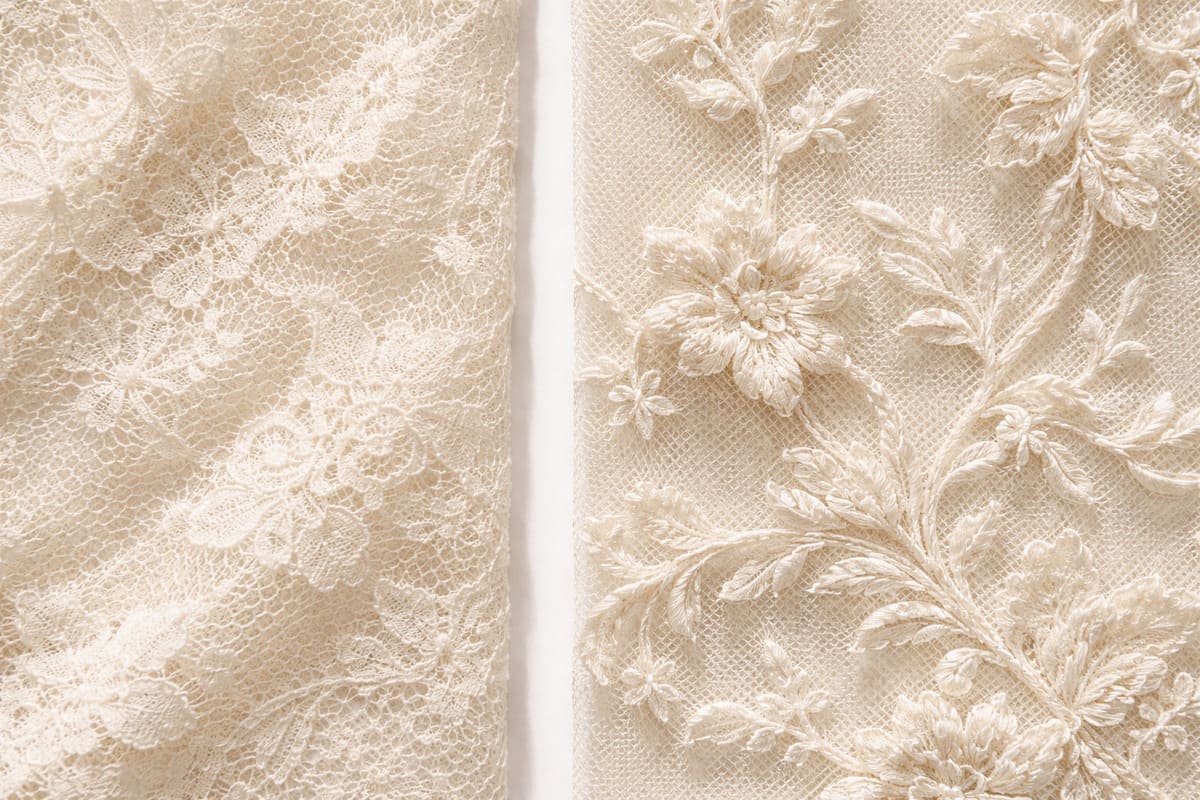
Lace is a fabric where the decorative pattern and the structure are one and the same — the motifs are created during the weaving or knitting process. Embroidered fabric starts with a pre-existing base (usually mesh or tulle), and decorative thread is stitched on top of it after the base is made.
Fabric Properties Side by Side
| Property | Lace | Embroidered |
|---|---|---|
| Pattern origin | Integral — woven or knitted into the fabric | Applied — stitched onto a base fabric |
| Base fabric | None — pattern IS the fabric | Mesh, tulle, or organza underneath |
| Texture | Flat to slightly raised | Distinctly raised above the base |
| Reversibility | Pattern visible on both sides | Clean on front, thread tails on back |
| Thread colors | Usually single color | Often multicolor |
| Edges | Scalloped or eyelash fringe | Can be any shape, cut to pattern |
| Cost | High (Leavers lace) to moderate (Raschel) | Varies widely by density |
How to Tell Them Apart: The Visual Test
Turn the fabric over and look at the back.
- Lace: the back looks like a mirror image of the front. The pattern is visible on both sides because it's part of the structure.
- Embroidered: the back shows thread tails, bobbin stitches, or a messy underside where the needle passed through the base fabric. You can clearly see two separate layers — the base mesh and the stitching on top.
The second test: look at the edges of a motif. In lace, the motif blends into the surrounding openwork seamlessly. In embroidery, you can often see where the thread starts and stops, and the base mesh is visible between motifs.
Common in Lingerie
Lace dominates in traditional and classic lingerie. Chantilly lace bras, guipure lace bodysuits, and eyelash lace trim are staples across all price points. Machine-made lace (Raschel) has made lace affordable for mass-market lingerie.
Embroidered fabric is increasingly popular in contemporary lingerie, especially from brands like Fleur du Mal, Thistle & Spire, and Dita Von Teese. The ability to use multiple thread colors creates possibilities that lace cannot — multicolor floral embroidery, scattered metallic stars, or gradient effects. Embroidered mesh is the dominant fabric in the "romantic but modern" aesthetic.
The luxury end blurs the line: some couture pieces use embroidered Chantilly lace, where lace serves as both fabric and base for additional embroidery.