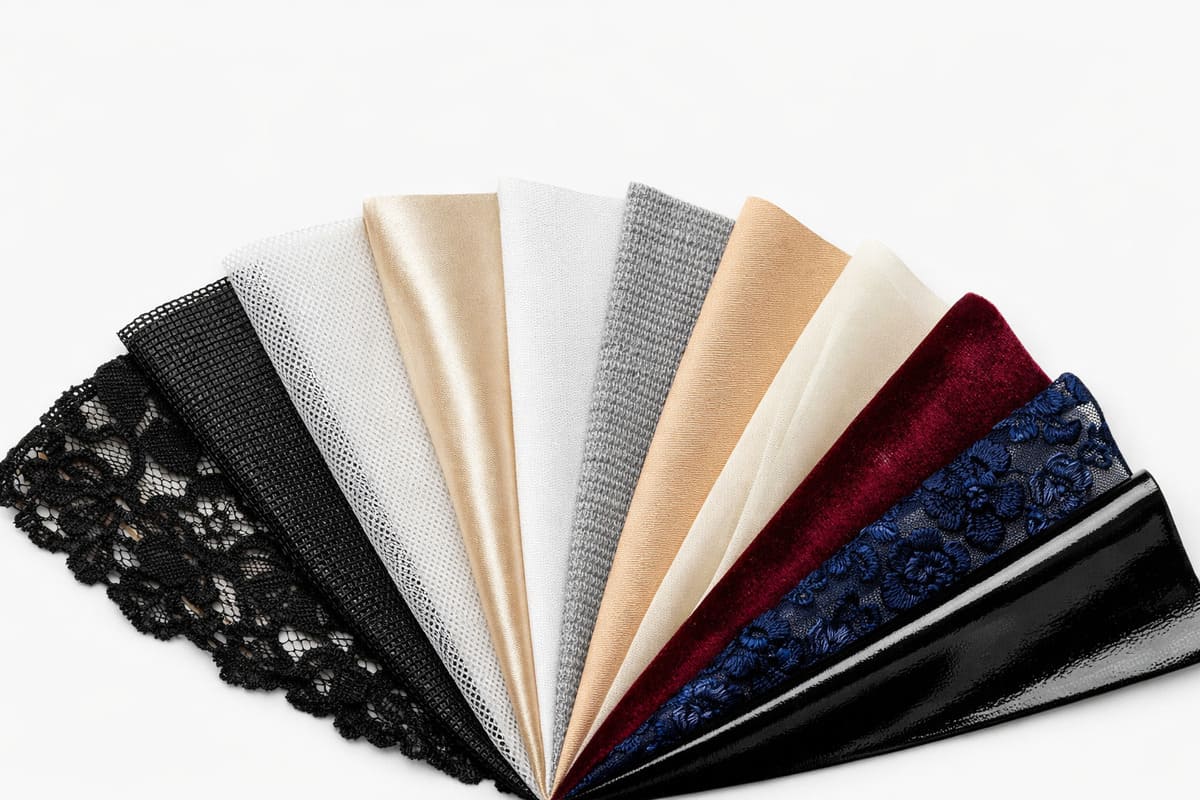
This lingerie fabric guide covers the eleven fabrics the museum uses to classify lingerie: lace, mesh, tulle, satin, cotton, jersey knit, microfiber, chiffon, velvet, embroidered fabric and leather or vinyl. Some of those names describe a fiber (cotton), some a fiber size (microfiber), some a construction (satin, jersey, lace), and one a finishing step (embroidery). That mix is why fabric labels confuse people, and why the clearest way to compare them is by what a wearer actually notices: how sheer, how stretchy, how shiny and how warm.
All eleven at a glance
Each fabric has its own entry, with history and identification notes, in the lingerie fabrics index. The table below is the short version.
| Fabric | What it is | Sheer? | Stretch | Sheen | Main job |
|---|---|---|---|---|---|
| Lace | Openwork with motifs made in one pass | Mostly | Rigid to good (stretch lace) | Low | Decoration |
| Mesh | Plain knitted net | Yes | Moderate to very high (power mesh) | Low | Structure, support |
| Tulle | Very fine net | Very | None to good (stretch tulle) | Low | Sheer layers, embroidery ground |
| Satin | Weave with long floats | No | Low unless elastane added | Very high | Slips, robes, trims |
| Cotton | Natural fiber, usually knitted | No | Low without elastane | None | Everyday comfort |
| Jersey knit | Weft knit of loops | No | Good, mainly across | None | Comfort, lounge, sleep |
| Microfiber | Ultra-fine synthetic, usually warp knit | No | Good with elastane | Soft | Invisible basics |
| Chiffon | Plain weave of crepe yarns | Yes | Slight | Soft shimmer | Overlays, flowing pieces |
| Velvet | Cut pile on a woven or knit base | No | None to good (stretch velvet) | Glow | Statement, cold season |
| Embroidered | Thread stitched onto a net | Between motifs | Reduced where dense | Varies | Decoration |
| Leather or vinyl | Hide, or plastic-coated fabric | No | Little | High (vinyl) | Statement pieces |
Sheerness, from most to least
- Tulle. The finest net. Over skin it reads as a light tint.
- Mesh. A coarser net, sheer to semi-sheer depending on weight.
- Chiffon. No holes at all; its fine twisted yarns diffuse light like frosted glass.
- Lace. Varies with type. Fine Chantilly-style lace is very sheer; heavy guipure is close to opaque.
- Embroidered fabric. Sheer between motifs, opaque under the stitching.
- The rest. Cotton, jersey, microfiber, satin, velvet and leather are opaque in normal lingerie weights.
Stretch, from most to least
Stretch now depends more on elastane content than on fabric type. Power mesh, with 10 to 20 percent elastane, stretches hardest and recovers firmly. Microfiber tricot and cotton-elastane jersey follow. Stretch lace, stretch tulle and stretch velvet all exist and are common. Woven satin, chiffon, rigid tulle and leather give little or nothing, which is why they are cut loose or built with seams and closures.
Shine and warmth
Satin is the shiniest of the woven fabrics, thanks to its floats. Vinyl, with its coated surface, can be shinier still. Velvet glows rather than shines, changing tone as the pile tilts. Microfiber has a soft sheen, chiffon a faint shimmer, and cotton and jersey none.
For warmth, velvet leads because its pile traps air. Leather and vinyl block airflow almost entirely, which feels warm and quickly becomes sweaty. Cotton and jersey sit in the middle and breathe well. Mesh, tulle, chiffon and lace are mostly air.
The pairs people mix up
Most confusion falls into a handful of pairs, each covered in its own comparison:
- Lace and mesh, both sheer and usually black. Pattern in the holes means lace: see lace vs mesh.
- Mesh and tulle, both nets. Scale and purpose separate them: see mesh vs tulle.
- Satin and chiffon, often the same fiber. Floats make satin; crepe twist makes chiffon: see satin vs chiffon.
- Cotton and microfiber, the two everyday basics. Breathability against invisibility: see cotton vs microfiber.
Using the lingerie fabric guide by occasion
Daily wear at home: cotton or cotton jersey, for breathability. Gynecologists commonly recommend cotton, or at least a cotton gusset.
Under fitted clothes: microfiber, with laser-cut or bonded edges.
Seen and meant to be: lace, embroidered mesh, satin.
Sleep and lounge: jersey, satin, or chiffon for robes and peignoirs.
Winter: velvet, or brushed cotton jersey.
Bridal: lace, tulle, chiffon and satin, often all in one set.
Most pieces are blends
Single-fabric lingerie is the exception. A typical unlined lace bra combines lace cups, stretch tulle or rigid bra tulle as a stabilizer, power mesh wings and a cotton or microfiber lining, plus elastic and satin-finished trims. Knowing each fabric's job makes a composition label readable. The two-line label that lists "main" and "contrast" is often lace or embroidery for the first and power mesh for the second.