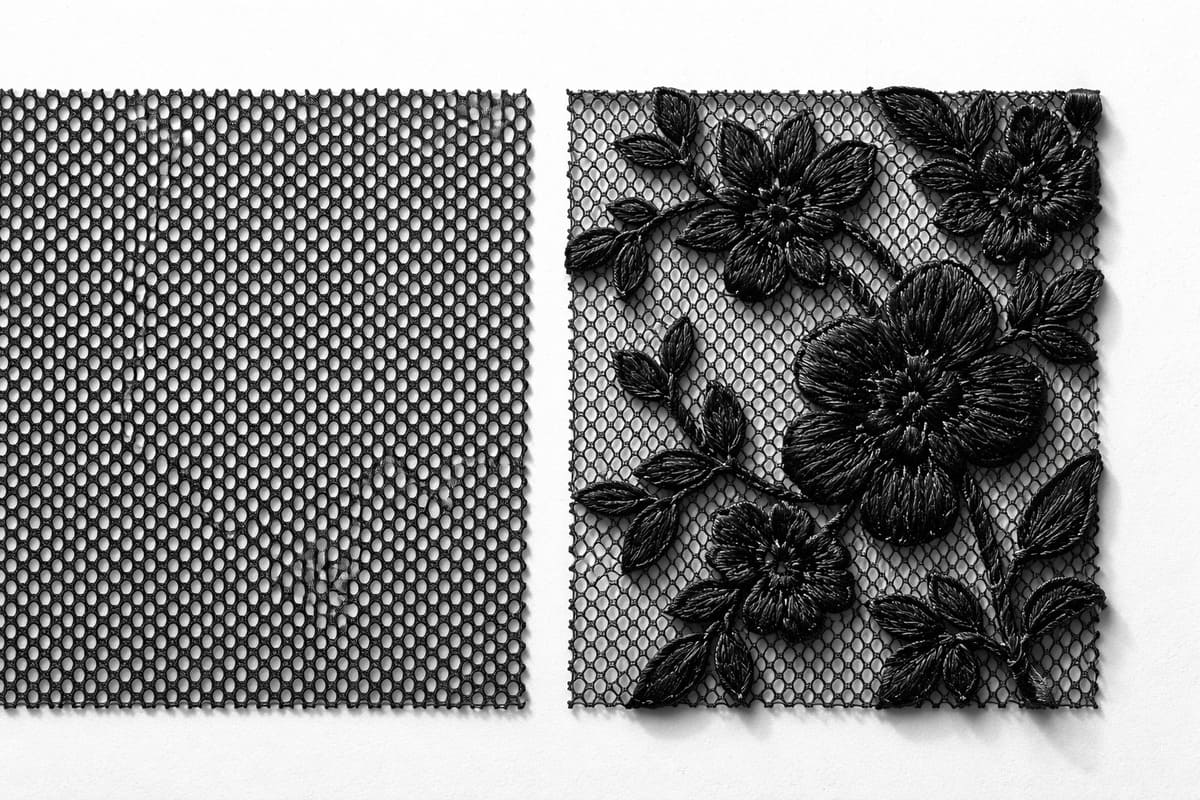
Mesh vs embroidered is less a contest between two fabrics than a before-and-after. Plain mesh is a net with a uniform grid of holes and no decoration. Embroidered lingerie fabric is, in most cases, that same kind of net, or a finer tulle, with a design stitched onto it by machine. The base stays; thread is added. So the practical questions are what the stitching changes about fit, feel and price, and how to spot it in a product listing.
The listing trap
Product titles say "mesh bra" for both. A sheer black bralette with nothing on it and a sheer black bralette covered in stitched flowers can share the same title, the same fiber content and nearly the same photo thumbnail. The fiber line, often something like 85 percent polyamide and 15 percent elastane, describes only the net. Embroidery thread may be a different fiber, and a care label may list it separately or not at all.
Zoom in on the photo instead. If the plain grid continues between and behind the motifs, it is embroidered mesh. If there are no motifs, it is plain mesh. If the motifs sit in a net that changes texture around them, it is lace, which is a separate comparison in lace vs embroidered.
How the design gets onto the net
Industrial embroidery on net descends from the Schiffli machine, which Isaak Gröbli developed in 1863 at Benninger in Uzwil, Switzerland, with practical machines on sale from 1868. It stitches many repeats at once across a wide panel of fabric, using a lock stitch in which a shuttle carries the bobbin thread through loops on the back. Today computer control has replaced the punched cards, but the principle holds, and St. Gallen embroiderers still work in lingerie fabric. Forster Rohner of St. Gallen, for example, sells embroidered allovers on stretch tulle for bra making.
Smaller runs use multi-head embroidery machines that stitch each motif separately. Either way, the result has a front and a back: the face shows the design, the reverse shows bobbin thread and short jumps between motifs.
Mesh vs embroidered: what stitching does to a net
Stretch. Plain lingerie mesh, especially power mesh with 10 to 20 percent elastane, stretches in both directions and snaps back. Stitching pins the net in place wherever thread lies on it. Light, scattered motifs barely matter. Dense allover embroidery can make a stretch net nearly rigid in those areas, which changes how a cup or panel must be cut.
Weight and warmth. Thread adds weight and a little opacity. An embroidered cup covers more than a plain mesh cup of the same base, which some wearers prefer.
Texture. Plain mesh is flat and soft against skin. Embroidered motifs stand proud of the net, and the reverse side can feel scratchy unless the piece is lined or the motifs are placed away from sensitive areas.
Durability. Mesh resists runs. Embroidery adds a new weak point: long surface stitches can catch on a hook or a ring and pull out of the design.
Price. Embroidery is an extra production step on top of making the net, so embroidered fabric costs more than plain mesh of the same base.
Where each earns its place
Plain mesh does structural work. Bra wings, back bands, side panels on briefs, shapewear panels and the bodies of sports bralettes are plain mesh because they need stretch and strength, not decoration. In minimalist lingerie, a clean mesh is also the whole design.
Embroidered mesh is the decorative layer. It is used on cups, front panels, bodysuit fronts and briefs where the pattern is meant to be seen. Because the net between motifs stays sheer, embroidery can place flowers or stars on what looks like bare skin, an effect solid fabric cannot give.
Many pieces use both: embroidered cups with plain power mesh wings, the embroidery for the eye and the mesh for the fit.
A quick check before buying
- Zoom on the photo to see whether the grid runs behind the motifs.
- Read the composition for a separate embroidery thread line.
- Check whether the embroidered area is lined; unlined dense embroidery can scratch.
- On a stretch piece, ask where the embroidery sits. Motifs on the wings will cut into the stretch you need there.
For the difference between a coarse net and a fine one, the base question underneath all of this, see mesh vs tulle. The lock stitch that Gröbli's machine put on sale in 1868 is, in principle, the same stitch holding the flowers on a bralette bought today.
Last updated
Questions
What is embroidered mesh?
Embroidered mesh is, in most cases, a plain lingerie net, or a finer tulle, with a design stitched onto it by machine. The base stays and thread is added on top. Because the net between motifs stays sheer, embroidery can place flowers or stars on what looks like bare skin, an effect solid fabric cannot give.
Does embroidery make a bra less stretchy?
It can. Stitching pins the net in place wherever thread lies on it. Light, scattered motifs barely matter, but dense allover embroidery can make a stretch net nearly rigid in those areas, which changes how a cup or panel has to be cut. Motifs placed on the wings will cut into the stretch needed there.
Why is embroidered lingerie more expensive than plain mesh?
Embroidery is an extra production step on top of making the net, so embroidered fabric costs more than plain mesh of the same base. Industrial embroidery on net descends from the Schiffli machine, developed by Isaak Gröbli in 1863 in Switzerland, which stitches many repeats at once across a wide panel of fabric.
How do I know if a mesh bra is embroidered?
Listings often call both a mesh bra, and the fiber line usually describes only the net. Zoom in on the photo instead. If a plain grid continues between and behind the motifs, it is embroidered mesh. No motifs means plain mesh. If the motifs sit in a net that changes texture around them, it is lace.
Sources
- en.wikipedia.org: Schiffli embroidery machine
- fabricatlas.com: power mesh
- sewingchest.co.uk: linen breeze sparkle multi embroidered allover stretch tulle fabric...
Discussion
Loading...