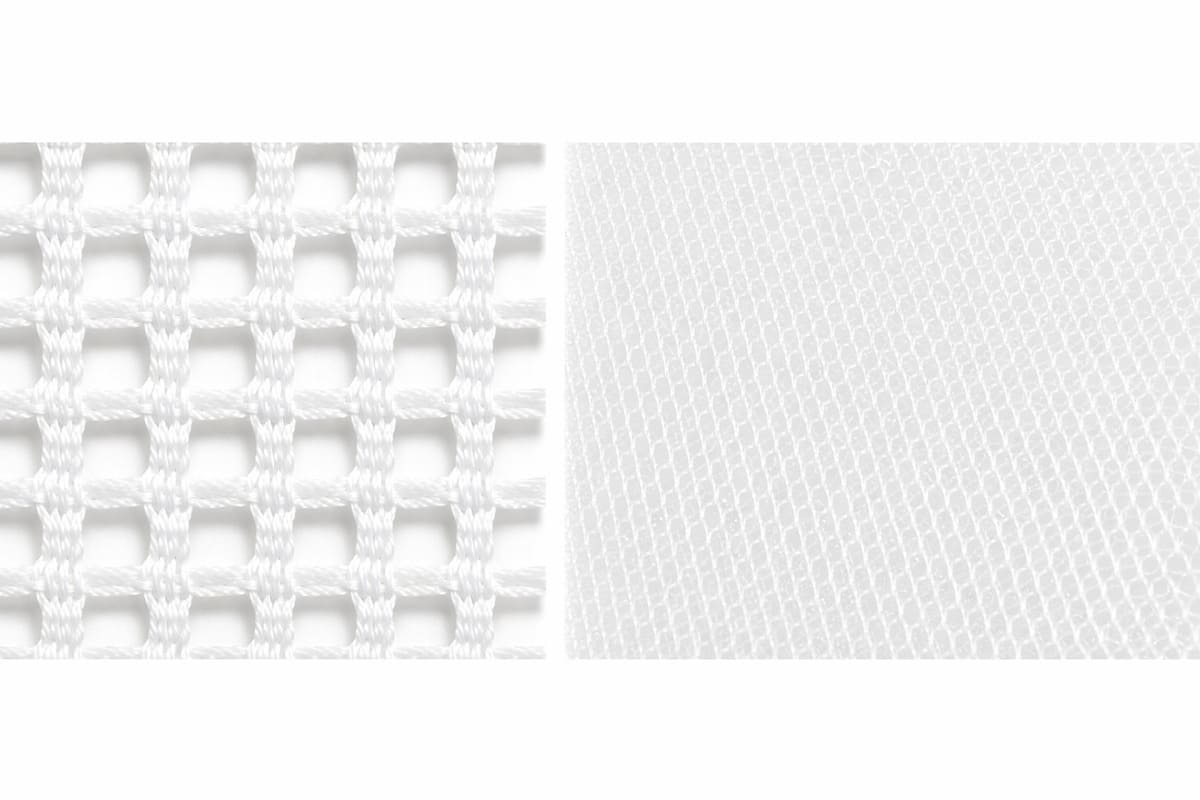
Mesh vs tulle is a question of scale and of job. Both are nets, both are mostly nylon or polyester today, and the line between them is fuzzy enough that suppliers use the words loosely. In lingerie, mesh usually means a sturdier, visibly open net, often with elastane, chosen to hold and ventilate. Tulle means a much finer, lighter net with tiny, regular openings, chosen to look like almost nothing on the skin.
Name, town and machine
Tulle takes its name from Tulle, a town in central France known for lace and silk in the 18th century, where the netting probably originated. Its industrial form came from England. John Heathcoat patented a bobbinet machine in 1808 and an improved version in 1809, and bobbinet, a tulle with a clean hexagonal mesh formed by threads looped diagonally around the warp, became the standard fine net of the 19th century. Machines built to Heathcoat's design still produce bobbinet in Chard, Somerset.
Mesh has no single birthplace. It is a broad trade term for open knitted fabrics, and the kind that matters in lingerie, power mesh, is a warp knit of roughly 80 to 90 percent nylon and 10 to 20 percent elastane, made on Raschel machines.
Why hole shape is a weak test
A common rule of thumb says mesh has square or diamond holes and tulle has hexagons. Classic bobbinet is hexagonal, so the rule has a basis. In practice, many knitted lingerie meshes have hexagonal or rounded openings too, and plenty of fabrics sold as tulle are warp knits rather than true bobbinet. Hole shape will mislead about as often as it helps.
Better tests, in order of reliability:
- Hole size. At reading distance, mesh holes are easy to pick out one by one. Tulle holes blur into an even veil, and you need to look closely or use a phone camera zoom to see the structure.
- Weight in the hand. Tulle is feather-light and drifts when dropped. Most lingerie mesh, power mesh above all, has noticeable body and falls straight down.
- Recovery. Stretch a corner and let go. Power mesh snaps back hard. Rigid tulle barely moves, and stretch tulle gives gently without that firm pull.
- Purpose on the garment. If it sits on a bra wing or a shapewear panel, it is almost certainly mesh. If it sits on an upper cup, a sheer overlay or as the ground for embroidery, it is probably tulle.
Stretch tulle muddies the picture
Older guides call tulle stiff and stretchless. That is true of traditional bridal tulle and of the rigid nylon "bra tulle" that bra makers use as a sheer cup lining to stop a cup from growing. It is not true of stretch tulle, a fine net that commonly contains 18 to 20 percent elastane and is now a standard lingerie fabric. Bra makers use it for upper cups, or to cover molded foam cups, though for a cup that must hold its shape it is usually backed with a stable lining.
So the real difference is not "stretchy mesh, rigid tulle". It is coarse and strong versus fine and light, with stretch available in both.
Mesh vs tulle inside one bra
Picture a plunge bra in black. The upper cup may be stretch tulle, so it lies flat against the breast with only a smoky tint. The lower cup may be lined with rigid bra tulle for support you never see. The wings will be power mesh, because they carry the tension of the band. Three nets, three jobs, and the swing tag may call all of them "mesh".
Durability
Fine tulle snags more easily than heavier mesh, and a snag in tulle can open into a visible hole. Power mesh resists runs well because warp knits lock their loops. Neither fabric likes hooks and Velcro in the same wash, which is why a laundry bag earns its keep with sheer lingerie.
Comfort
Both breathe well, since much of each fabric is air. The more noticeable difference is hand feel. Some nylon tulle feels slightly crisp or papery on bare skin, while soft mesh feels closer to a fine knit. Quality varies far more than the fabric category, so the hand test beats any rule.
Where they meet other fabrics
Tulle is the favorite ground for embroidery, where the base must nearly vanish so the motifs appear to float. Swiss embroiderer Forster Rohner of St. Gallen, for instance, sells multi-colored embroidered allovers on stretch tulle for bra making. For that comparison see mesh vs embroidered, and for the other sheer pairing that confuses buyers, tulle vs chiffon, where one fabric is a net and the other is not a net at all.
Last updated
Questions
Is tulle the same as mesh?
Not quite, though suppliers use the words loosely. Both are nets, mostly nylon or polyester. In lingerie, mesh usually means a sturdier net with openings you can see, often with elastane, used to hold and ventilate. Tulle is a much finer, lighter net with tiny regular holes, chosen because it looks like almost nothing on the skin.
Do tulle holes have to be hexagonal?
No. Classic bobbinet tulle has a hexagonal net, which is where the rule of thumb comes from, but many knitted lingerie meshes have hexagonal or rounded openings too, and plenty of fabric sold as tulle is a warp knit rather than true bobbinet. Hole size, weight in the hand and how hard the fabric snaps back are more reliable tests.
Is tulle stretchy?
It depends on the type. Traditional bridal tulle and the rigid nylon bra tulle used as a sheer cup lining barely move. Stretch tulle, a fine net that commonly contains 18 to 20 percent elastane, is now a standard lingerie fabric for upper cups and for covering molded foam cups, usually backed with a stable lining where the cup must hold its shape.
Does tulle rip easily?
Fine tulle snags more easily than heavier mesh, and a snag in tulle can open into a visible hole. Power mesh resists runs well because warp knits lock their loops. Neither fabric likes hooks and Velcro in the same wash, so a laundry bag is worth using for any sheer lingerie made from either net.
Where did the name tulle come from?
Tulle is named after the town of Tulle in central France, known for lace and silk in the 18th century and the probable birthplace of the netting. Its industrial form came from England, where John Heathcoat patented a bobbinet machine in 1808. Machines built to his design still produce bobbinet in Chard, Somerset.
Sources
- en.wikipedia.org: Tulle (netting)
- en.wikipedia.org: Bobbinet
- fabricatlas.com: power mesh
- braandcorsetsupplies.com: fm 38164 adore dot stretch tulle fabric
- stephieslingerie.com: bra tulle 12 yard black white
- sewingchest.co.uk: linen breeze sparkle multi embroidered allover stretch tulle fabric...
Discussion
Loading...