The Short Answer
Both are full-coverage bras that cover the entire breast. A full cup lifts and supports while maintaining the breast's natural projection. A minimizer actively redistributes breast tissue to reduce projection — making the bust appear up to an inch smaller from front to back. Same coverage area, opposite shape philosophy.
Construction Side by Side
| Feature | Full Cup | Minimizer |
|---|---|---|
| Coverage | Full | Full |
| Cup construction | Multi-panel, supportive | Multi-panel, redistributive |
| Projection | Maintains or enhances | Reduces by 1"+ |
| Cup shape | Rounded, projected | Flattened, spread wider |
| Panel engineering | Lifts up and forward | Spreads inward and upward |
| Target wearer | D+ wanting support | D+ wanting a smaller profile |
How to Tell Them Apart
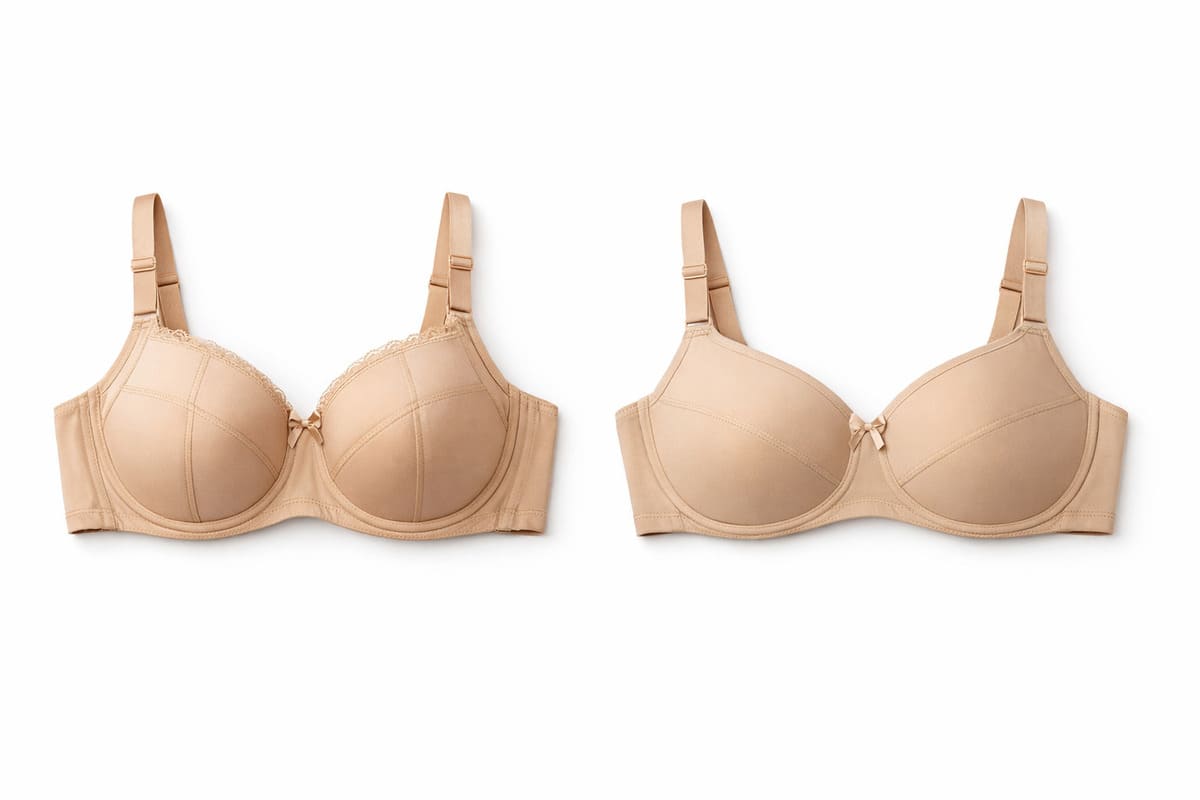
Put them on (or look at them on a mannequin form). The full cup creates a projected, rounded shape — the breast extends forward from the chest. The minimizer creates a flatter, wider shape — the breast is spread out rather than projected. In a button-down shirt, the full cup may cause gapping between buttons; the minimizer won't.
From the outside, look at the cup seaming. Minimizers typically have a distinctive diagonal seam across the cup that actively redirects tissue, while full cups have vertical and horizontal seams designed for lift.
When to Wear Each
Full cup: When you want to embrace your natural bust shape with maximum support. The workhorse for D+ cup sizes in everyday wear.
Minimizer: Under button-down shirts, professional blazers, and fitted jackets where bust projection causes gapping or an unbalanced silhouette. Also chosen by wearers who simply prefer a lower-profile look.
The Comfort Question
Neither is inherently more comfortable than the other — both are full-coverage underwire bras. The difference is purely about shape. Some wearers find minimizers slightly less comfortable because the redistribution can feel unnatural at first, but most adjust within a few wears.