The Short Answer
A push-up bra uses angled padding to lift breast tissue upward and inward, creating more cleavage. A plunge bra has a deep V-shaped center gore that dips low between the cups, designed to hide under low-cut necklines. They solve different problems — the push-up is about shape enhancement, the plunge is about neckline compatibility.
Construction Side by Side
| Feature | Push-Up | Plunge |
|---|---|---|
| Center gore | Standard height, narrow | Deep V or U shape, dips low |
| Padding | Asymmetric — thick at bottom/outer, thin at top | Optional — can be padded or unpadded |
| Primary purpose | Lift + cleavage creation | Low-neckline compatibility |
| Cup angle | Cups pushed together | Cups angled inward toward gore |
| Strap placement | Wide-set | Slightly outward |
| Underwire | Always | Almost always |
How to Tell Them Apart
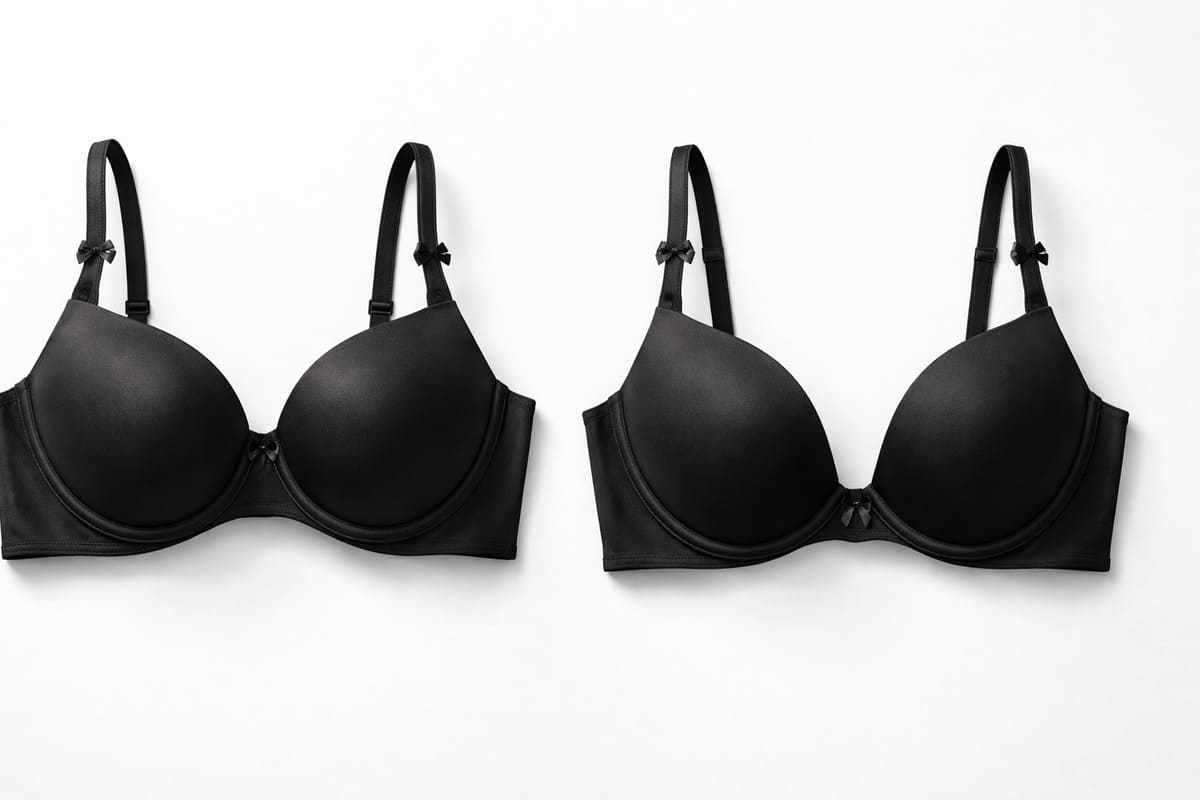
Look at the center gore — the bridge of fabric between the cups. If the gore is a normal height but the cups have visible angled padding (thicker at the bottom-outside, thinner at the top), it's a push-up. If the gore dips into a deep V well below the cup tops, it's a plunge — regardless of whether it has padding.
Many bras are both: a push-up plunge combines the low gore with angled padding. When a bra is labeled "push-up plunge," the plunge describes the neckline and the push-up describes the padding.
When to Wear Each
Push-up: When you want more cleavage and a fuller look under any neckline — crew necks, scoop necks, button-downs. The lift is the point, not the neckline depth.
Plunge: Under wrap dresses, deep V-necks, and anything where a standard bra would peek out at the center. You need the gore to sit lower than the garment's neckline.
History
Wonderbra patented the original push-up in 1964 in Canada, but it didn't explode until the 1994 "Hello Boys" campaign in the UK made it a cultural phenomenon. The plunge silhouette emerged more quietly in European lingerie houses during the 1980s as wrap and V-neck fashion demanded a bra that stayed hidden.