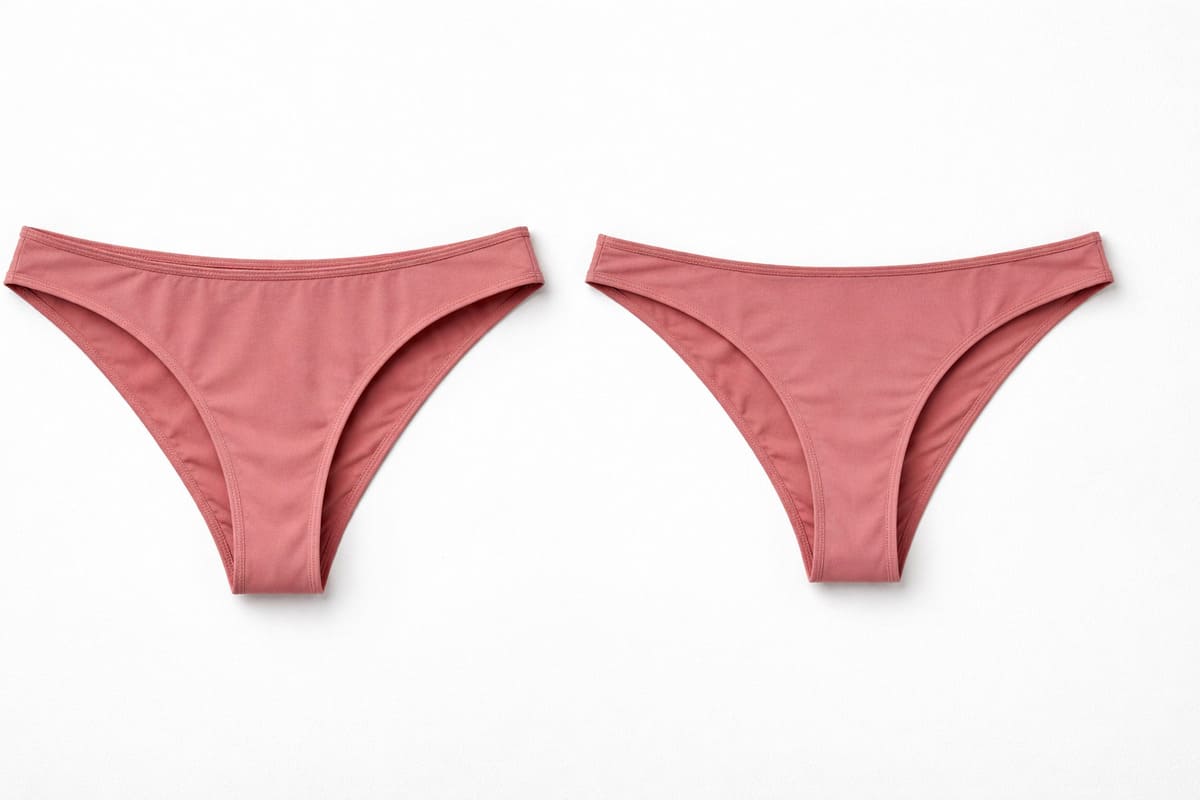
Tanga vs Brazilian is the closest call in the whole panty taxonomy, and an honest answer starts with an admission: the lingerie trade has no agreed standard for either name. Both sit between a thong and a bikini brief. In the way this encyclopedia classifies them, a tanga has high-cut, narrow sides and a back that covers only part of the seat, while a Brazilian pares the sides down even further, often to a band at the hip bone, and gives back some rear coverage in exchange.
Put simply: the tanga saves fabric at the back, the Brazilian saves it at the sides.
Why two names for one neighborhood
Brands use whichever word suits their market. A French or Spanish shopper hears "tanga" and thinks thong. A British shopper hears it and expects a small brief. "Brazilian" carries the glamour of Rio beachwear and appears on everything from string-sided swim bottoms to fairly modest everyday briefs. Wikipedia's panty glossary groups the two together as "an intermediate step between thongs, which have minimal rear coverage, and bikinis", which is about as far as any neutral source will go.
Lay ten tangas and ten Brazilians from different labels on a table and several will swap sides without anyone noticing. That is the market as it is, not a failure of the shopper.
The measurements that separate them
When a garment has to go in one box or the other, we look at three dimensions, in this order.
| Measurement | Tanga | Brazilian |
|---|---|---|
| Side height at the hip | Narrow, but still a fabric panel | Very narrow, sometimes a single band or strap |
| Rear coverage | Partial, upper seat covered | Moderate, a little more than a tanga |
| Rise at the front | Low to mid | Low to mid |
| Back shape | Small trapezoid or rounded triangle | Wider back, often cut in a V or gathered at the center seam |
| Typical home | Everyday lingerie | Swimwear crossover and lingerie |
The side height is the most reliable single check. If the hip is reduced to something you could call a strap, the piece reads as a Brazilian. If there is a recognizable fabric panel at the hip, however slim, it reads as a tanga.
The center-back seam
Many Brazilian-labeled briefs carry a seam or ruched gather down the center back that pulls the fabric slightly inward. This shapes the seat and gives the cut its lifted look. Tangas more often have a flat, unseamed back panel. It is a tendency rather than a rule, but it helps when side widths are similar.
Where the Brazilian name came from
The Brazilian brief borrows its name from beachwear. Brazilian beach style of the 1970s and 1980s favored smaller, higher-cut bikini bottoms, and Soul Brasil magazine notes that the high-cut bottom became known internationally as the "Brazilian bottom". By the late 1980s, the same source says, minimalism reached its peak with the fio dental, the "dental floss" bikini.
Lingerie brands took the name and the high leg, then softened the back for clothes that would be worn under a skirt rather than on sand. The tanga's word came through Portuguese too, but its English-language meaning settled on the small brief with narrow sides. For the history of that word and its very different meaning in Spain and France, see our thong vs tanga comparison.
How each one wears
The differences that matter most on the body are small but real.
At the hip. A Brazilian's narrow band sits on the hip bone and creates a long leg line, which is why the cut works so well in swimwear. On softer hips, a very thin band can dig in and create a bulge above it. A tanga's wider side panel spreads that pressure.
At the back. The Brazilian's slightly larger back and center seam tend to stay in place better when walking. A tanga's smaller back can travel inward during the day, which some wearers like and others do not.
Under clothes. Both leave a short line across the seat, and both lines disappear under denim. Under fine jersey or satin, the edge finish decides more than the cut. A bonded or laser-cut edge hides; a folded elastic edge shows.
Buying advice that survives the labels
Shop by photograph, not by name. Look at the hip from the side and the back from behind. Read the fabric content: a Brazilian in stretch lace with a scalloped edge behaves very differently from one in smooth microfiber.
Then check the size guide carefully. Brazilian and tanga styles with narrow sides are less forgiving of sizing errors, because there is so little fabric at the hip to absorb a difference. If you are between sizes, the larger one usually solves both the dig and the creep.
The overlap is also why our records keep both names. Brands label them differently, people search for both, and the side construction difference holds up when you lay the garments flat.
Last updated
Questions
Is a Brazilian cut the same as a tanga?
Not quite, though the trade has no agreed standard for either name and brands often swap them. Both sit between a thong and a bikini brief. A tanga saves fabric at the back and keeps a slim fabric panel at the hip. A Brazilian pares the sides down even further, often to a band at the hip bone, and gives back a little rear coverage.
Why are Brazilian panties called Brazilian?
The name comes from beachwear. Brazilian beach style of the 1970s and 1980s favored smaller, higher-cut bikini bottoms, and that high-cut bottom became known internationally as the Brazilian bottom. Lingerie brands borrowed the name and the high leg, then softened the back so the garment could be worn all day under a skirt instead of on the sand.
Do Brazilian panties dig into your hips?
They can. A Brazilian's narrow band sits on the hip bone, which creates a long leg line but can dig in on softer hips and push up a small bulge above it. A tanga's wider side panel spreads the pressure more evenly. With either cut, if you are between sizes, the larger size usually solves both the digging and the creeping.
Which stays in place better, a tanga or a Brazilian?
The Brazilian usually does. Its slightly larger back panel, often shaped by a center-back seam or ruched gather, tends to hold its position when walking. A tanga's smaller, flatter back can travel inward over the course of a day. Some wearers like that and others do not, so it depends on what you find comfortable.
Sources
- en.wikipedia.org: Panties
- en.wiktionary.org: tanga
- soulbrasil.com: bikini over 70 years of revolution and sensuality
Discussion
Loading...