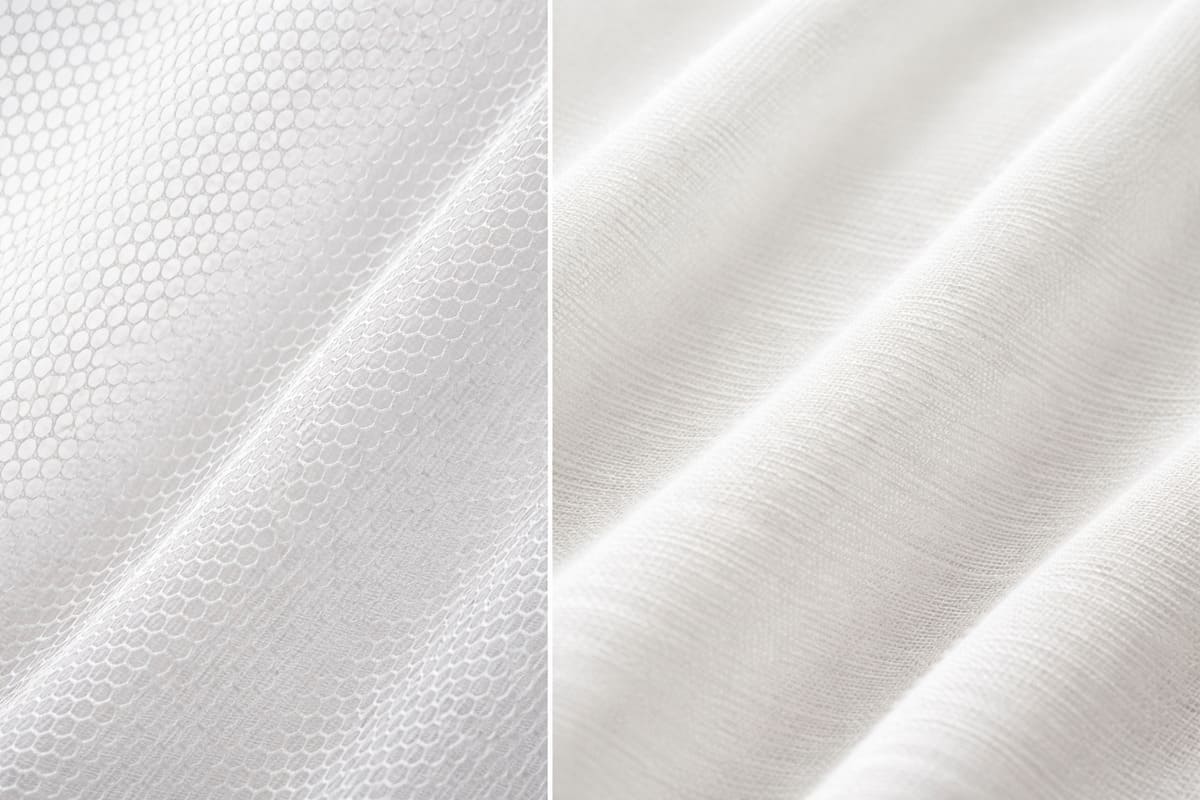
The Short Answer
Tulle is a net fabric — it has hexagonal holes between the threads, like an ultra-fine screen. Chiffon is a woven fabric — the threads are packed tightly together with no intentional holes, but the yarns are so thin and twisted that light still passes through. Tulle is transparent because of holes. Chiffon is transparent because of thin threads.
Fabric Properties Side by Side
| Property | Tulle | Chiffon |
|---|---|---|
| Structure | Hexagonal net (open holes) | Plain weave (no holes, twisted yarns) |
| Why it's sheer | Holes between threads | Threads are too thin to block light |
| Texture | Slightly stiff, crisp | Soft, slightly crinkled (crepe) |
| Body | Holds shape, can puff out | No body — drapes and clings |
| Weight | Ultra-light | Ultra-light |
| Stretch | None | None |
| Transparency | Very high — nearly transparent | High — sheer but not fully transparent |
| Feel | Slightly scratchy or papery | Soft, slightly rough (crepe twist) |
How to Tell Them Apart: The Visual Test
Hold the fabric up to a window or lamp and look through it.
- Tulle: you'll see a visible pattern of tiny holes — a honeycomb or hexagonal grid. The fabric looks like a screen or net, just extremely fine.
- Chiffon: no holes. The fabric is uniformly translucent, like frosted glass. Light passes through evenly without a grid pattern.
The touch test: tulle feels slightly stiff and crisp — it holds its shape when you scrunch it. Chiffon feels soft and collapses immediately when released.
Common in Lingerie
Tulle is the base fabric for embroidered lingerie. When you see delicate floral motifs that look like they're floating on skin, the invisible base beneath them is usually tulle. It also appears as sheer overlays on bra cups, inserts in panties, and throughout bridal lingerie. Tulle's slight stiffness gives structure without weight.
Chiffon is used for flowing, romantic pieces. Sheer chiffon panels on babydolls create movement. Chiffon robes and peignoirs have a liquid drape that tulle cannot achieve. Chiffon sleeves on bridal chemises float away from the body.
The design distinction: tulle creates structure (it can puff, layer, and hold shape), while chiffon creates flow (it drapes, clings, and moves with the body).