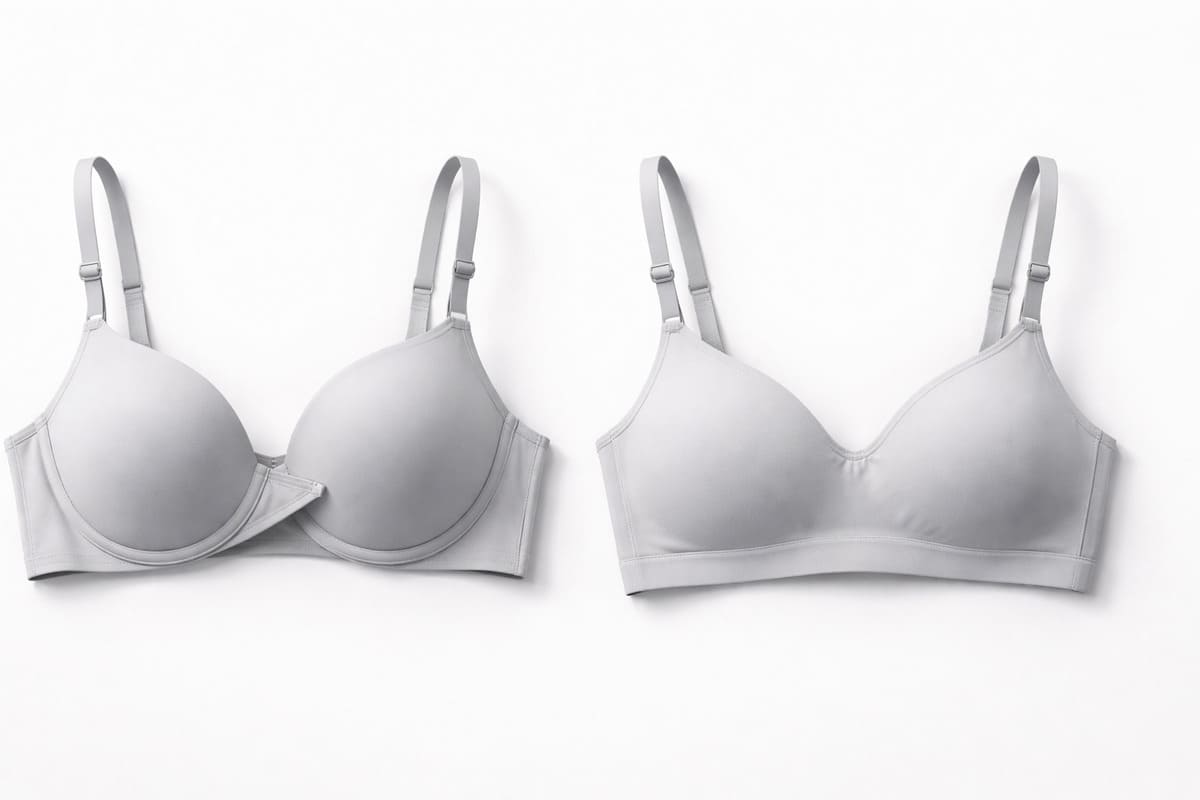
The Short Answer
An underwire bra has a curved wire (metal, plastic, or resin) sewn into a channel at the base of each cup, providing rigid support and defined lift. A wireless bra achieves its cup shape through fabric alone — molded foam, seamed panels, or reinforced elastic. The wire is the single structural difference that changes everything about fit, support, and comfort.
Construction Side by Side
| Feature | Underwire | Wireless |
|---|---|---|
| Support mechanism | Rigid curved wire under each cup | Fabric, foam, or seamed panels |
| Lift | Definite lift and separation | Gentle shaping, less lift |
| Cup definition | Sharp, defined cup shape | Softer, more natural shape |
| Comfort | Can dig if sized wrong | Generally more comfortable |
| Best for | C cup and above, formal wear | A–C cups, casual wear, recovery |
| Durability | Wire can warp or poke through | No wire to break |
How to Tell Them Apart
Run your finger along the bottom edge of the cup. If you feel a rigid curved element under the fabric — it's underwire. If the bottom edge is soft and flexible — it's wireless. You can also flex the cup: an underwire bra resists bending at the base, a wireless bra flexes freely.
The Comfort vs Support Tradeoff
This is the central tension in bra design. Underwire provides more lift and a more defined shape, but it's a rigid element pressing against your ribcage all day. Wireless is more comfortable, but for larger cup sizes (D+), it may not provide enough lift to prevent shoulder strain from the weight.
Modern wireless engineering has closed this gap significantly. Brands like ThirdLove, True & Co, and Knix have built wireless bras with enough panel engineering to support D and DD cups — something that seemed impossible ten years ago.
When to Wear Each
Underwire: Professional settings, formal wear, fitted tops, anytime you need a defined silhouette. The default for C+ cup sizes.
Wireless: Weekends, work-from-home, travel, post-surgery recovery, sleeping. Increasingly worn daily by A–C wearers who prioritize comfort.
History
Underwire first appeared in the 1930s but didn't become standard until the 1950s when metal supply was no longer rationed (WWII had diverted wire to the war effort). The wireless movement gained momentum in the 2010s as athleisure blurred the line between loungewear and daywear.