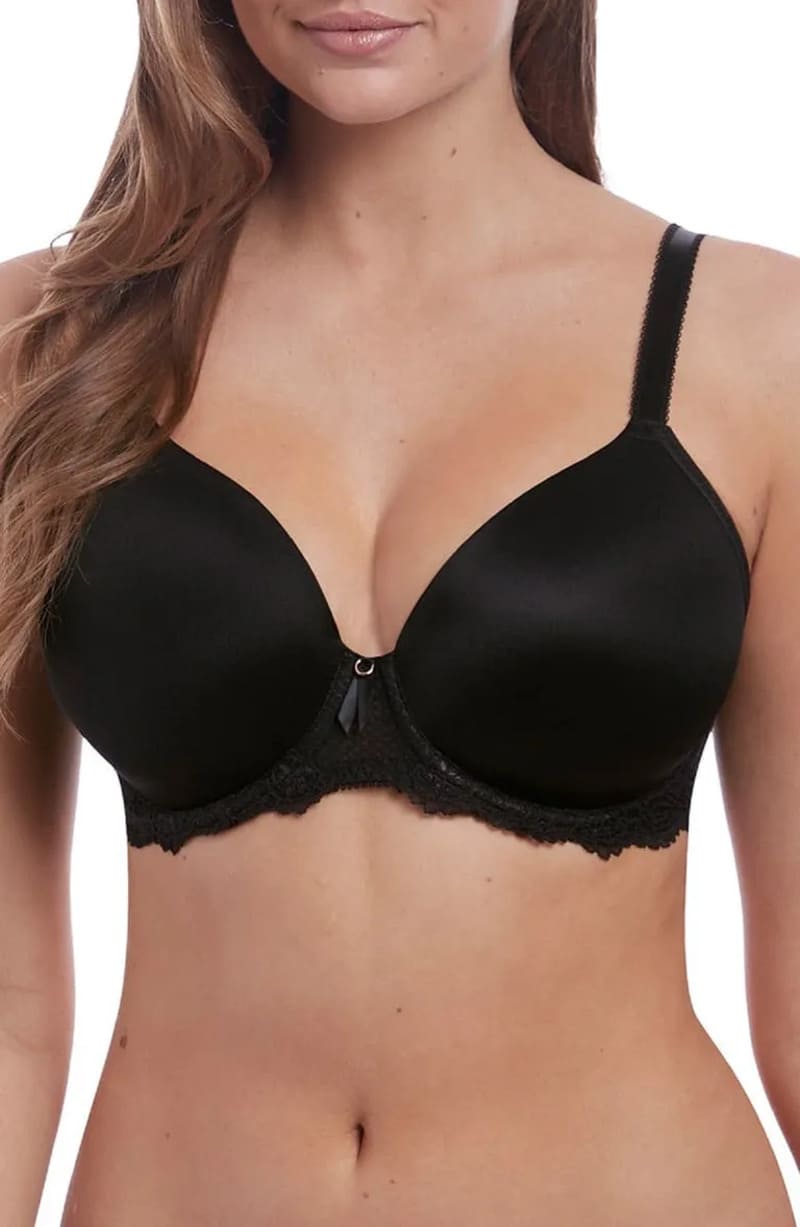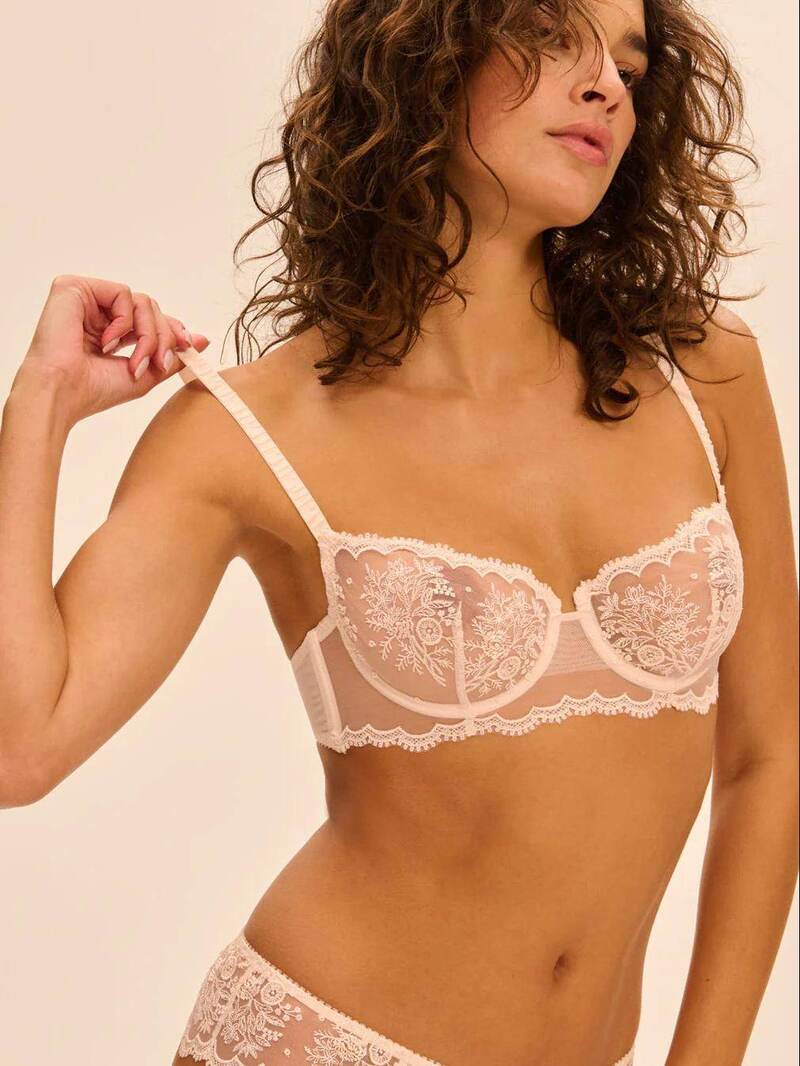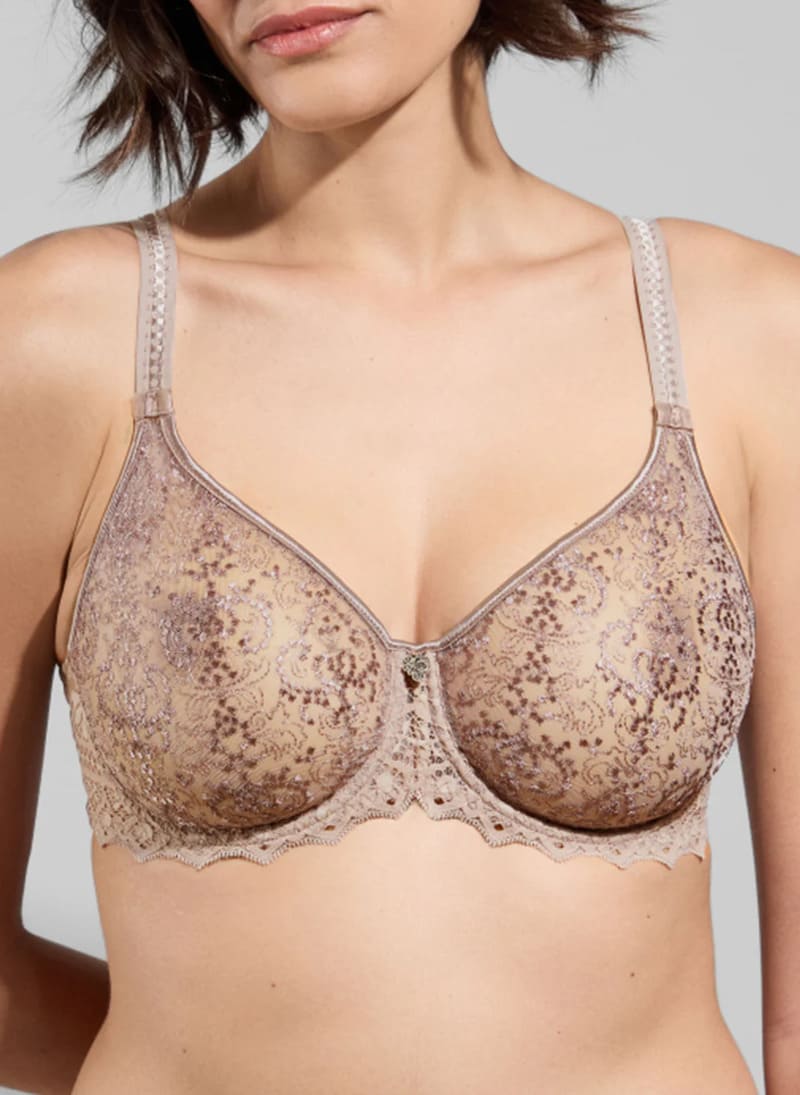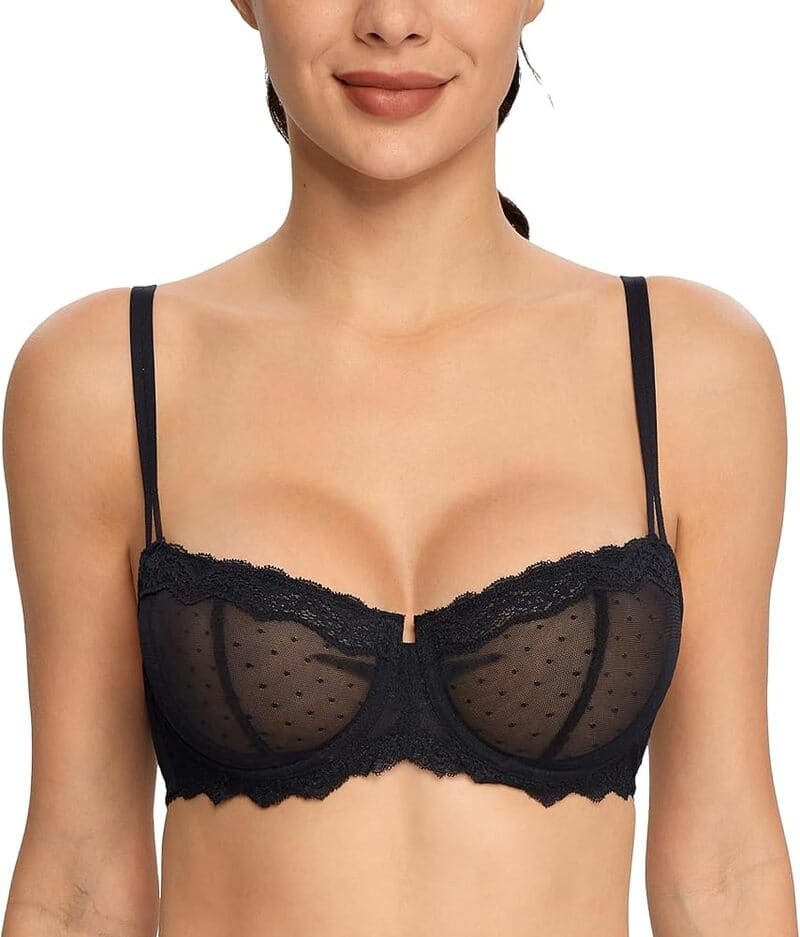
The balconette, also sold as the balcony bra, is named for the shelf it makes. The top edge of the cup runs nearly straight across the breast instead of curving over it, and the straps attach at the outer corners of the cups. The result is a wide, square neckline and a lift that pushes upward rather than inward.
Most balconettes are underwired with seamed cups, a horizontal or vertical seam dividing the cup into panels to give the upright shape, though molded and padded versions are common. The style suits wearers with full upper breast tissue, and it sits well under square, sweetheart and boat necklines where a plunge's straps would show. On shallow or bottom-heavy shapes it can gape, because the top of the cup has nothing to fill it.
The cut is usually dated to the late 1930s, but it became fashionable in the 1950s, the decade of strapless gowns, wide necklines and the lifted bust. It has stayed in production ever since, from full-bust specialists to fashion lace sets.
The demi cup is the most common mix-up. Both are cut low, but the demi's top edge is rounded and its straps sit closer to the middle of the cup. A full cup covers far more of the breast. A plunge reverses the geometry, with straps closer together and a V at the center instead of a straight line.
How to Identify
- Upper cup edge runs nearly straight across, not curved
- Straps attach at the outermost corners of the cups
- Square, wide neckline seen from the front
- Cups cover roughly half to two-thirds of the breast
- Often a horizontal or vertical seam dividing each cup
- Low, short center gore
Buy a balconette for the neckline it solves, then check that your shape can fill it. The cup stops at roughly nipple level, so everything depends on how much tissue sits in the upper half of the breast. When that part is full, the straight top edge lies flat and the lift looks natural. When it is empty, no amount of strap tightening fixes the gap.
The shelf test: whose shape fills a straight cup
Put the bra on, lean forward, scoop each breast into the cup from the side, then stand up straight and look at the top edge in a mirror.
- Flat against the skin, no gap: the cut suits you. Round shapes and breasts that are full on top usually pass.
- A gap of more than a fingertip, about 0.4 in (1 cm): the cup is too big or your breasts are fuller at the bottom. Try a smaller cup, or move to a plunge bra, whose angled edge follows a bottom-heavy or shallow shape better.
- A ridge where the edge cuts in: the cup is too small. Go up a cup and keep the band.
ThirdLove's guide puts the balconette's sweet spot at fuller busts, and that matches what fitters see in practice: a D cup and up has more upper tissue to fill the shelf. Small busts can wear one, usually in a lightly padded version where the foam does the filling.
Where band, wire and strap should land
The band does most of the work. It should run level from front to back and feel snug on the loosest hook when new, so you can tighten it as the elastic relaxes. Two fingers should slide under it at the back, not a whole hand.
The wire should sit on the ribcage behind the breast tissue at the side, never on the breast itself. If it presses into the side of the breast, the cup is too small even if the front looks fine.
Straps are the common complaint. Because they attach at the outer corners of the cup, they slide off narrow or sloping shoulders. Shorten them first. If they still slip, look for a balconette with straps set a little further in, or convert them to a crossback if the bra has a J-hook.
Square, sweetheart and off-shoulder: what to wear over it
The straight top edge and wide straps hide under any neckline that is cut across the chest: square, sweetheart, boat, wide scoop and corset-style tops. It is also the usual answer for a fitted bodice that would show a full cup above the neckline.
Skip it under a deep V. The gore is low but wide, and it shows at the base of a plunging neckline. Under thin, close T-shirts a seamed balconette also prints its cup seams; a molded version, or one in smooth stretch lace on the top cup, reads cleaner. The site's balconette vs demi cup exhibit covers the neckline overlap between the two cuts.
Full-bust balconettes worth trying
The style is a staple of full-bust specialists because seamed cups can be engineered for depth. Panache cuts balcony bras deep into its range: its Eden balcony runs into the M cups, and the Allure demi balcony starts at a 28 band, which matters for small backs with large cups.
At these sizes look for three-part seamed cups, a side support panel and a firm, non-stretch lining in the lower cup. Stretch lace across the top cup helps if your size shifts through the month; rigid lace and embroidered tulle look sharper but forgive less.
Washing and storing a seamed cup
Hand wash in cool water with a mild detergent and press the water out in a towel rather than wringing. Dry flat or hang from the center gore, never from the straps, which stretches them. Seamed cups can be folded; molded ones should be stored nested, one cup inside the other, so the foam keeps its curve. Rotating two or three bras and giving each a day off lets the elastic recover between wears.
Shop
See balconette styles on AmazonAs an Amazon Associate we earn from qualifying purchases. It does not change what we write.
Sources
- thirdlove.com: balconette bra vs demi bra whats the difference which is right for me
- en.wikipedia.org: List of bra designs
- en.wikipedia.org: Balconet
- brafinder.com: elomi vs panache
Last updated