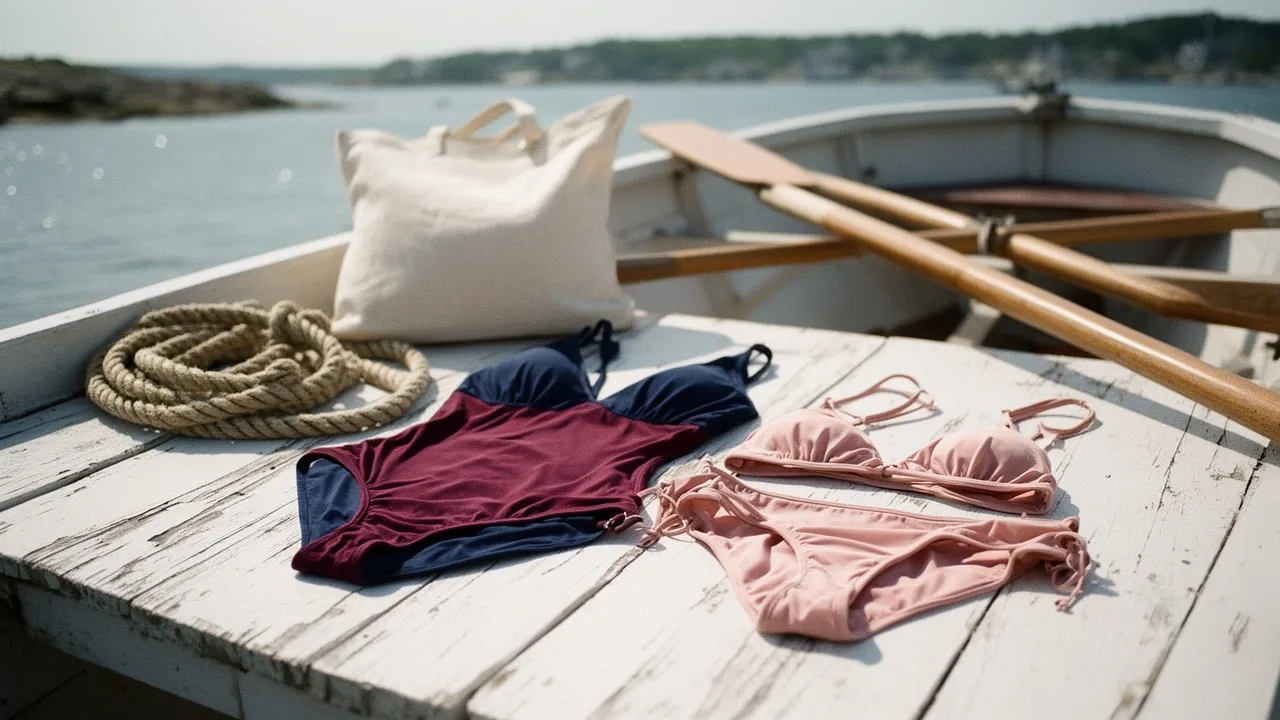
J.Crew is an American clothing retailer headquartered in New York City, founded in 1947 as Popular Merchandise, Inc. by Mitchell Cinader and Saul Charles and renamed J.Crew in 1983. It sells preppy, classic American clothes through catalogs, stores and its website, and its swimwear, sold as separate bikini tops and bottoms and as one-pieces, is the part of the business that brings it into this encyclopedia. J.Crew has never been a lingerie house. Its swim range is its closest approach to intimates.
From Popular Merchandise to a rowing name
Popular Merchandise began as a budget mail-order company selling inexpensive women's clothing through in-home sales. For more than three decades it was a modest business in a crowded market. The change came in 1983, when the Cinader family relaunched it under a new name. "Crew" came from the sport of rowing, with its East Coast college associations, and the "J" was added because it looked good on the page.
The name was a piece of positioning. Rowing suggested Ivy League campuses, boathouses and old money without the price of actual old-money tailoring. Everything J.Crew sold afterward, from rollneck sweaters to chinos to swimsuits, leaned on that picture.
The catalog years
The 1980s were J.Crew's catalog decade. Annual sales rose from about $3 million to more than $100 million within five years, as the company mailed its catalogs to a steadily wider list. The catalog was the product as much as the clothes were. It photographed models on beaches, docks and porches, and it sold an idea of a summer house in New England to readers across the country.
Swimwear fitted that picture well. A catalog built on beach photography needs things to wear on the beach, and the J.Crew swimsuit, plain, well cut and sold in a run of solid colors, became a dependable mail-order item.
The company opened its first retail store in March 1989 at South Street Seaport in Manhattan. Stores followed across the country, and over time the group grew to more than 500 locations across its brands.
J.Crew owners: from the Cinaders to the lenders
The Cinader family controlled J.Crew until October 1997, when the private equity firm Texas Pacific Group bought a majority stake. The company went public in 2006. In 2011 TPG Capital and Leonard Green & Partners took it private again in a buyout valued at about $3 billion, a deal that loaded the business with debt.
In between, J.Crew had its most visible period. Mickey Drexler, the former head of Gap, became chief executive in 2003 and stayed until 2017. Jenna Lyons rose to creative director and became, unusually for a retail executive, a fashion figure in her own right; she left in 2017, as did menswear head Frank Muytjens. The company bought the denim label Madewell in 2004 and built it into a separate chain, and it ran J.Crew Factory outlets and the children's line crewcuts alongside the main brand.
The debt caught up with it. On May 4, 2020, J.Crew filed for Chapter 11 bankruptcy protection, pointing to pandemic store closures on top of its existing borrowing. It was one of the first major American retailers to fail in the pandemic. It emerged from bankruptcy in September 2020, with Anchorage Capital Group and Leonard Green & Partners as owners. Its headquarters are at 225 Liberty Street in Manhattan, and its chief executive is Libby Wadle.
The swim range today
On its current site, J.Crew sells women's swimwear as mix-and-match separates and one-pieces, with cover-ups and beach shorts alongside. The range is large for a non-swim brand, close to 90 styles in one recent listing. Bikini tops include a string triangle, a cut close to the lingerie triangle bra, and the one-pieces include a ruched bandeau style. One-pieces come in classic and long-torso fits, a sizing detail more common at swim specialists than at general retailers.
The company also runs a line it calls Classic Sculpt, used across both bikinis and one-pieces and pitched on shaping and support. It is a reminder that swimwear borrows its engineering from the bra and the girdle: shaping panels, power-mesh linings and molded cups all came to the beach from the lingerie trade. The site also promotes a swimsuit take-back program, Recycle Swim & Earn.
For readers who want the intimates comparison, J.Crew's swim bottoms sit in the same families as underwear: compare the bikini bottom with its underwear cousin, the bikini brief; the two differ more in fabric and lining than in shape.
What J.Crew means for this archive
J.Crew matters here less for any single garment than for the way it sold them. Its catalog turned a small range of plain swimsuits into part of a lifestyle, and it did it with photography rather than with fashion shows. Since the 2020 bankruptcy the brand has been owned by its former creditors, and swimwear remains one of the steady categories in a store built on staples.
Last updated
Sources
- en.wikipedia.org: J.Crew
- jcrew.com
- jcrew.com: swimwear
Collections (1)
Members
How J.Crew fits
Loading member reviews...
24 products in our archive
Use our Lingerie Identifier to find matching pieces