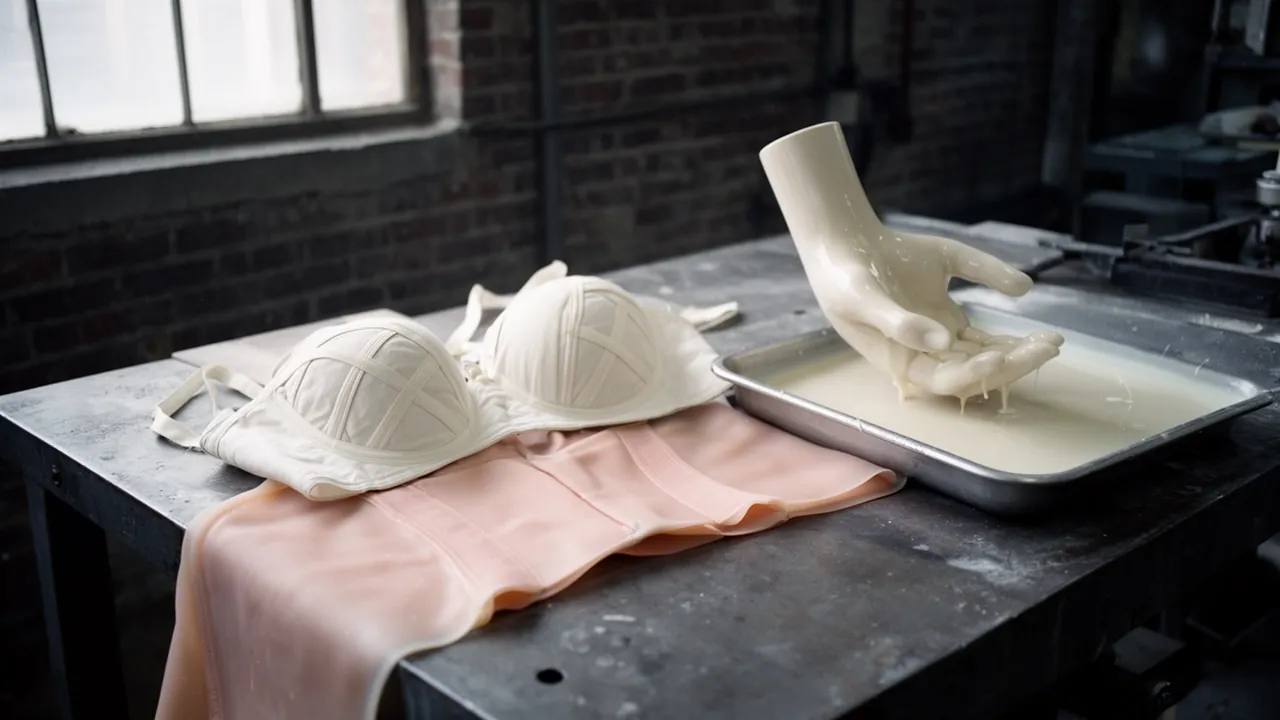
Playtex is an American bra and shapewear brand that grew out of the International Latex Corporation, a rubber goods company Abram Nathaniel Spanel started in Rochester, New York, in 1932. The Playtex name itself dates from 1947. Over the following decades it gave the mass market the latex girdle, the lifts-and-separates crisscross bra and the first underwear commercials on network television, and its apparel business is now part of Hanesbrands, which Gildan Activewear bought in 2025.
Spanel's latex company in Rochester and Dover
Spanel's International Latex Corporation, usually shortened to ILC, began with dipped latex goods: bathing caps, swimwear and baby pants. In 1939 the company moved to Dover, Delaware, where Wikipedia records it as the first large non-agricultural business in the city.
Liquid latex could be formed over a shaped mold into a seamless sheath, and ILC saw that the same process could make a girdle. In 1940 the company introduced the Living Girdle, protected by a patent on a manufacturing method that kept a latex girdle from splitting along its seams if it developed a small tear or hole. The advertising showed women stretching and moving freely. The garment itself was solid rubber and, by most accounts, uncomfortable to wear. Comfort was not yet the selling point; a smooth sheath that would not split at the seams was.
Play plus latex: the 1947 reorganization
In 1947 ILC reorganized into four divisions, and one of them was called Playtex, a portmanteau of "play" and "latex." The name carried the advertising promise of the girdle: foundation wear a woman could move in. Over time the division's name became the company's public face and outlived the latex that inspired it.
Lifts and separates: the Cross Your Heart bra and a television first
The bra that made Playtex a household name, the Cross Your Heart, was marketed from 1954 under the slogan that it "lifts and separates." Its name borrowed the schoolyard oath "cross my heart," with the pronoun turned toward the shopper. As the name suggests, the support crossed between the cups, and the promise was a lifted, divided outline, the shape 1950s sweaters and fitted dresses were cut for. It was a full cup bra for everyday wear, sold in department stores at a mass-market price, and the slogan became one of the most quoted lines in American advertising.
Playtex was also bold in where it advertised. In 1955 it became the first company to advertise undergarments on network television, years before most rivals would risk it. Underwear had been sold through print and store windows; Playtex put it into the living room.
From the 1970s the brand pushed the Eighteen Hour bra on a promise of comfort across a long working day.
The Apollo spacesuit division
The same latex skills took ILC somewhere no other lingerie maker has been. In 1962 the industrial division of Playtex won a contract to develop spacesuits for the Apollo program, including a customized suit for Neil Armstrong. A firm that knew how to make rubberized garments that bent with the body turned out to be useful to NASA. The division was spun off in 1967, two years before the Moon landing, and became ILC Dover.
A brand sold many times
From 1969 Joel Smilow ran Playtex as chief executive, and he stayed with the business through five owners. Esmark bought Playtex in 1975 for $210 million. Esmark sold it to Beatrice Foods in 1985, and in 1986 Smilow's investment group bought it back for $1.25 billion, selling the Max Factor, Almay and Halston cosmetics brands to Revlon for $345 million to help pay for the deal.
In 1988 the company split in two. Playtex Apparel kept the bras and girdles. Playtex Family Products, later Playtex Products, kept tampons and other household goods. The two halves have had separate owners ever since, which is why the name today appears on bras, tampons, baby bottles and household gloves made by unrelated companies.
Sara Lee and the 1994 Wonderbra launch
In 1991 Smilow sold Playtex Apparel to the Sara Lee Corporation for $571 million. Inside Sara Lee it joined a large intimate apparel group that also held Dim, Bali and the rights to Wonderbra. In 1994 the Playtex division was given the job of launching the Wonderbra in the United States. The plunge push-up was already made in Montreal by Canadelle, but Playtex spent a year redesigning it for American customers and backed it with a $25 million campaign featuring the Czech model Eva Herzigová. The launch helped make the push-up bra the defining shape of the mid-1990s.
Hanesbrands, Europe and Gildan
In 2006 Sara Lee spun its clothing business off as Hanesbrands Inc., which took over Playtex apparel in North America. The European side of the business went to the investment fund Sun Capital Partners and was renamed DBApparel. In 2014 Hanesbrands bought DBApparel, bringing the European and American Playtex apparel operations back under one owner.
The trademark arrangements are now intricate. Playtex Marketing Corp. owns the mark in the United States and Canada and licenses it by product category. A Hanesbrands subsidiary, HBI Branded Apparel Enterprise, holds the license for Playtex apparel there and the international rights in most markets. Feminine care went to the Swedish company Essity in a deal closed in February 2026.
On December 1, 2025, Gildan Activewear of Montreal completed its purchase of Hanesbrands, so the bra brand that began as a dipped-latex girdle in Delaware now belongs to a Canadian maker of basics, alongside the Wonderbra it once introduced to America.
Last updated
Sources
- en.wikipedia.org: Playtex
- fr.wikipedia.org: Playtex
- en.wikipedia.org: Wonderbra
- en.wikipedia.org: Hanesbrands
Collections (1)
Members
How Playtex fits
Loading member reviews...
10 products in our archive
Use our Lingerie Identifier to find matching pieces