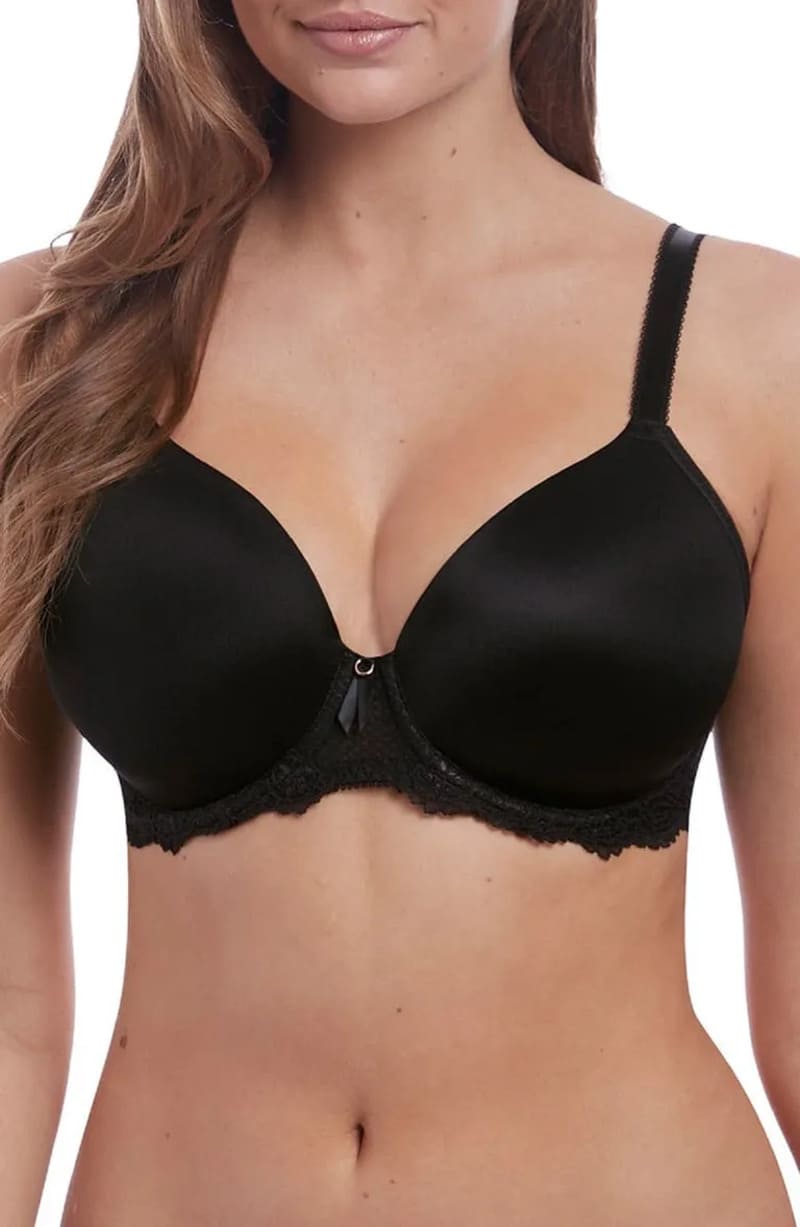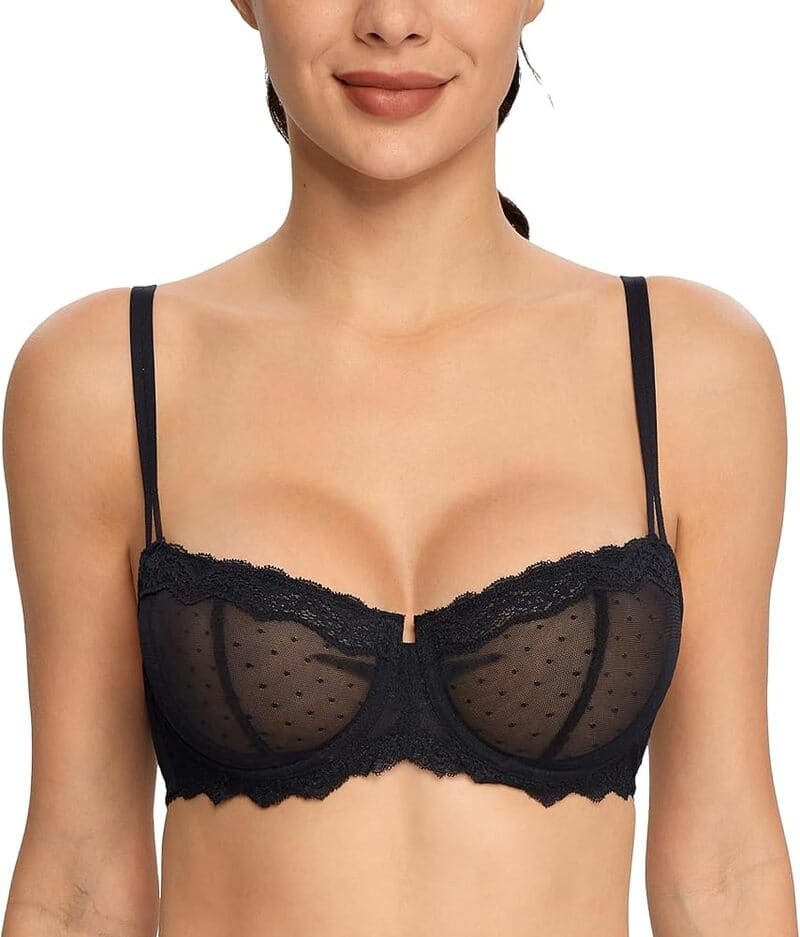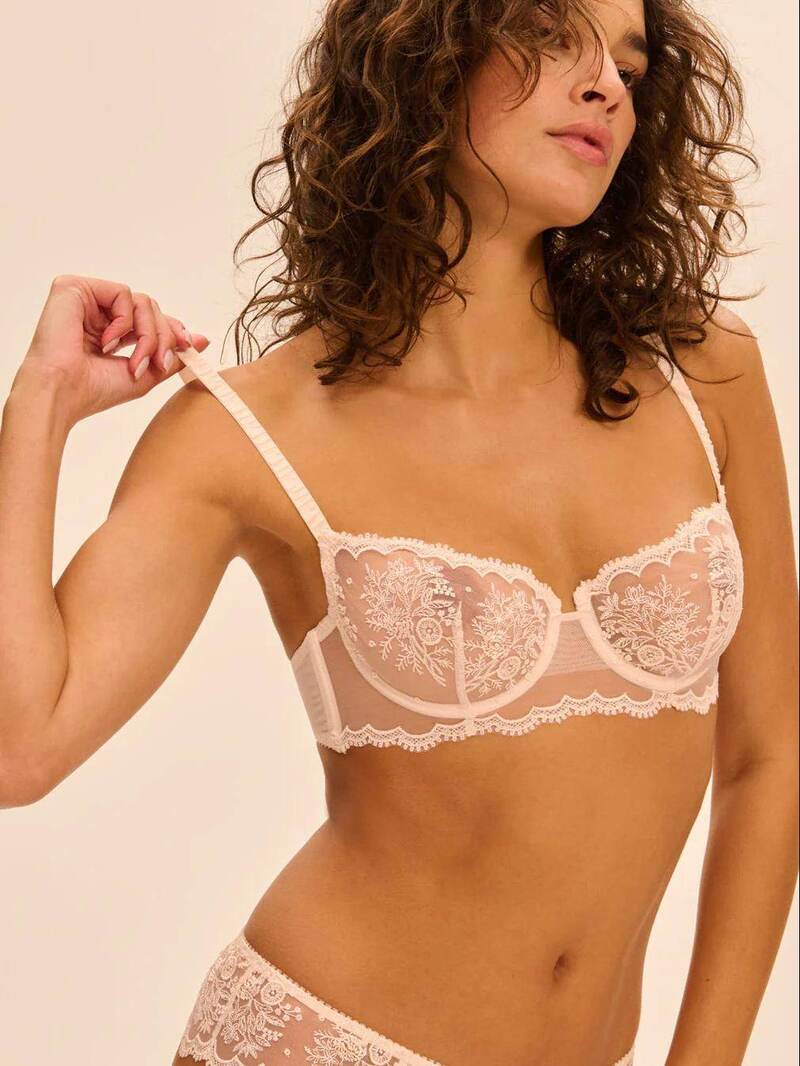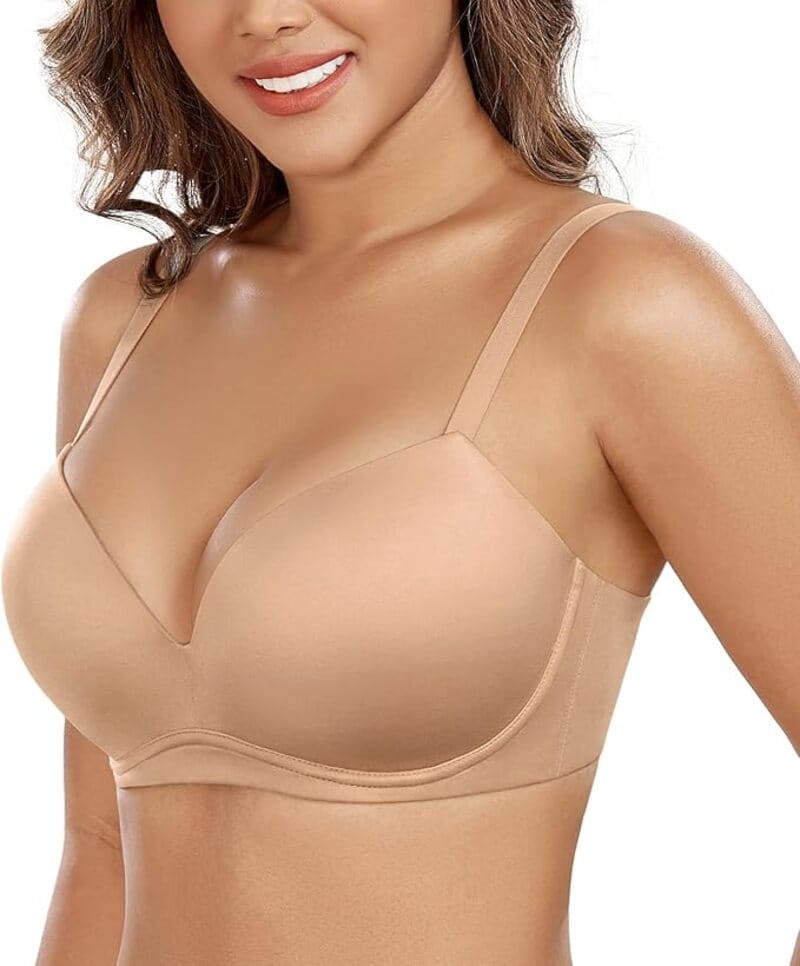
Cleavage is the whole point of the push-up bra, and the padding does the work. The pads are graded: thick at the bottom and outer edge of each cup, thin or absent at the top. That wedge pushes breast tissue upward and toward the center, so the wearer gets a fuller upper curve and a narrower gap between the breasts than her natural shape gives. Some versions use removable pads, gel or air inserts in place of fixed foam.
The cups angle in toward a low, narrow center gore, and an underwire gives the pad something firm to push against. The style suits small and medium busts best. On a large cup the added volume can spill over the top edge, so full-bust ranges lean toward gentler lift styles.
The modern push-up starts in Canada. Designer Louise Poirier developed a deeply plunged push-up for the Canadian Lady Corset Company in the early 1960s, sold under the Wonderbra name, and in 1964 Canadian Lady licensed its designs to Gossard in Britain. Victoria's Secret launched its own Miracle Bra in 1993 and sold about two million in the first year. In 1994 Sara Lee, by then the owner of Wonderbra, declined to renew the Gossard license and relaunched the brand with the Hello Boys posters of Eva Herzigova, which made the push-up a household word.
A plunge bra shares the low gore but not necessarily the pads; plunge describes the neckline, push-up the volume. A balconette lifts with a straight top edge and wide- set straps rather than inward pressure. A demi cup is cut low but has even padding or none at all.
How to Identify
- Padding visibly thicker at the base and outer side of each cup (check the cut edge or the side view)
- Cups tilted inward toward a low, narrow center gore
- Cleavage gap already visible on the form or hanger
- Underwire channel along the bottom of each cup
- Pockets for removable pads inside some styles
- Outer fabric can be anything from satin to lace
Most push-up bras that disappoint fail in one of two ways: the pad shoves tissue over the top edge of the cup, or the cup is so roomy that the pad does nothing at all. Both are fit problems, and both are easy to spot in a fitting room mirror once you know what to look for.
Who gets the most from a push-up bra
The style rewards small and medium busts with some tissue sitting low or wide on the chest. The graded pad gathers that tissue toward the center, so an A, B or C cup gets the most visible change. Wide-set breasts benefit too, because the inward tilt closes a gap that an unpadded cup leaves open.
Skip it, or choose a light version, if your breasts are already full on top. Extra volume on a full upper curve goes straight over the neckline. If you mainly want lift without the inward push, a balconette does that with a straight top edge.
The spill test and the gap test
Because the pad fills part of the cup, the size that fits you in an unlined bra may not fit here. Keep your usual band and judge the cup on the body:
- Top edge: there should be no ridge where tissue bulges over the cup. A clean line under a thin knit top is the proof.
- Upper cup: a hollow or a fold at the top means the cup is too big, or the pad sits too low for your shape.
- Wires and gore: each wire should sit on the ribcage behind the breast tissue, and the center gore should lie flat on the breastbone. A gore that floats a half inch (about 1 cm) off the chest usually means the cups are too small.
- Band: level all the way round and firm on the loosest hook. The band carries the weight; the straps only steady the cup.
Raise your arms and twist. If the breast slips out from under the wire, the band is too loose or the cup too shallow.
Necklines that want cleavage, and ones that fight it
A push-up earns its place under a low V, a wrap dress, a sweetheart neckline or a square neck cut low. The low gore is built for those shapes. For a deeper V that drops toward the sternum, a plunge bra with a lower gore is the safer choice.
High crew necks and thin, clingy jersey are where it works against you. The extra volume makes a close-fitting top look tight across the chest, and the pad edge can print through fine knits. For those, a smooth T-shirt bra gives the shape without the push.
Foam, gel and frames worth paying for
Pad material decides how the bra looks after six months. Dense molded foam holds its shape longest; cheap foam creases at the fold line and the dent shows through clothes. Gel and air inserts feel softer and move more like tissue, but they add weight at the base of the cup.
Look at the frame as well as the pad. The Wonderbra Ultimate Plunge, the current version of the line that made the push-up famous, uses foam cups with what the brand calls patented hand-shape technology and a plastic frame and center front piece in place of a steel wire. Its straps detach so it converts to a racerback, and it is sold from 30DD to 38F, a wider cup range than push-ups once offered.
Removable pads are useful when one breast is larger than the other. Take the pad out of the fuller side, or swap in a thinner insert, and the two cups even out.
Washing a molded cup without denting it
Heat and folding ruin foam. Wonderbra labels the Ultimate Plunge as hand wash only, and that is good practice for any padded cup. Use cool water and a mild detergent, press the water out with a towel rather than wringing, and dry the bra flat with the cups in their natural shape.
Store it with one cup nested inside the other. Folding a push-up in half, cup against cup, breaks the foam at the center and leaves a permanent crease in exactly the spot the pad is meant to build up.
Shop
See push-up bra styles on AmazonAs an Amazon Associate we earn from qualifying purchases. It does not change what we write.
Sources
- en.wikipedia.org: Wonderbra
- en.wikipedia.org: Push up bra
- wonderbra.co.uk: ultimate plunge bra
- en.wikipedia.org: Brassiere measurement
Last updated