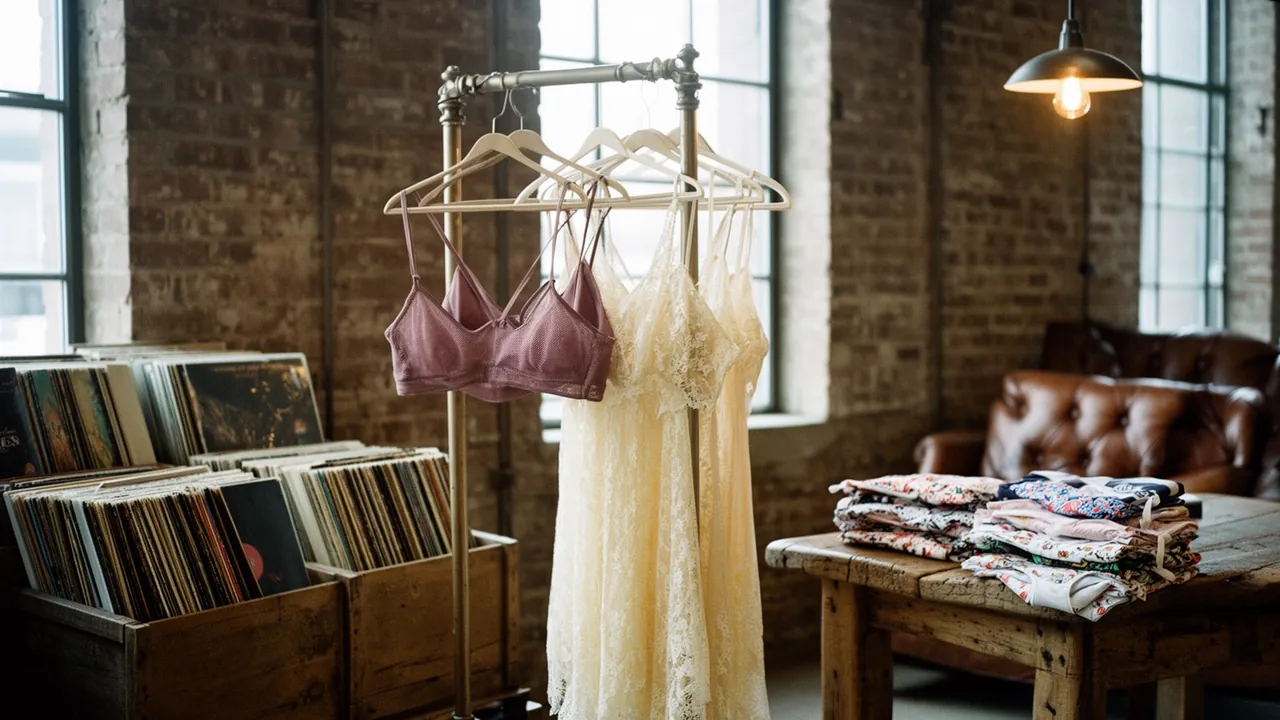
Urban Outfitters is an American fashion and lifestyle retailer that began in 1970 as a small store called Free People, opened near the University of Pennsylvania in West Philadelphia by Richard Hayne, Judy Wicks and Scott Belair. It took the Urban Outfitters name and incorporated in 1976, and it is now the flagship of URBN, the Philadelphia group that also owns Anthropologie and Free People. Its intimates, mostly bralettes, soft bras, slips and underwear packs, are sold to a young customer alongside records, posters, homewares and vintage clothing. Urban Outfitters is a store with a lingerie section, not a lingerie brand, and its place in this encyclopedia comes from the volume and the influence of that section.
A student project in West Philadelphia
The first shop grew out of a student entrepreneurship project at Penn. Hayne and Wicks were married at the time, and the shop's name, Free People, fit the moment. When the business grew and a second store opened, the founders renamed it Urban Outfitters. The original name did not disappear. In 1984 Urban Outfitters revived Free People as a wholesale clothing line under its private label division, and it later became a retail chain of its own.
Hayne has remained at the center of the company for more than fifty years and still serves as chief executive. URBN trades on Nasdaq under the ticker URBN, and by 2019 the group reported revenue of about 3.9 billion dollars.
The URBN family
In 1992 Hayne opened Anthropologie for customers who had outgrown Urban Outfitters. URBN today lists its brands as Urban Outfitters, Anthropologie, Free People, FP Movement, Anthropologie Weddings, the garden store Terrain, the Menus and Venues hospitality business, and Nuuly, the clothing rental service it launched in 2019, along with a resale platform called Nuuly Thrift. The group operates roughly 700 stores across the United States, Canada, the United Kingdom, Western Europe and a handful of other markets.
The three apparel chains are each pitched at a different age, and each sells intimates to its own customer. Urban Outfitters takes the youngest: students and people in their twenties who want lingerie that looks like the rest of their wardrobe.
How Urban Outfitters sells intimates
Urban Outfitters has never published a history of its lingerie department, and its website blocked our attempts to catalog the range. What can be said, from this encyclopedia's own brand file and the store's general character, is that the section matches the store, with the weight on unstructured pieces: the lace or mesh bralette, the triangle bra, the cotton brief and the thong, the slip dress worn as outerwear, and corset-style tops that blur the line between lingerie and going-out clothes. Vintage-inspired styling runs through it, which suits a chain that began as a student shop in 1970.
This is the same bralette-led territory that grew through the 2010s as younger shoppers moved away from padded push-up bras and toward wireless, lightly lined styles. Urban Outfitters sold that look to a mass audience in its stores and online. It is a weaker choice for customers who need underwire support in fuller cup sizes, and it makes little effort to be anything else.
The comparison with Free People
The nearest comparison is inside the same group. Free People sells intimates and swimwear as part of a bohemian look aimed at a slightly older customer, while Urban Outfitters generally sits lower on price and leans toward trend. The bralette is common ground, sold at two different price levels. For a retailer, owning both is a way of keeping the customer as she gets older and richer.
Controversy as a habit
Urban Outfitters has rarely gone long without a product controversy. Its Wikipedia record lists objections from the NAACP, the Anti-Defamation League and the Navajo Nation, among others, and a row over keffiyeh scarves in 2007. The company has also been criticized over labor practices: it refused collective bargaining rights to employees in Stockholm in 2009, and it scored only 11 to 20 percent in the 2021 Fashion Transparency Index because it does not publish its factory list.
That lack of factory disclosure matters for lingerie as much as for anything else on its shelves, since a buyer cannot trace where a bralette was made. Fifty-odd years after a student shop in West Philadelphia, Urban Outfitters is still Richard Hayne's company, and the bralette has become one of its quiet staples.
Last updated
Sources
- en.wikipedia.org: Urban Outfitters
- en.wikipedia.org: Free People
- en.wikipedia.org: Anthropologie
- urbn.com: our brands
Members
How Urban Outfitters fits
Loading member reviews...
376 products in our archive
Use our Lingerie Identifier to find matching pieces