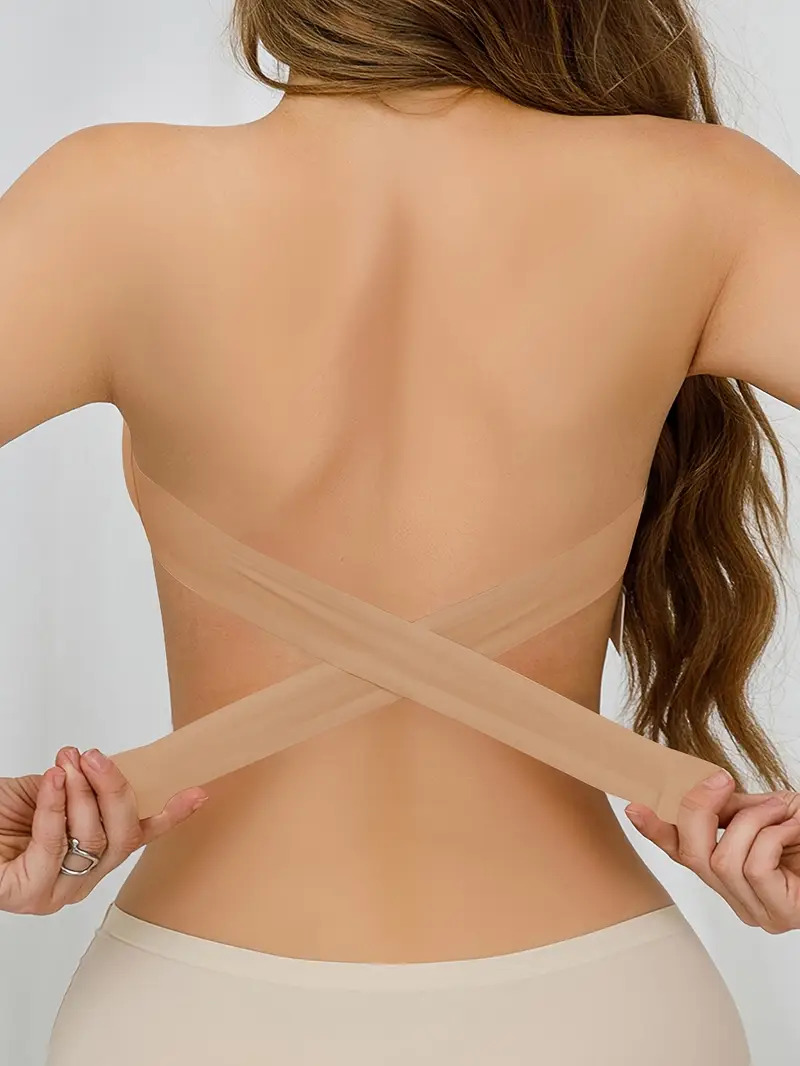
A low-back bra solves the dress that dips to the waist at the back. The cups are ordinary, usually molded and underwired, but the band does not run straight round under the shoulder blades. Long extensions angle down from the side wings to a closure at the lower ribs or the waist, so the bra disappears below the line of the dress. A second type uses a convertor strap that wraps the waist and fastens at the front, leaving the back bare except for a thin line low down.
An angled band gives less leverage than a horizontal one, so support is usually lighter than in an everyday bra. The style suits small to medium busts best and works under evening dresses, low-back bodysuits and backless tops. Full busts often need a low-back design with a deep plunge and firmer wings, or a dress with support built in.
No inventor is recorded for the low-back bra. It exists because evening dress keeps cutting lower at the back, and the bra followed with longer, angled wings and convertor straps.
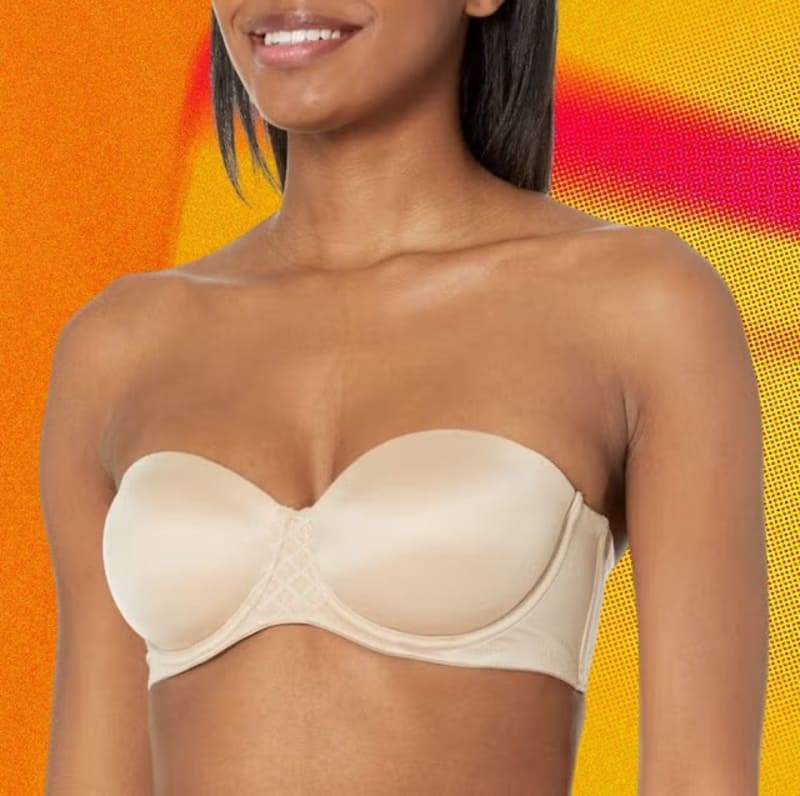
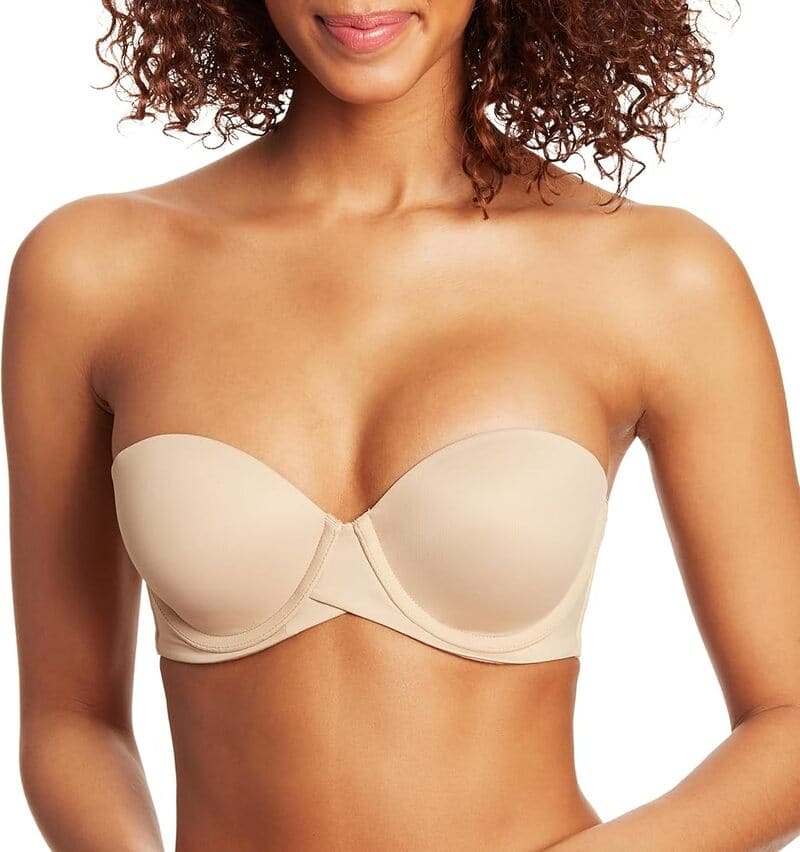
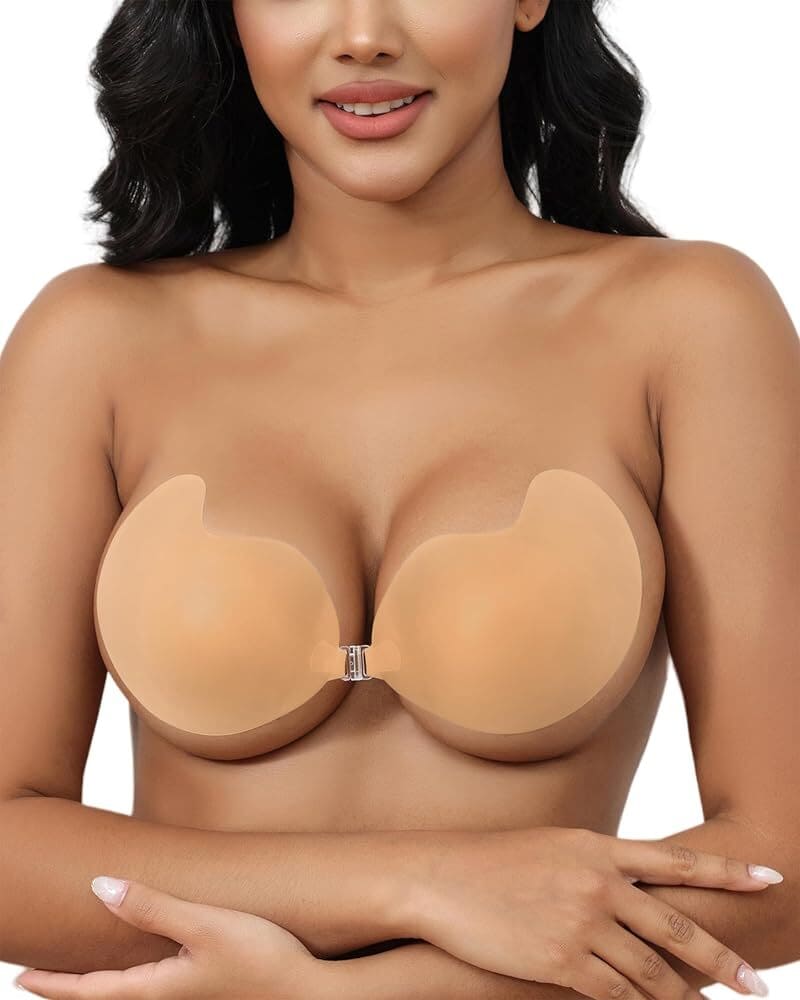
An adhesive bra has no band at all, which makes it the fallback when even a low band would show. A strapless bra keeps the band at its usual height and removes the straps. A convertible bra may offer a low-back setting with extra straps, but its band still sits in the normal place.
How to Identify
- Back closure at the waist or lower ribs
- Long, angled extensions running down from the side wings
- Or a convertor strap that wraps the waist and fastens at the front
- Open upper back with no fabric between the shoulder blades
- Usually molded, underwired cups at the front
Start with the dress, not the bra. A low-back bra is only right if its lowest visible point sits below the lowest point of the back opening, and the only way to know is to measure the garment before you shop.
Measure the back of the dress first
Put the dress on, or lay it flat, and measure from the top of your shoulder down to the lowest point of the back opening. Then do the same on your current bra, to the top edge of the band. The difference tells you how far the band has to drop.
As a rough guide:
- Opening ends 2 to 4 inches (5 to 10 cm) below an ordinary band: a low-back bra with angled wings that close at the lower ribs will usually hide.
- Opening reaches the waist: you need a convertor strap that wraps the waist, or a style that closes right at the waistline.
- Opening drops below the waist: no banded bra will hide. Look at an adhesive bra or a dress with cups sewn in.
Check the side view too. A deep armhole can reveal the side wing even when the back is covered.
Three ways to clear a bare back
The first is the angled wing: a normal cup with long extensions that slope down to a hook closure near the waist. It gives the most support of the three because it still has a full band, only lower.
The second is the convertor strap, a thin elastic that runs from the back of the cups round the waist and fastens at the front. It leaves the back bare except for a narrow line low down. Some multiway bras ship with one; Wonderbra sells a Multiway bra whose fastenings let it convert to a low-back setting, alongside an Ultimate Backless style in 32A to 38DD with silicone along the underbust elastic to stop it moving.
The third gives up the band entirely. Backless strapless styles such as Fashion Forms' Go Bare rely on adhesive cups, which suits small busts and short evenings best.
Fitting an angled band
An angled band pulls the cups down and back, not straight back, so the fit checks change slightly. Fasten it and look for these faults:
- Cups tipping forward at the top edge. The band is too loose to counter the angle; go down a band size.
- Wings cutting into the waist. The closure is too tight or sits on soft tissue; let it out one hook.
- Straps doing all the work. With less leverage from the band, many people overtighten straps. If the shoulders take most of the weight after an hour, the support level is too low for your bust.
Silicone grip along the top or bottom of the band helps on slippery dress linings. Lift your arms above your head before you leave the house, because a band that shifts in the fitting room will shift on the dance floor.
Full busts and very low backs
Above about a D cup, low-back styles need firmer wings, deep side support and usually an underwire to stop the cups rolling. Plunge fronts help, because the deep center lets the cups sit closer to the body. Even then, a very heavy bust and a waist-deep back opening are a poor match, and the honest answer is often built-in support. Many evening dresses can be fitted with sewn-in cups by a tailor, which removes the band problem altogether.
A strapless bra solves a different problem, the bare shoulder, and keeps its band at the usual height, so it will show under most low-back dresses.
Under what, exactly
Low-back bras earn their keep under backless evening gowns, cowl-back dresses, low-back bodysuits and halter tops that leave the shoulder blades bare. They are less useful under sheer fabrics, where the long wings show through as a V. Choose a nude close to your skin tone rather than white for pale or sheer fabrics, and black only for black dresses. For everyday tops with a modest scoop at the back, a convertible bra with crossed straps is usually enough.
Backless / Low-Back Bra in our archive
Brands with the most pieces in our archive that our image classifier identifies as this cut. Labels are automatic and can be wrong.
Shop
See backless / low-back bra styles on AmazonAs an Amazon Associate we earn from qualifying purchases. It does not change what we write.
Sources
- wonderbra.co.uk: ultimate backless bra
- wonderbra.co.uk
- fashionforms.com
- en.wikipedia.org: Brassiere measurement
Last updated