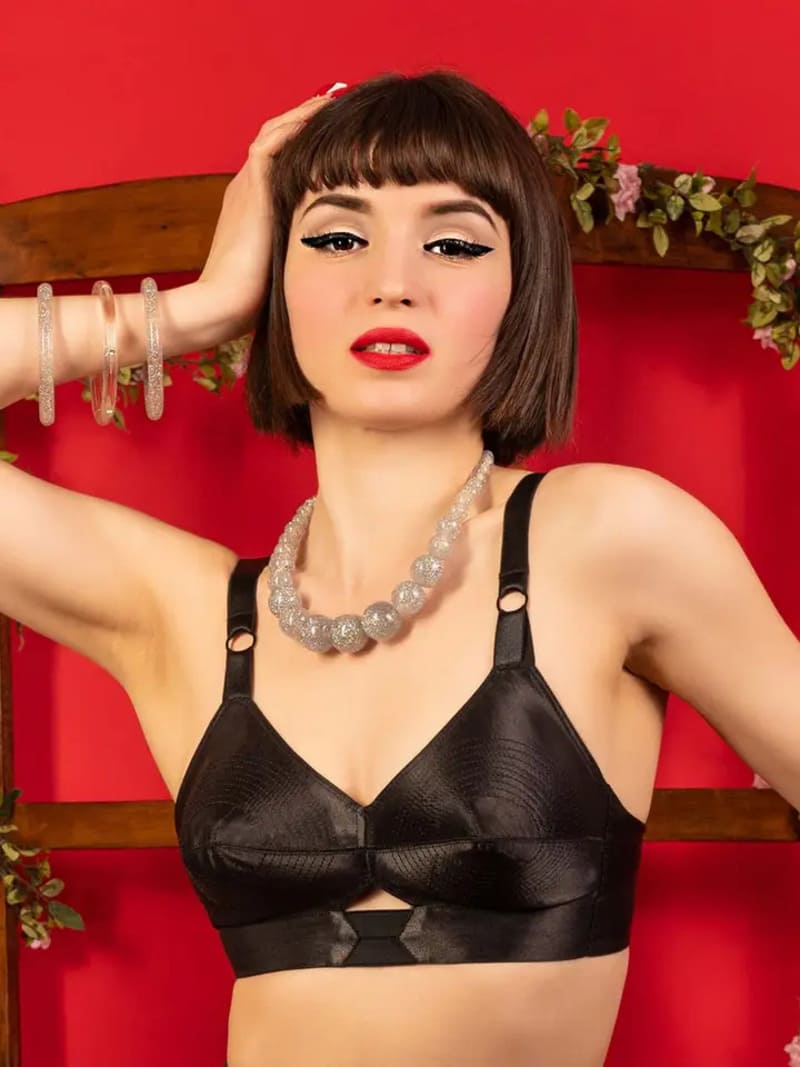
The bullet bra, also called the cone or torpedo bra, shapes each breast into a point. Its cups are cut as cones and stitched in concentric circles or a continuous spiral from the base to the tip, and the rows of stitching stiffen the fabric so the cone holds its form. Cotton, satin and nylon were the usual materials. It was meant to be worn under a fitted sweater, and that was the whole effect.
The look grew out of Hollywood. Lana Turner's tight sweater in They Won't Forget (1937) made her the first sweater girl, and the profile spread through the 1940s into the 1950s, when pointed bras sat alongside the longline and the strapless as the decade's defining foundation shapes. Howard Hughes famously engineered a cantilevered underwire bra for Jane Russell in The Outlaw, though Russell later wrote that it was so uncomfortable she quietly wore her own bra instead.
The cone faded from everyday wear in the 1960s as softer, rounder shapes took over. It came back as costume, most famously in the pink satin cone-bra corset Jean Paul Gaultier made for Madonna's Blond Ambition tour in 1990, and it survives today in vintage reproduction and pin-up lingerie.
It has no close modern neighbor in this taxonomy. Modern molded cups are rounded, and a cone-shaped cup sold today is a deliberate retro reference.
How to Identify
- Conical cups ending in a defined point
- Concentric circular or spiral stitching across each cup
- Cotton, satin or early nylon rather than modern microfiber
- Narrow straps and a multi-hook back band
Wearing a bullet bra today means choosing between a real piece from the 1940s or 1950s and a reproduction cut from the old patterns. The original is the better object; the reproduction is almost always the better thing to wear.
Buying an original
Mid-century cone bras turn up at vintage fairs and online in cotton, satin and early nylon. Before buying one to wear, check the parts that age worst.
- Elastic. Stretch the band and the elastic panels gently. If they crackle, feel crisp or stay stretched, the rubber has perished and will not recover.
- Stitching. The concentric or spiral rows on each cone hold its shape. Broken rows mean a cone that collapses.
- Hooks and eyes. Look for rust stains around the metal, which spread when washed.
- Fabric. Cotton yellows and satin splits along folds. Hold the cups up to the light to find thin spots.
Size an original by measuring it, not by its label. Letter cup sizes go back to 1932, when S.H. Camp and Company linked breast size to the letters A to D, and Warner adopted cup sizing in 1937, so most post-war bras carry a letter. Cone depth and band length, though, varied from maker to maker. Lay the bra flat, measure the band unstretched, and compare it with your underbust in inches.
An original in good condition is worth more kept than worn. Sweat and washing shorten the life of fabric that is already seventy years old.
Sizing a reproduction
What Katie Did, the first company to put the bullet bra back into production, in 1999, gives the most detailed sizing advice. Its Maitresse is a soft-cup, wire-free bra in polyester satin, spiral-stitched, with a band of very limited stretch. Elastic appears only between the cups and at the back by the hooks.
The band is sized the traditional way, so it runs smaller than many modern labels. Across the range, from 30DD to 40F, the unstretched band measures 25 to 35 inches (63 to 89 cm). The company says A to D cup wearers often take their usual size. Wearers in DD and up often need to sister size, one band up and one cup down.
If you wear molded T-shirt bras, measure before ordering. The non-stretch cups of an authentic bullet bra have to be filled properly to make a smooth point. What Katie Did also warns that your bullet bra size may not match the size printed in your modern bras.
Filling the point
In an unpadded cone, your own breast tissue makes the tip, so the silhouette varies from one wearer to the next. A slightly soft point is normal. A dented or folded tip means the cup is too big.
For a sharper line, What Katie Did makes a padded version with a 5 mm (about 0.2 inch) layer of foam that holds the cone on its own, and sells small bullet bra pads that sit in the tip. The padded version works best under fitted knitwear, where a soft point shows.
Dressing over the cone
The bra was designed for one silhouette, and it still looks right in that setting. Wear it with a close-fitting cashmere or angora sweater, a fitted 1950s day dress, or a blouse tucked into a high-waisted skirt. For the full period line from bust to hip, add a girdle or wear a longline bra with the same cone cups.
Under loose modern clothes, the point just looks odd. Under a plain T-shirt it reads as costume, which is the right call for a pin-up event.
Where the cone survives
Daywear dropped the cone in the 1960s, but rockabilly and burlesque scenes, which borrow from the 1950s, kept it alive. The fashion world came back to it when Jean Paul Gaultier based Madonna's 1990 Blond Ambition costume on a 1940s Perma-Lift bullet bra. For how the cone fits among today's shapes, see the complete bra type guide. What Katie Did says its bullet bras have been made in the same factory in India since 2003, with some of its original machinists still sewing them.
Shop
See bullet bra styles on AmazonAs an Amazon Associate we earn from qualifying purchases. It does not change what we write.
Sources
- whatkatiedid.com: all about bullet bras
- whatkatiedid.com: 1950s bullet bra maitresse
- en.wikipedia.org: History of bras
- en.wikipedia.org: Sweater girl
- en.wikipedia.org: Bullet bra
Last updated