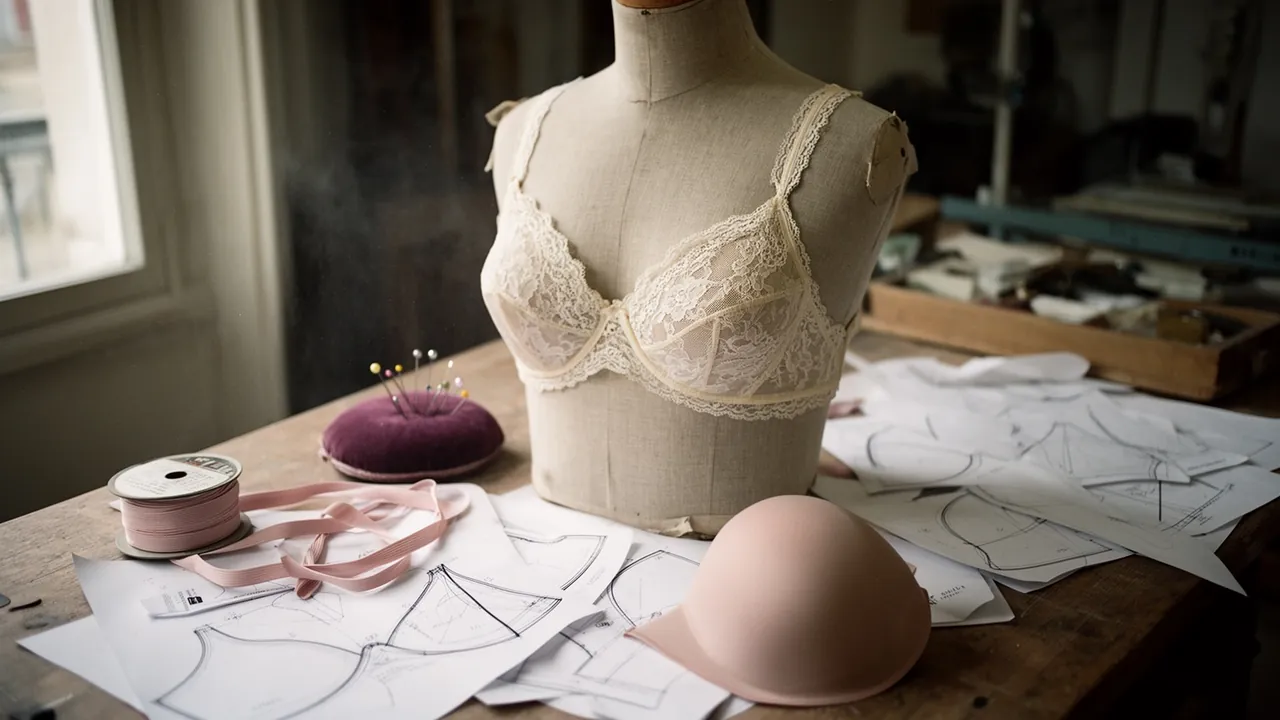
Lejaby, now trading as Maison Lejaby, is a French lingerie house founded in 1930 by Gabrielle "Gaby" Viannay and her brother-in-law Marcel Blanchard in Bellegarde-sur-Valserine, a town in the Ain department near the Swiss border. The firm started as La Gaby and took the Lejaby name later. For decades it was France's second-largest lingerie maker after Chantelle, and it is remembered for the Pigeonnant uplift bra, the 1965 Miss Top and the 1995 Nuage microfiber bra. Its head office is now in Caluire-et-Cuire, just north of Lyon.
From La Gaby to Lejaby
The company's roots go back further than its name. Corsetry in the area traces to 1884 and the work of Louis Neyron with Dr. Rasurel. Gaby Viannay set up her own business in the 1930s in Bellegarde, with Marcel Blanchard running the commercial side while she ran the product. The name was simply hers: La Gaby, softened into the single word Lejaby.
The common description of Lejaby as a Lyon house is half right. It was born in Bellegarde, more than 100 kilometers from Lyon, and only later moved its headquarters into the Lyon area, first to Rillieux-la-Pape and now to Caluire-et-Cuire.
Lejaby in the 1960s: the Pigeonnant and Miss Top
The firm's big growth came in the 1960s under Maurice Bugnon, who acquired the company and expanded it across Europe. Two moves defined the decade. Lejaby launched Le Pigeonnant, an uplifting bra whose name, from the French for a pigeon's puffed-out breast, passed into everyday French as the word for a push-up bra. And it secured exclusive French rights to Lycra, DuPont's spandex fiber, at the moment when stretch was changing how bras fit.
The result was Miss Top, launched in 1965. It sold three million units, a figure that would be respectable for a bra today and was remarkable then. Lycra let Lejaby make a lighter, softer bra that moved with the body, a clear break from the heavily structured foundation garments of the 1950s.
Nuage, 1995
Three decades later Lejaby did it again with Nuage ("cloud"), a molded, seam-free bra in microfiber, designed to be invisible under close-fitting clothes. It sold more than a million units in its first year. Nuage belongs to the same family as the modern T-shirt bra, and it arrived just as smooth microfiber cups were becoming the default for everyday lingerie.
Warnaco, Palmers and the factory closures
At its peak in the early 2000s Lejaby ran eight production sites and employed about 1,000 people. The ownership story after that is a hard one. The American group Warnaco bought Lejaby in 1996, and Warnaco itself filed for bankruptcy in 2001. In 2008 the Austrian hosiery and lingerie group Palmers Textil bought Lejaby for €45 million.
Palmers closed the French factories one by one between 2010 and 2012: Bellegarde-sur-Valserine, Le Teil, Bourg-en-Bresse and finally Yssingeaux in the Haute-Loire. The company went into judicial liquidation. In January 2012 a consortium led by Alain Prost, a lingerie executive who had spent twenty years at L'Oréal, five at Groupe Chantelle and two at La Perla (and no relation to the racing driver), bought the business for one euro. The court-approved plan kept 195 jobs at Rillieux-la-Pape. It could not keep Yssingeaux, where about 450 jobs had been under threat.
Yssingeaux became a national story, drawing visits from political figures as a symbol of lost French manufacturing. The site was later taken over by Sofama, a leather-goods subcontractor to Louis Vuitton.
Maison Lejaby
Under Prost the company was renamed Maison Lejaby and launched Maison Lejaby Couture, a high-end line made in France. The rest of production moved abroad. By 2018 most of it came from Tunisia, Morocco and China, with only 7 to 10% still made in France. The investment firm Impala took about two-thirds of the company after 2015, and in 2019 Thierry Le Guénic and Stéphane Collaert bought it from Impala.
The brand's reputation in this period rested on lace and silhouette: underwired bras and matching briefs in French lace, with a cut that customers recognized, and a large share of sales in Eastern Europe.
That exposure proved costly. Lejaby was placed in judicial restructuring on January 2, 2024, after losing about 30% of its revenue from the Ukraine region following the war. In May 2024 a Franco-Indonesian consortium took over the company, keeping 24 of its 49 employees. A house that once had a thousand workers and eight factories now operates as a small design company near Lyon, still carrying the name Gaby Viannay gave it.
Last updated
Sources
- fr.wikipedia.org: Lejaby
Members
How Lejaby fits
Loading member reviews...
241 products in our archive
Use our Lingerie Identifier to find matching pieces