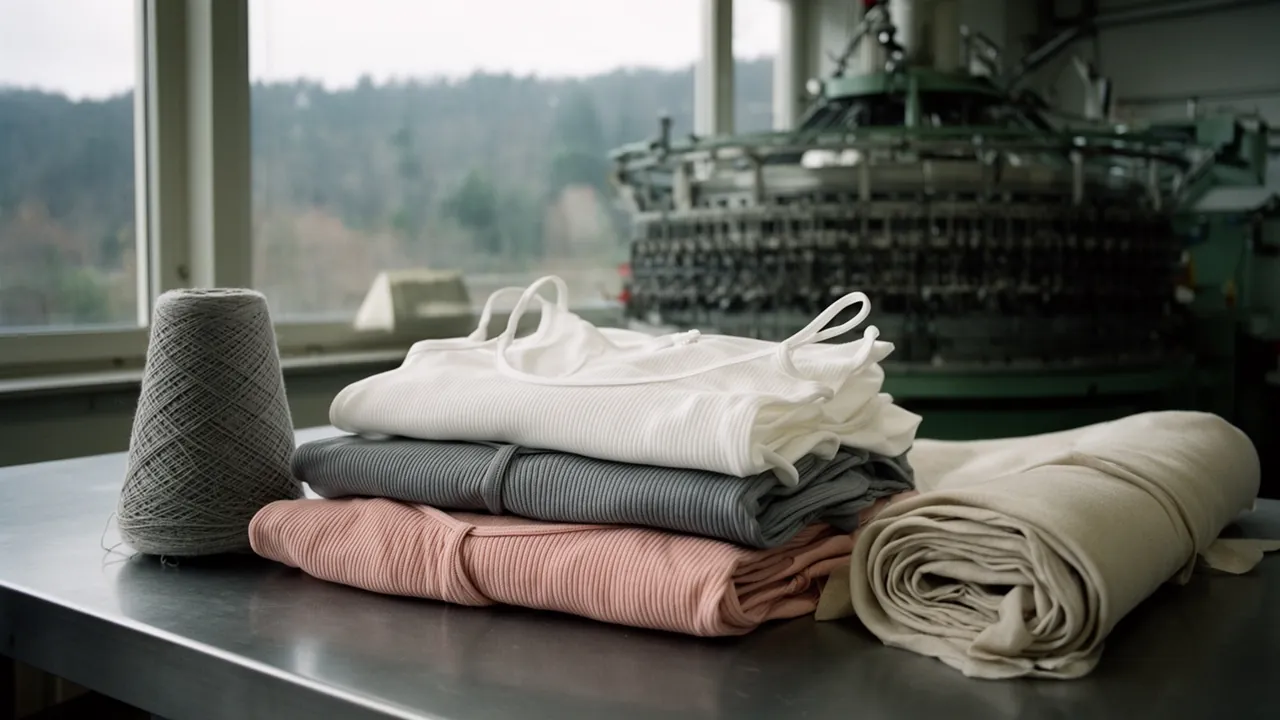
Mey is a family-owned German maker of underwear, nightwear and lingerie based in Albstadt, in the Swabian Jura of Baden-Wurttemberg. Franz Mey founded it in 1928 as a contract knitting shop, and the third generation of the family still runs it, knitting most of its own fabric in Albstadt.
A knitting shop in the Swabian Jura
Albstadt and the villages around it have been a center of knitwear and underwear making since the nineteenth century, a cluster of small knitting mills on the high plateau south of Stuttgart. Franz Mey set up there in 1928 with a Lohnwirkerei, a knitting business working to order for other firms. It was a supplier's trade, not a brand.
After the war, in 1948, Franz and his brother Karl founded Gebruder Mey and began making finished clothing for women, men and children. A factory building went up in Lautlingen, now part of Albstadt, in 1952. By 1956 Franz was running the company with his son Albrecht.
1959: women's underwear only
The decisive choice came in 1959. The family decided to stop making a bit of everything and to specialize in women's underwear, with a deliberate push upward in quality. The same year it began building a sewing branch in Dormettingen.
In 1961 and 1962 it took a second decision that still shapes the brand. Mey would sell through specialist retailers and put every product under its own name. That ended the anonymous contract work the company had started with.
The Mey-Rand and other inventions
1978: an edge that does not show
Mey's best-known technical idea is the Mey-Rand, or Mey edge, launched in 1978. It is a finishing method for leg and waist openings designed so that the edge neither shows through clothing nor adds bulk. Long before bonded and laser-cut seamless briefs became a category, this was a German knitter's answer to the visible panty line.
Undershirts and blouse helpers
Other products followed the same practical line: the "Drunterhemd", an undershirt meant to be worn under other clothes, and the "Blusenwunder", a top designed to sit invisibly under a blouse. These are not glamorous garments. They are the reason Mey is found in so many German drawers.
Factories in Germany, Portugal and Hungary
Franz Mey died in 1974, and his sons Albrecht and Dietmar took over. In 1984 the company added men's underwear by taking over a factory in nearby Bitz, which still operates as a legally separate company. The Dormettingen sewing plant was rebuilt in 1987, a factory opened in Celorico da Beira in Portugal in 1991, and a plant at Veresegyhaz in Hungary followed in 2000.
Today a large share of production happens in these own plants. About 85 percent of Mey's fabric is made at Albstadt, 89 percent of its suppliers are in Europe, and since 2019 it has molded its own bra cups at the Hungarian site. Much of the range is soft jersey knit, often cotton, which is what a firm that began as a contract knitter would be expected to do best.
The Swabian boomerang
Mey's environmental record starts earlier than most. In 1997, with the Fischer works, it introduced a reusable hanger system nicknamed the "Swabian boomerang": hangers collected from shops after sale and sent back for reuse, with sorting work given to a local workshop employing people with disabilities. The hanger won an "eco product of the year" award in 1998. Since 2019 the company has published an annual sustainability report, and it uses only mulesing-free wool.
Third generation
After Albrecht Mey's death in 2002 the management was reorganized and the women's and men's businesses brought under one leadership. The same year Mey launched a nightwear line, Meynight. Matthias Mey, grandson of the founder, has been managing director since 2014, alongside Florian and Markus Mey.
In 2020 Mey was one of the first German textile companies to switch production to fabric face masks, and in November that year it received the Baden-Wurttemberg economic medal. Since 2019 it has run multi-brand shops under the name Mes amis, and in 2025 it opened Mey flagship stores in Freiburg and Hamburg. Turnover in 2024 was about 123.4 million euros, with just over 1,100 employees.
The family also keeps a sewing-machine museum at Lautlingen, run by the Albrecht Mey foundation, with machines from the eighteenth and nineteenth centuries and a reconstruction of an English sewing machine of 1790.
Last updated
Sources
- de.wikipedia.org: Mey (Unternehmen)
- mey.com
Members
How Mey fits
Loading member reviews...