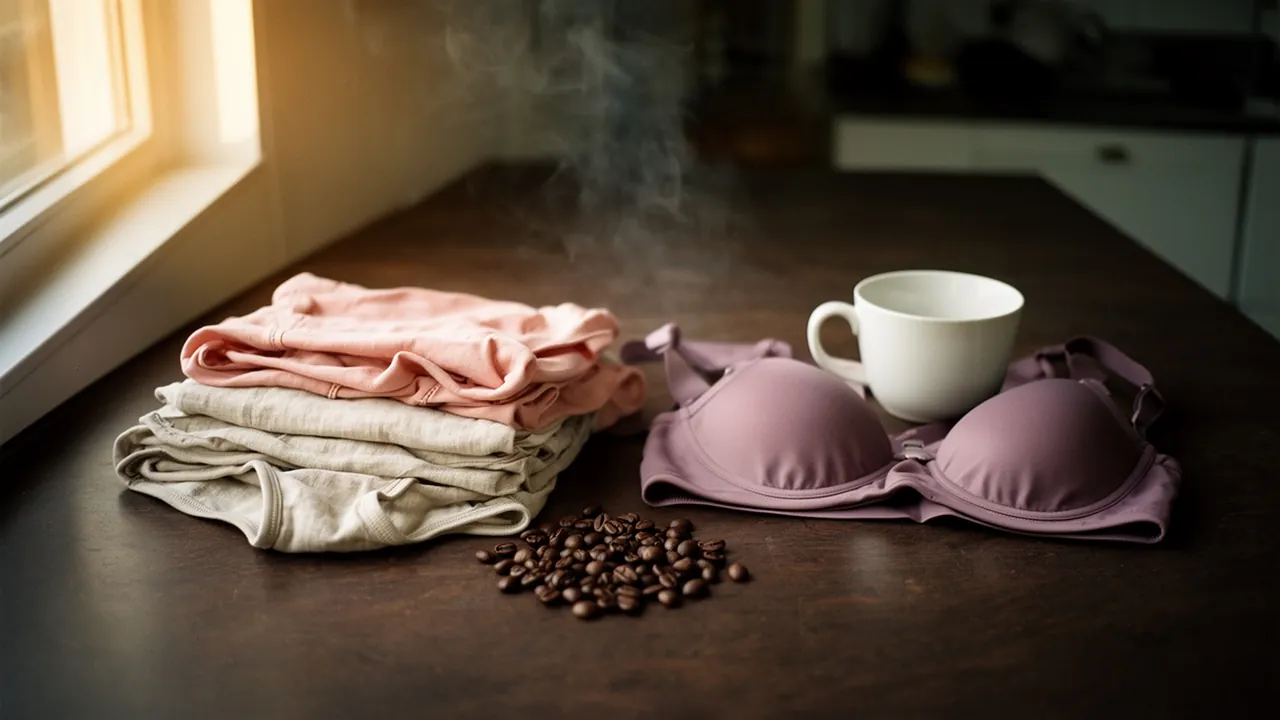
Founded in Hamburg in 1949 by the coffee merchant Max Herz and the spice trader Carl Tchilinghiryan, Tchibo is a German coffee company, and an odd entry for a lingerie encyclopedia. That is the point of including it. Alongside roasted coffee, Tchibo sells bras, briefs, shapewear and nightwear through a rotating non-food range, and in Germany its weekly offers have made it one of the more unusual places where women buy everyday underwear.
A name made of a man and a bean
The brand name is a contraction of "Tchiling" and "Bohne", the German word for bean: Tchilinghiryan's nickname joined to the product. The business began as a mail-order coffee seller, posting packets of beans to customers at a time when coffee was still a luxury in postwar West Germany. The first Tchibo shop opened in Hamburg on October 13, 1955, and its novelty was that customers could taste the coffee before buying it.
How a court ruling put underwear next to the coffee
The non-food business did not start as a plan. In 1973 a ruling by Germany's Federal Court of Justice stopped Tchibo from giving away promotional items with its coffee. The company had stock left over and began to sell those goods instead of handing them out. The experiment worked, and it hardened into a format: a small, themed collection of household goods, clothing and gadgets that changes every week and is gone when it sells out. The German slogan "Jede Woche eine neue Welt", every week a new world, describes it exactly.
That rhythm is the opposite of how most lingerie is sold. A specialist brand keeps a core bra in the line for years so that a customer can buy the same size again. Tchibo's model rewards impulse and timing: a set of organic cotton briefs or a wireless bra appears in the weekly theme, sells through, and may not come back in the same form.
What sits in the Wäsche aisle
The current women's underwear range on tchibo.de covers briefs, straight-leg pantys and higher-cut Brazilian briefs, soft-cup, underwired, push-up and sports bras, shapewear, bustiers and vests. Much of it is cut from organic cotton jersey with a little elastane; sports pieces use polyester and polyamide for moisture handling, and some styles carry lace trims. Prices on the site run from about 15 euros for a five-pack of basic briefs to about 35 euros for specialized pieces, with multipacks doing much of the work.
Tchibo also sells partner labels next to its own pieces. Sloggi underwear appears in the range, and the site has run themed collections from Triumph, described in shades of dark blue, rose and bordeaux. Loungewear and nightwear get their own theme worlds.
Scale and ownership
Tchibo is owned by Maxingvest AG, formerly Tchibo Holding, which is controlled by the Herz family. In 2024 the company reported about 3.36 billion euros in revenue and 10,452 employees. It runs roughly 550 shops in Germany and about 320 abroad, in countries including Austria, the Czech Republic, Hungary, Poland, Slovakia, Switzerland and Turkey, plus a large online shop. It left the British high street by 2009 and returned to the UK online in 2016. Headquarters are in Hamburg's City Nord office district.
The company has picked up recognition for corporate responsibility work, including the 2012 Business Ethics Award and Germany's federal CSR prize in 2013, and in 2014 it signed Greenpeace's Detox commitment on hazardous chemicals in textile production, a pledge that covers the same supply chains that make its underwear.
The seven Tchibo pieces in this archive are plain, wearable basics. They were bought, most likely, by someone who came in for coffee.
Last updated
Sources
- en.wikipedia.org: Tchibo
- de.wikipedia.org: Tchibo
- tchibo.de
- tchibo.de: unterwaesche
Collections (1)
Members
How Tchibo fits
Loading member reviews...
7 products in our archive
Use our Lingerie Identifier to find matching pieces