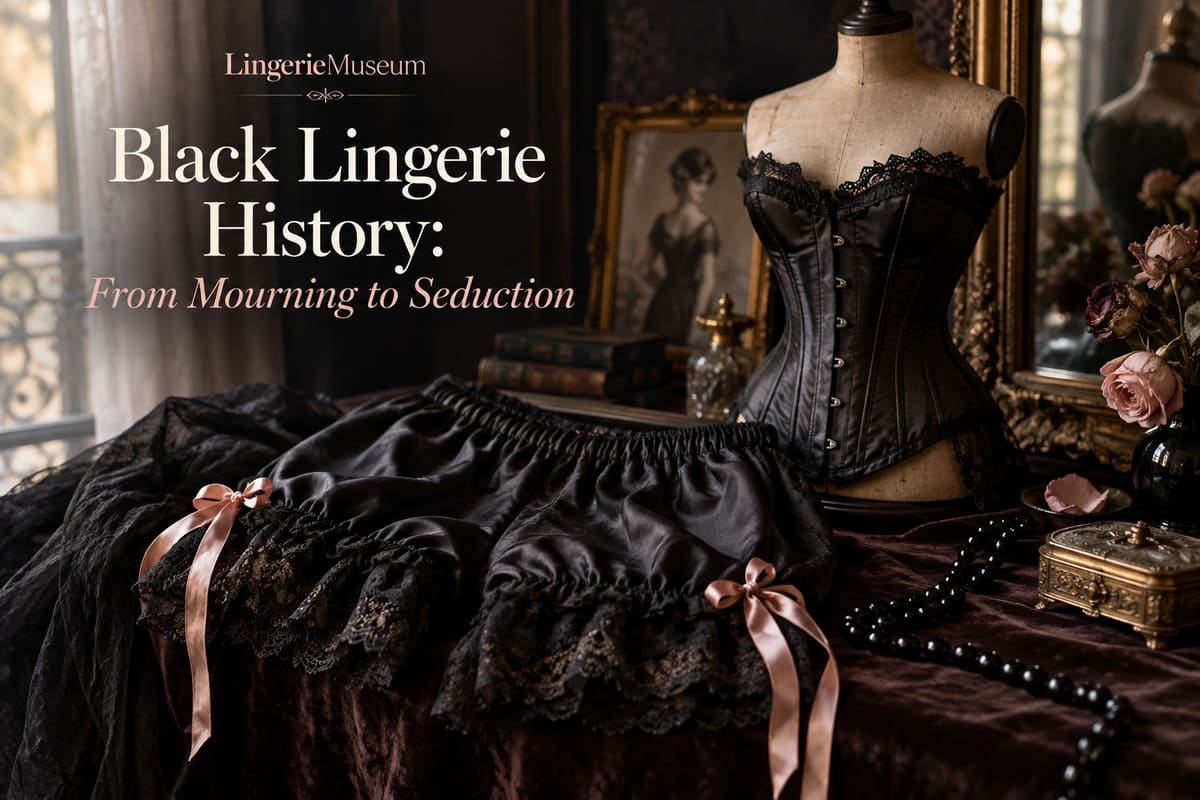
Black lingerie, today the default color of the lace bra, started its modern history in mourning. In Victorian Britain and the United States black was the color of grief, governed by strict rules after 1861, and it took cheap synthetic dyes, French luxury underwear around 1900, Coco Chanel's 1926 black dress, an American mail-order catalog in 1946 and a Soho shop in 1994 to turn it into the color of seduction and then of the everyday basic.
Mourning black after 1861
Queen Victoria's grief set the terms. After Prince Albert died in December 1861 she entered mourning and wore black for the rest of her life, and formal mourning customs peaked during her reign. Social norms could keep a widow in special clothes for up to four years. Full mourning gave way to half mourning, when muted colors such as lilac, grey and lavender were allowed back. Jet jewelry became highly popular.
The Victoria and Albert Museum describes how "a cult of mourning developed from the 1860s onwards" with strict rules that required dull, matte fabrics such as crepe for the first period. Its collection holds a black silk satin bodice and skirt from the 1880s, labeled by Jay's, the Regent Street mourning warehouse that traded "by appointment to the Queen." The glossy satin, the museum notes, suggests a later phase of mourning, perhaps a year after the death. Shine itself was regulated. The black lace and jet of every gothic Halloween costume borrow from this wardrobe.
What mourners wore underneath is far less documented than the outer layers. The surviving dresses show that black was public and obligatory. Black worn next to the skin was another matter, and it arrives in the record a few decades later, as fashion rather than grief.
Black lace before black lingerie
Lace got there first. Black silk Chantilly lace, made in the 19th century mostly in Bayeux in Normandy and in Geraardsbergen in present-day Belgium, was prized in its best grades as suitable for mourning wear, and it sold widely in Spain and the Americas. In 1844 a machine was patented that made black silk Chantilly lace hard to tell from the handmade kind.
That patent matters for the black lingerie drawer. Black lace that could be made by machine was the material that later trimmed corsets, knickers and, eventually, bras at a price the mass market could pay.
Cheap black: the aniline dyes
Before synthetic dyes, good black was costly. In the 16th century it signaled wealth among Spanish aristocrats and Dutch merchants partly because the imported oak galls used to dye it were so expensive. The change came out of a laboratory accident. In 1856 the 18-year-old William Henry Perkin, trying to make quinine, produced mauveine, the first synthetic dye, and the next year opened a dyeworks at Greenford, west of London. There is a neat irony in the timing: mauve, the color of half mourning, was the first color the new industry sold.
Black followed. The chemist John Lightfoot (1831-1872) developed the first commercially successful route to aniline black. Inexpensive synthetic black dyes, together with the industrialized textile trade, made good black cloth available to ordinary buyers for the first time. Mourning black became cheaper to buy, and black for its own sake became possible.
Black silk knickers, about 1905
The V&A's underwear collection shows the shift in three objects. A corset from 1890 to 1895 is pink silk satin trimmed with black handmade lace, threaded with dark pink ribbon. A corset of about 1900, made in England, is boned black satin throughout. And a pair of knickers of about 1905, made in France and sold by the London store Woolland Brothers, is black silk, tied at the waist with narrow pink silk ribbon, with a wide frill of alternating bands of black machine-made lace at the legs.
Pink ribbon has no place in mourning. These are Belle Epoque luxury pieces in which black was chosen for effect. They were also exceptions: until the 1950s most underwear was simple, functional and white, and prints and colors arrived as everyday options only after that.
Chanel takes black out of the funeral
In 1926 American Vogue published a drawing of a simple black dress by Coco Chanel and called it a uniform for all women of taste, comparing it to the Ford car. Before that, black in women's dress meant grief or service: widows wore it, and so did maids. Chanel's dress broke the link with mourning for outerwear. She did not design underwear, but it made black ordinary in the wardrobe, and the drawer followed.
Racy black by mail, 1946
The step from chic to sexy was American. After his discharge from the armed forces, Frederick Mellinger set up a mail-order business in New York in 1946, Frederick's of Fifth Avenue, which moved to Los Angeles the next year as Frederick's of Hollywood. Its catalog offered "racy black bras and panties embellished with lace and appliqués," sold under the line "Fashions Change--But Sex Is Always in Style." Black underwear now had an address, a price list and a clear message.
Soho, 1994
Agent Provocateur opened on Broadwick Street in Soho in 1994, founded by Joseph Corré and Serena Rees. In the V&A's words, the shop sells "daring and glamorous underwear, which takes its inspiration from 1950s sex sirens and pin-up girls." The museum acquired a 1997 set from it: powder-pink satin with black Leavers lace, a bra, a corset and an elasticated waspie, and a 1990s corset from the same shop carries black elastic suspenders.
The palette is worth a second look. Pink satin under black lace is exactly the combination of the 1890s corset in the same collection, a hundred years earlier. The V&A stores the Jay's mourning dress and the Soho underwear under one roof, black satin for a widow and black Leavers lace for Broadwick Street.
Last updated
Questions
Why is black lingerie considered sexy?
Black first meant mourning, then became fashion. French luxury underwear around 1900 used black for effect, Chanel's 1926 black dress made the color ordinary, and in 1946 Frederick's of Hollywood began selling racy black bras and panties by mail under the line Fashions Change, But Sex Is Always in Style. That catalog tied black underwear to seduction.
Did Victorian women wear black underwear for mourning?
The record is thin. Surviving mourning dresses show that black outer clothing was public and obligatory, with strict rules about dull fabrics such as crepe. What widows wore underneath is far less documented. Black worn next to the skin appears in collections a few decades later, around 1900, as a fashion choice rather than a sign of grief.
When did black underwear become common?
Slowly. Cheap synthetic aniline black dyes put good black cloth within reach of ordinary buyers, and black silk knickers appear in France around 1905. Those were luxury exceptions: until the 1950s most underwear was simple, functional and white. Colors and prints became everyday options only after that, and black is now the default color of the lace bra.
How did cheap dyes change black clothing?
Before synthetic dyes, good black was expensive because it relied on imported oak galls. After William Henry Perkin made the first synthetic dye in 1856, the chemist John Lightfoot developed the first commercially successful aniline black. Cheap synthetic blacks and industrial textile production put good black cloth within reach of ordinary buyers for the first time.
Sources
- en.wikipedia.org: Mourning
- en.wikipedia.org: Queen Victoria
- aol.com: 10 victorian mourning traditions feel 120746000
- collections.vam.ac.uk: O1457181
- collections.vam.ac.uk: O361255
- collections.vam.ac.uk: O354902
- collections.vam.ac.uk: O115832
- collections.vam.ac.uk: O84533
- collections.vam.ac.uk: O67107
- en.wikipedia.org: Chantilly lace
- en.wikipedia.org: Mauveine
- en.wikipedia.org: Polyaniline
Discussion
Loading...