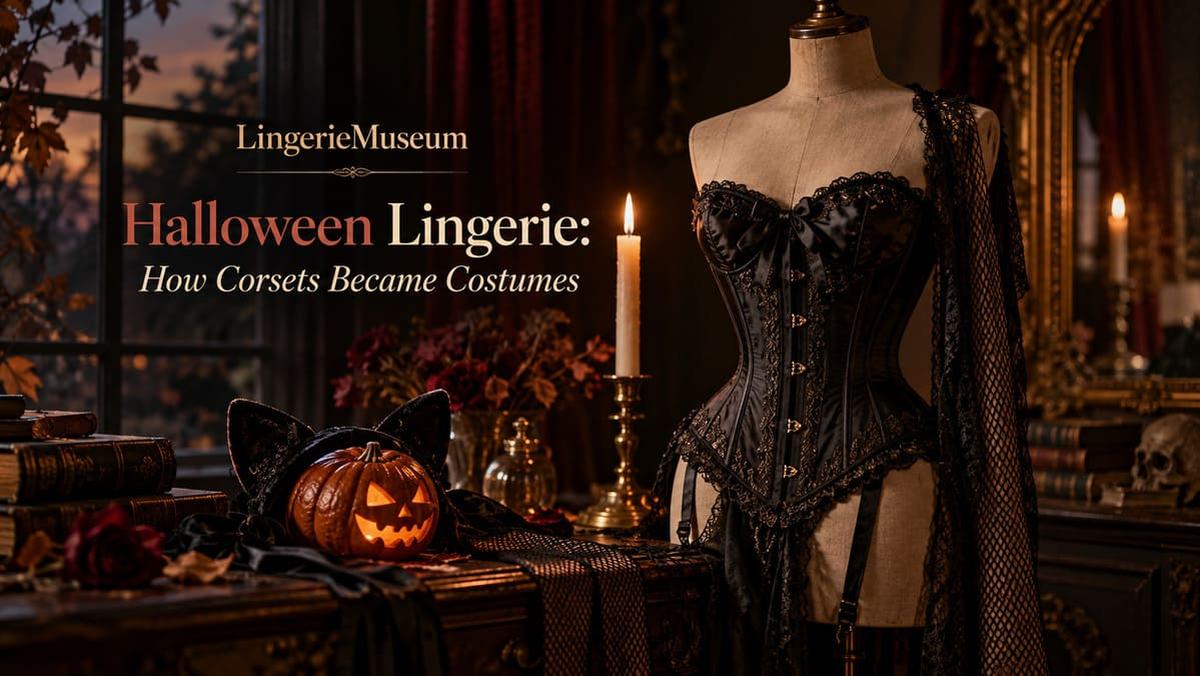
Halloween lingerie, the corset, bodysuit or babydoll worn with cat ears or a costume hat to an adult party, is an American invention of the last fifty years. It grew out of the adult Halloween parties and parades of the 1970s and became a product category around 2000, when Los Angeles hosiery maker Leg Avenue and, a few years later, the Arizona web retailer Yandy began selling lingerie dressed up as costumes.
Crepe paper and Minnie Mouse
For most of its American life, Halloween dress showed very little skin. The Victorians took up the holiday partly through Robert Burns's poem "Halloween," and the Halloween historian Lesley Bannatyne told TIME in 2014 that they "were obsessed with ghosts at this time." Their costumes leaned toward the exotic, a gypsy or an Egyptian princess, glamorous but covered.
The 1920s brought crepe-paper costumes. In the 1930s firms such as A. S. Fishbach and Ben Cooper began mass-producing costumes for stores as trick-or-treating spread across North America; the term itself first appears in the United States in 1934. After the Second World War the holiday belonged mainly to children. Bannatyne's summary of the period is hard to improve on: "Women would dress up as Minnie Mouse, but there wasn't a sexy Minnie Mouse."
Greenwich Village, 1974
The adult Halloween that lingerie later colonized began on the street. On October 31, 1974, the puppeteer and mask maker Ralph Lee organized an informal parade of puppets around the Westbeth artists' housing in Greenwich Village. It had roots in the city's queer culture and grew into the world's largest Halloween parade; in its 51st year, in 2024, it drew more than 65,000 participants.
Bannatyne points to the same decade in other cities, describing "outrageous gay Halloween parades in the Castro District, Greenwich Village and Key West." TIME's 2014 history by Laura Stampler puts the turn plainly: it was not until the 1970s, when adults took Halloween back after the sexual revolution, "that the truly sexy costumes emerged." Television and film with higher hemlines and more nudity pushed in the same direction through the 1980s.
How Halloween lingerie became a product
Cat ears at a Chicago trade show
Leg Avenue began in 1984 with a family from Taipei reworking imported stockings, adding zippers and lace, and selling them at swap meets and kiosks in downtown Los Angeles. The company was incorporated in 1999. By its own account, a customer's remark at a trade show in Chicago led it to come back the following year with black lingerie and a pair of cat ears, the start of what is now a catalog of more than 650 costume styles beside 300 hosiery styles.
The cat ears matter less than the black lingerie under them. A hosiery and lingerie maker already had the expensive part of a costume, the bodice and the legs, and could finish the look with an inexpensive accessory.
Yandy and the costume as headline
Yandy was founded in 2007 in Scottsdale, Arizona, by the brothers Chad and Evan Horstman. Chad Horstman is often credited with starting the trend of turning pop-culture events into "sexy" costumes. Speaking to TIME in 2014, he traced his company's odder costumes back to one called Tina the Taxi Driver.
The method had a cost. In September 2018 Yandy listed a "Brave Red Maiden" costume, a red mini dress, cloak and white headdress drawn from "The Handmaid's Tale," at $64.95. After the backlash it pulled the costume, while saying it stood by its message, "Own Your Sexy."
Mean Girls and the 2000s boom
By the time of the Yandy launch, the joke was already in the culture. In the 2004 film Mean Girls, Cady's narration explains that "in Girl World, Halloween is the one night a year when a girl can dress like a total slut and no other girls can say anything about it." The line is still the most quoted summary of the genre, and it puts the policing where the film's audience recognized it, among women rather than men.
Money followed. Americans spent an estimated $6.9 billion on Halloween in 2013, including a predicted $2.6 billion on costumes, with more spent on adult costumes than on children's. A year later TIME reported that adults were projected to spend $1.4 billion on costumes, at a moment when retailers offered a "sexy lobster."
The criticism, and the longer view
The sexualization of women's costumes remains the genre's standing controversy, and the Handmaid's Tale episode showed how quickly it can flare. Historians tend to answer with a longer view. The historian Nicholas Rogers of York University, in the same TIME piece, traced costuming back to Hallowmass, when boy choristers cross-dressed in churches. Halloween dress, on that reading, was always about stepping outside ordinary rules for a night. Lingerie is simply the rule the late twentieth century chose to break.
Why the corset carries the costume
Look at almost any women's costume on a Halloween shop rack and the base garment is lingerie: a laced corset or bustier, a bodysuit, fishnet stockings, sometimes a garter belt. A nurse, a pirate and a witch differ mainly in a hat, a color and a printed apron. The corset bra and the boned bustier do the structural work, which is why the same black bodice can be sold three ways in one season.
The pattern is older than the costume trade. Frederick's of Hollywood sold racy black bras and lace-trimmed panties by mail from 1946, under the tag line "Fashions Change--But Sex Is Always in Style." Its garter belts, sheer bras and fishnets are the same pieces that fill the costume racks today, with a hat added.
For 2026 the National Retail Federation expects Halloween spending of $13.5 billion, and half of those celebrating plan to dress in costume. Ralph Lee's parade, for the record, started with puppets.
Last updated
Questions
When did Halloween costumes become sexy?
Mostly in the 1970s, when adults reclaimed Halloween after the sexual revolution, through events like the Greenwich Village parade begun in 1974 and gay parades in the Castro and Key West. Before that, women's costumes stayed covered, and after World War II the holiday belonged mainly to children. Lingerie costumes became a product category around 2000.
Who started selling lingerie as Halloween costumes?
The Los Angeles hosiery maker Leg Avenue was among the first. By its own account, a customer's remark at a Chicago trade show led it to return the next year with black lingerie and cat ears. It now offers more than 650 costume styles. Yandy, founded in Scottsdale, Arizona, in 2007, followed with pop-culture themed costumes.
What happened with Yandy's Handmaid's Tale costume?
In September 2018 Yandy listed a costume called Brave Red Maiden, a red mini dress, cloak and white headdress based on The Handmaid's Tale, priced at $64.95. After a public backlash the company pulled it, while saying it still stood by its message, Own Your Sexy. The episode showed how quickly criticism of sexualized costumes can flare.
Why are so many women's Halloween costumes built on corsets?
Because the lingerie does the structural work. Most costumes on a Halloween rack start with a laced corset or bustier, a bodysuit, fishnet stockings or a garter belt. A nurse, a pirate and a witch differ mainly in a hat, a color and a printed apron, so the same black bodice can be sold three ways in one season.
Sources
- time.com: sexy halloween costumes history
- en.wikipedia.org: Halloween costume
- en.wikipedia.org: Village Halloween Parade
- en.wikipedia.org: Halloween
- legavenue.com: about us
- en.wikipedia.org: Yandy.com
- wftv.com: 839376571
- en.wikiquote.org: Mean Girls (2004 film)
- fundinguniverse.com: frederick s of hollywood inc history
- nrf.com: halloween
Discussion
Loading...