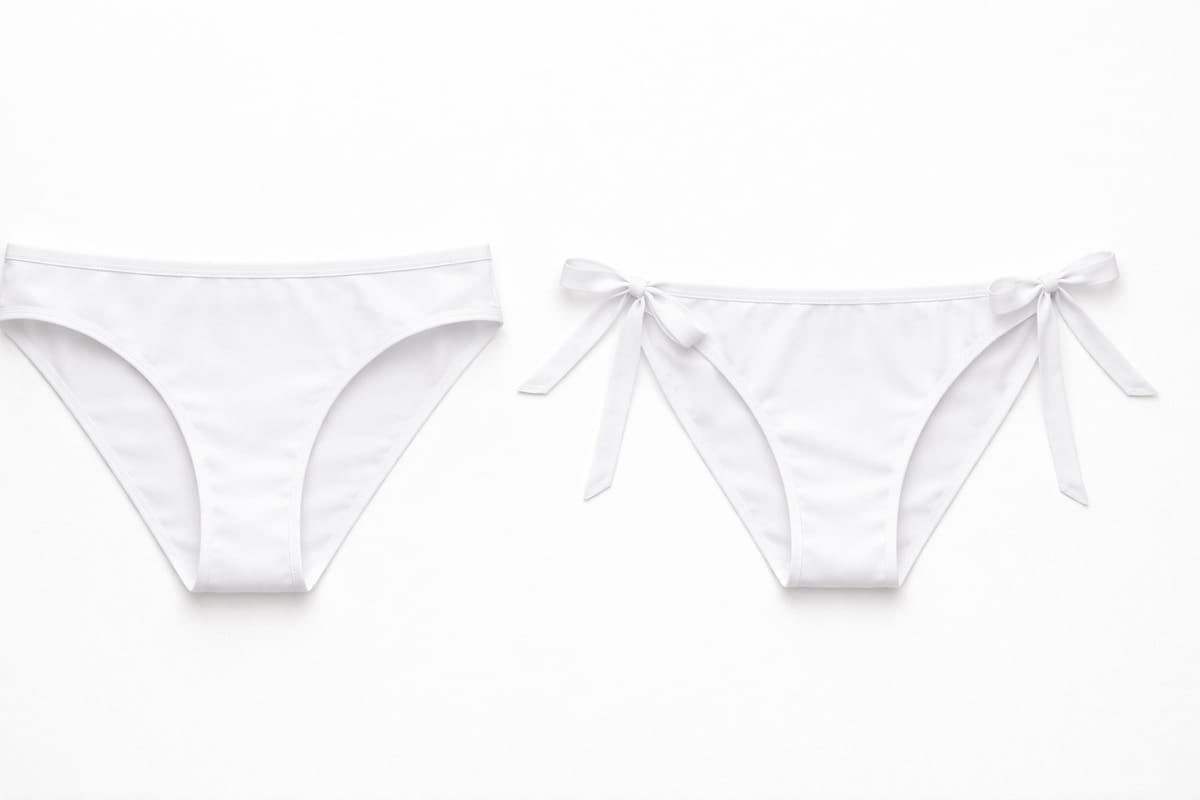
Knots or elastic, not coverage, is what decides side-tie vs bikini brief. A bikini brief is a closed loop: a continuous elastic waistband that you step into and pull up. A side-tie is open at each hip, where a pair of ties or ribbons are knotted, usually into bows, to hold the front and back together. The coverage of the two can be almost identical. What changes is how the garment goes on, how it adjusts, and what it says.
Elastic band or two knots
On a bikini brief the waistband does all the work. Elastic gives it grip, the size is fixed by the stretch, and nothing needs doing once it is on.
On a true side-tie the ties do all the work. Each side ends in a pair of strings, cords or ribbons, sometimes threaded through a loop or ring, and the wearer sets the tension by knotting them. That brings three practical differences:
- Adjustable fit. The same garment can be tied looser or tighter, and the two sides can be set differently.
- Removable without stepping out. Untie one or both sides and the garment comes off. This is useful in swimwear, at a fitting, and in the bedroom.
- Bulk at the hip. A knot and bow are thicker than an elastic band. Under fitted clothes they show.
From the beach to the bedroom
The side-tie's natural home is swimwear. The bikini itself dates to 5 July 1946, when Louis Réard presented his two-piece in Paris and named it after Bikini Atoll. The tie-side version came later. Wikipedia credits the model Brandi Perret-DuJon with the first formal presentation of the string bikini, at the opening of a New Orleans shopping center in 1974. In Brazil, Soul Brasil magazine lists string tie-side bottoms among the styles that appeared on the beaches in the 1970s.
The tie-side swim bottom has a functional logic: it can be adjusted wet, and it takes the place of elastic that would weaken in salt and chlorine. When the style moved into lingerie, the ties became mostly decorative. Satin ribbon, silk cord and lace-trimmed ties turned the fastening into the garment's main ornament.
That is why the side-tie appears so often in bridal and boudoir collections. A bow is a natural thing to untie.
Real ties and decorative bows
Not every garment sold as side-tie actually opens. Three types are common.
Working ties
The sides are fully open and the ties are the only closure. This is the original form, common in swim and in some lingerie.
Ties over elastic
A narrow elastic band runs round the hip as on a bikini brief, and the ties are threaded through or stitched over it. They can be loosened slightly but will not open the garment. This gives the look with the security of elastic.
Decorative bows
A bow is sewn on at each hip over a continuous waistband. The garment is, in practice, a bikini brief with trim.
Check the product photo for a gap at the hip, or read the description for words like "adjustable" or "fully opening". If neither appears, assume the bows are decoration.
Side-tie vs bikini brief for daily wear
For everyday wear, the bikini brief is the better choice by a wide margin. It is quicker to put on, it stays put through a full day without retying, and it lies flat under pants and skirts. It also comes in every fabric from cotton jersey to lace.
The side-tie is a special-occasion piece. It suits:
- Swimwear, where adjustability and quick removal are useful
- Bridal and honeymoon sets
- Lingerie meant to be seen, where the bow is the point
- Loose dresses and skirts, where the knot will not show
It suits tight clothes, sport and sleep poorly, since the knots can work loose or press into the hip when lying on one side.
Tying it so it stays
A bow tied with a single loop comes undone easily. A double-knotted bow, or a square knot with the loops tucked, holds much better. Ribbon ties in slippery satin need an extra knot; cotton cord or textured elastic grips better on its own. Tie both sides to the same tension, then check the gusset sits centrally before going out.
For how the bikini brief compares with the swim bottom it was named after, see our bikini brief vs bikini bottom comparison.
The 1974 string bikini needed four knots to stay on. The bikini brief needs none, which goes a long way to explaining why one fills underwear drawers and the other fills honeymoon suitcases.
Last updated
Questions
Do side-tie panties actually untie?
Not always. Working ties are the only closure, so untying them opens the garment. Some styles run ties over a narrow elastic band, which lets you loosen them slightly but not open the panty. Others simply have decorative bows sewn on over a continuous waistband. Look for a gap at the hip in the photo, or words like adjustable or fully opening.
How do you tie side-tie underwear so it stays up?
A bow tied with a single loop comes undone easily, so use a double-knotted bow or a square knot with the loops tucked. Slippery satin ribbons need an extra knot, while cotton cord or textured elastic grips better on its own. Tie both sides to the same tension, then check that the gusset sits centrally.
Are side-tie panties good for everyday wear?
Not really. For daily wear a bikini brief is the better choice by a wide margin: it goes on quicker, stays put all day without retying and lies flat under pants and skirts. A side-tie's knots are bulkier than elastic, show under fitted clothes, can work loose during sport and press into the hip when you lie on your side.
Who wore the first string bikini?
The model Brandi Perret-DuJon is credited with the first formal presentation of the string bikini, at the opening of a New Orleans shopping center in 1974. String tie-side bottoms were also appearing on Brazilian beaches in the 1970s. The tie-side made practical sense in swimwear, since it could be adjusted wet and replaced elastic that weakens in salt and chlorine.
Sources
- en.wikipedia.org: Bikini
- soulbrasil.com: bikini over 70 years of revolution and sensuality
Discussion
Loading...