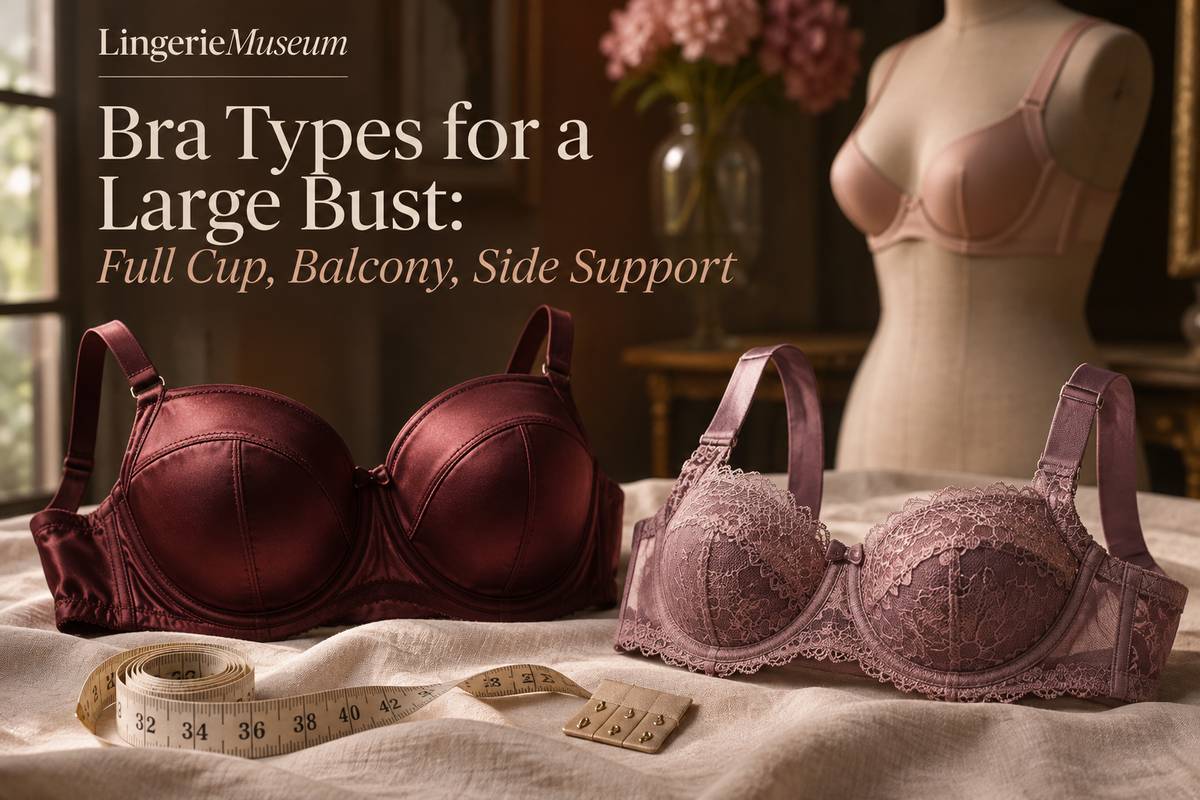
The bra types that support a large bust best are the full cup, the balconette (balcony) with firm or seamed cups, the side support bra, and the minimizer, all built on a firm band with three or more hooks and wide straps. Underwired, seamed cups from D cup upward give the most lift; the band, not the straps, should carry the weight.
Start with the band, not the style
Fitters repeat one rule more than any other: the band does most of the work. Cora Harrington of The Lingerie Addict calls the band the part "where most of your support comes from," and says it should run level around the body, not ride up at the back. Brastop, a UK full-bust retailer, puts a number on it: more than 80% of support from the band and less than 20% from the straps.
This matters more for a large bust than a small one, because the usual sizing mistake pushes the wrong way. Wikipedia's bra size entry, summarizing fitting studies, gives the most common error as "too large a back band and too small a cup," with 38C worn in place of 34E. A loose band slides up at the back and hands the load to the straps, which is where shoulder grooves come from. The University of Wollongong's Breast Research Australia group, led by Julie Steele and Deirdre McGhee, says more than 70% of women wear the wrong size bra.
Three checks apply to every style below, all from Harrington's guide: the band is level, the center gore (the strip between the cups) lies flat on the breastbone, and the wires surround the whole breast with no tissue outside, over or under the cup.
Bra types for a large bust, one by one
Full cup
The full cup bra covers the whole breast, with a high top edge and sides that wrap back toward the underarm. Bravissimo, which sells only D cups and up, calls it "an all-rounder that works really well for most boob shapes," and notes its straps sit a little closer together, so they slip off less. If the top edge cuts in, Bravissimo suggests a full cup with a stretch or elasticated top section, which follows a fuller upper bust instead of making a ridge.
Balconette with seamed or rigid cups
The balconette lifts from below and has wide-set straps attached at the side of the cup. Bravissimo describes it as "a popular everyday style" for big busts and makes a useful distinction: some balcony styles have stretch lace in the top cup, which molds to the shape, while "other balconette styles have more rigid fabric which offer even more support." For a heavy bust, pick the rigid one. It shows more upper breast than a full cup, so it suits square necklines.
Side support bra
A side support bra adds a vertical panel at the outer edge of each cup, near the armpit, or hides a fabric sling inside the cup. The panel holds tissue that would otherwise spread sideways and moves it forward. Wacoal describes its side support styles as using slings or engineered cup panels to guide tissue "inward and upward," and pitches them at fuller and wide-set busts. If tissue escapes toward your arm in a full cup, try this next.
Minimizer
A minimizer does not reduce anything; it spreads tissue flatter and a little wider so the bust projects less. It is the answer to one specific problem, the shirt that gapes between buttons across the bust. Wacoal claims its Visual Effects minimizer reduces the bustline by up to one inch. The trade-off is shape: the profile is broader and less lifted than a seamed full cup.
Plunge
Bravissimo says larger-busted wearers who find tall center wires uncomfortable may prefer a plunge's low gore. Choose one with seamed cups, not padded molded ones.
How a cup is built: seams, wires and slings
Molded, seamless cups are smooth under a T-shirt, but a single pressed shape cannot fit as many breast shapes at large volumes. Seamed cups are cut from two, three or four pieces, and each seam is a place where the maker can steer tissue. A vertical seam lifts; a horizontal seam gives a rounder, more projected shape; a vertical side panel pulls tissue forward from the outer edge. Many full-bust bras combine them, which is why three- and four-part cups dominate D+ ranges.
Wire width matters too. The wire should sit on the ribcage behind the breast at the side, not on breast tissue and not in the armpit. If it digs into the arm, the wire is too wide or too tall for your frame, and a different brand's cut may fix what a size change cannot.
Bands, straps and hooks on D+ ranges
Full-bust bras are wider at the back and at the sides. Expect three or four hooks rather than two, a deeper band, and wings that rise higher under the arm. On straps, research backs what fitters say. A 2015 University of Wollongong study by Celeste Coltman, McGhee and Steele tested sports bra straps on 23 active women with D cups and larger, and found that wide straps, about 4.5 cm (1.75 inches), caused less discomfort and lower strap pressure than standard-width ones. The study was small and about sports bras, but it points the same way as fitters' advice on everyday straps.
Where D+ sizes come from
UK brands built the full-bust market, and their sizes run further than most department stores carry. Bravissimo began as a mail-order business started by Sarah Tremellen in 1995, opened its first shop in Ealing, London, in 1999, and sells D to L cups; Wacoal Europe bought it in 2024. Elomi, made by Wacoal EMEA, lists UK bands 32 to 48 and cups D to K for its lingerie. Curvy Kate, launched at the Harrogate Lingerie Show in July 2009, makes D to K cups.
Those letters are UK letters. The UK runs D, DD, E, F, FF, G, GG, H, while many US makers go D, DD, DDD, G, H, so a UK F and a US F are not the same cup. Elomi's US site lists its range in US sizes for that reason. Check which system a size chart uses before you order, and treat a fitting every six months, the interval Elomi suggests, as routine rather than optional.
Last updated
Questions
What is the most supportive bra for big breasts?
For everyday wear, an underwired full cup or side support bra with seamed cups, a firm band and three or more hooks gives the most support. The style matters less than the fit: if the band is too loose, any bra will let the straps take the weight and the bust drop.
Are wireless bras good for a large bust?
They can be, but they need more structure to do the work a wire does: a deep, firm band, seamed or molded cups, and wide straps. Bravissimo recommends non-wired styles for sleep, pregnancy, breastfeeding and after breast surgery. For all-day lift at larger cup sizes, most full-bust ranges still lean on underwires.
Why do my bra straps dig into my shoulders?
Usually because the band is too big. When the band rides up at the back, the straps end up holding the bust. Fitters say the band should carry most of the support, so try a firmer band, often one size smaller with a larger cup letter, before buying wider straps or strap cushions.
Is a DD the same as an E cup?
No. In UK sizing, E is the cup after DD, then F, FF and G. Many US brands use DDD instead of E and then jump to G, so a UK cup letter and a US one with the same name can differ. Check which system a brand's size chart uses before ordering.
Sources
- bravissimo.com: bra style guide
- bravissimo.com: what is a balcony bra
- thelingerieaddict.com
- en.wikipedia.org: Bra size
- uow.edu.au: about
- elomilingerie.com: advice
- en.wikipedia.org: Curvy Kate
- 365retail.co.uk: bravissimo acquired by wacoal europe
- timeout.com: bravissimo
- pmc.ncbi.nlm.nih.gov: PMC5005736
- us.brastop.com: bra fitting tips
- brastop.com: what is a side support bra
Discussion
Loading...