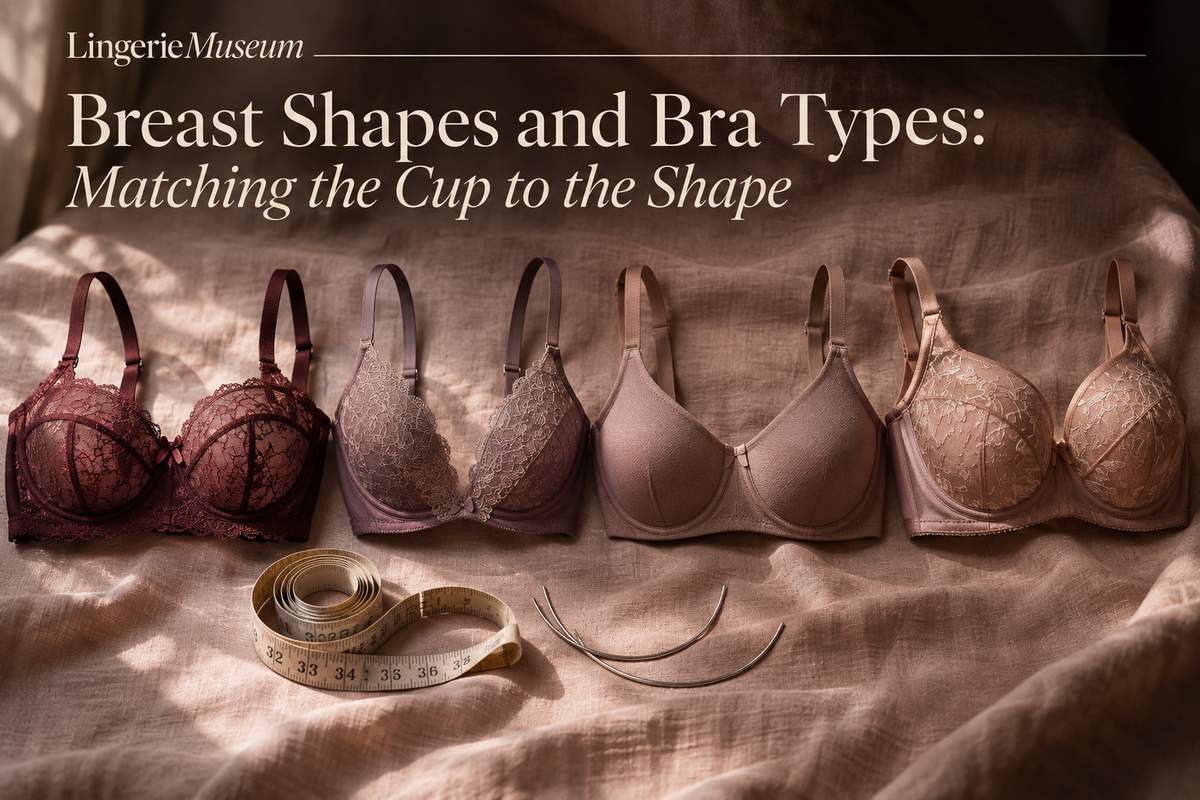
Breast shapes change which bra types fit, even at the same size. Full-on-top breasts need an open or stretchy upper cup, full-on-bottom breasts need a cup with little fabric above the nipple, close-set breasts need a low center gore, wide-set breasts need side support, shallow breasts need rounded cups and projected breasts need deep, seamed ones.
That is the short version fitters give. The longer one starts with a correction: there is no official list of breast shapes. Wacoal's guide names five, BraFinder's names seven, and retailers swap labels freely. Underneath, they all measure the same few things.
What a breast shape description actually measures
Bra Directory, a division of the retailer Your Bra Store, breaks shape into four separate scales rather than one label:
- Fullness: whether there is more tissue above the nipple (full on top), below it (full on bottom), or about the same.
- Projection: projected breasts have more tissue gathered around the root, the base where the breast meets the chest; shallow breasts spread the same tissue over a larger area.
- Root width: narrow or wide, which decides how wide the underwire should be.
- Firmness: self-supporting versus soft or pendulous tissue.
Add two more that every guide uses, spacing (close-set or wide-set) and symmetry, and you have the whole system. A single person can be shallow, full on bottom, wide-set and slightly asymmetric at once, which is why "teardrop" or "bell" labels so often fail to predict anything. Read your shape as a set of answers, not one word.
To find yours, BraFinder suggests standing at a mirror without a bra and looking at where the volume sits relative to the nipple. Look from the side for projection and from the front for spacing and fullness.
Breast shapes and bra types, one shape at a time
Full on top
The upper edge of the cup is the problem. A tall, rigid neckline presses into upper tissue and pushes it over the edge. Bra Calculator's shape guide warns against "rigid full-coverage cups with tight top edges" and points to the open upper cup of a balconette bra. Plunges with a low, open top work for the same reason; a plunge with a closed, high neckline does not.
Full on bottom (shallow on top)
The opposite fault: the lower cup fills and the top gapes. Wacoal, which says women who have breastfed often have this shape, recommends "an elastic neckline and close-set straps." Bravissimo's style guide names the half-cup as good for breasts "fuller at the bottom" and for anyone who gets "gaping with other styles."
Guides disagree on the label here. Bra Calculator sends full-on-bottom shapes to the plunge bra and full-on-top shapes to balconettes, while many fitters say the reverse, because balconette and plunge patterns vary so much between brands. Follow the rule underneath both: whichever style you try, the top edge should lie flat with no fabric left standing above the breast.
Close-set
Close-set breasts leave little space on the breastbone, so a tall center gore sits on tissue instead of the chest. Miss Mary of Sweden advises close-set wearers to avoid high underwires and consider "a lower centre wire or non-wired style." That makes the plunge, with its short V-shaped gore, the usual first try.
Wide-set and east-west
These breasts sit apart and point outward, with tissue resting toward the sides of the body. Wacoal recommends "open wires and side slings," which bring the tissue in and center it. BraFinder lists front-closure, plunge and side-support styles, and warns against styles without side support. Bra Calculator calls side support the "best first choice for inward shaping."
Shallow
Shallow breasts have a wide base and little depth in profile. Miss Mary is plain about it: "A shallow breast doesn't mean a smaller size." It recommends rounded cups, calls a minimizer ideal, and advises avoiding pointed unpadded cups that leave an empty tip. Bra Directory adds that shallow shapes "tend to do better with bralettes and wireless options."
A shallow wearer who sees wrinkled, empty cups usually buys smaller. Bratabase, the bra review database, calls this the "orange in a glass" effect and says the cause is often the reverse: the wires sit on breast tissue instead of around it, so the cup cannot settle. Their fix is "wider wires and usually bigger cup sizes."
Projected
Projected breasts stand forward from a small footprint. BraFinder recommends unlined seamed cups, balconettes and full cups, and warns against shallow molded cups and push-ups. Bra Directory notes that projected shapes may need larger cup sizes, and that narrow roots "tend to do well with narrower underwires."
Asymmetric
Some difference between the two sides is normal. Cleveland Clinic calls slightly asymmetrical breasts "very common," and the University of Portsmouth's Research Group in Breast Health tells women that "most women have one breast bigger than the other," with straps adjusted to different lengths. Wacoal advises fitting the larger breast and choosing fabric with good stretch; Bravissimo says stretch lace at the top of a balconette cup "moulds to your unique shape." A new difference is another matter: Cleveland Clinic advises seeing a doctor about any change that makes one breast look or feel different from the other.
Check the fit before blaming the shape
Shape advice only works on a bra that is the right size. Before deciding a style does not suit you, lean forward, fasten the band, and use what fitters call the scoop and swoop: Bratabase describes it as moving tissue "from your sides to the center" so all of it sits in the cups. Then check the Portsmouth group's criteria: a level band, breasts fully enclosed with no bulging or gaping, wires following the breast crease rather than sitting on tissue, and a center front flat against the body.
If the cups still gape or cut in after that, the style is the problem, and the shape notes above tell you which direction to move. Our complete bra type guide covers the construction of each style in more detail.
The Portsmouth group also notes that breasts change shape and size through life and that you may need a different size depending on where you shop. A shape you worked out ten years ago is worth checking again before you rule a style in or out.
Last updated
Questions
How do I know what breast shape I have?
Stand side-on and face-on at a mirror without a bra. Compare the tissue above and below the nipple for fullness, check from the side whether the breast stands forward or spreads wide for projection, and look at the gap between the breasts for spacing. Most people combine several traits rather than fitting one named shape.
Can breast shape change over time?
Yes. The University of Portsmouth's Research Group in Breast Health notes that breasts change shape and size throughout life, and Wacoal observes that women who have breastfed often become fuller at the bottom than the top. Recheck your shape and size rather than assuming an old fit still holds.
Is it normal for one breast to be bigger than the other?
Yes. Cleveland Clinic describes slightly asymmetrical breasts as very common, and Portsmouth's breast health researchers say most women have one breast bigger than the other. Fit the bra to the larger side and adjust the straps separately. A new difference that appears suddenly should be checked by a doctor.
Why does my bra gap at the top even though it is the right size?
Top gaping usually means the cup shape does not match your fullness. Breasts with less tissue on top leave the upper cup empty in tall, rigid cups. Wacoal suggests elastic necklines and close-set straps, and Bravissimo suggests half-cup styles for breasts fuller at the bottom. Try the scoop and swoop first to make sure all tissue is in the cup.
Sources
- wacoal.ca: breast shape guide
- brafinder.com: breast shape guide
- bradirectory.ca: breast shape guide
- bra-calculator.com: best bra types for every breast shape
- missmary.com: best bra styles projected or shallow breasts
- bravissimo.com: bra style guide
- bravissimo.com: what is a balcony bra
- bratabase.com: orange in a glass
- bratabase.com: breast root
- bratabase.com: scoop and swoop
- my.clevelandclinic.org: breast asymmetry
- port.ac.uk: research group in breast health
Discussion
Loading...