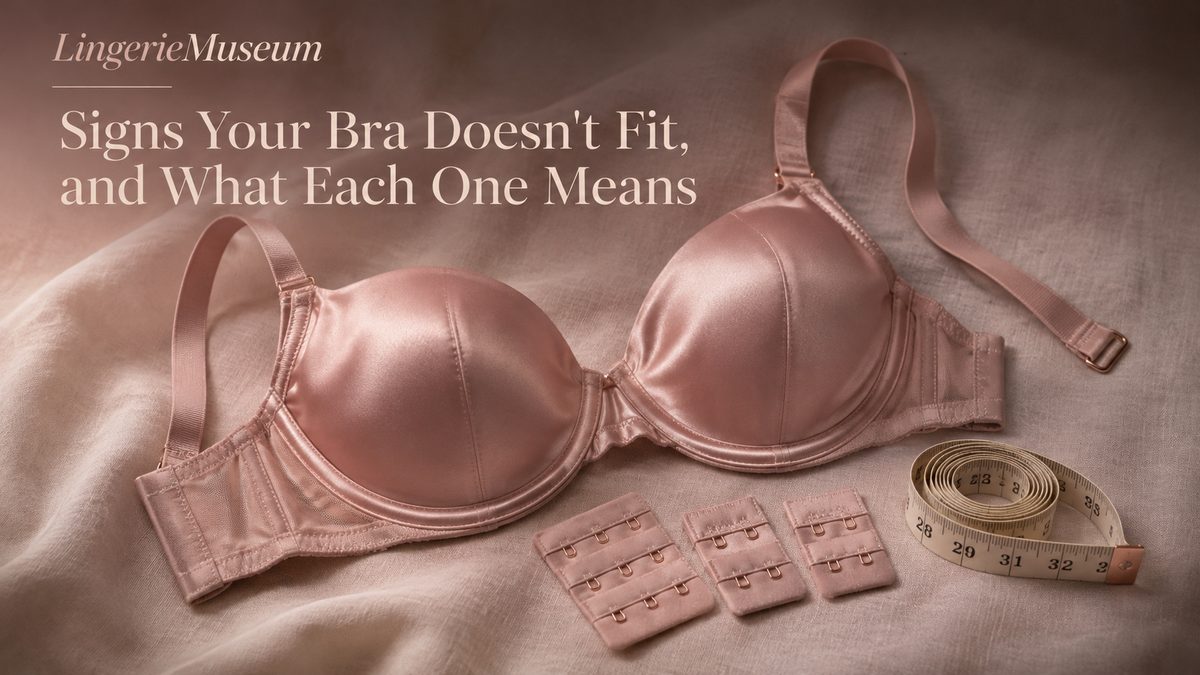
The clearest signs your bra doesn't fit are a band that rides up your back, straps that dig in or slide off, a center gore that floats off your breastbone, breast tissue spilling over the cup edges, empty or wrinkled cups, and underwires that sit on breast tissue instead of your ribcage. Each sign points to a specific part of the bra, usually the band or the cup.
That matters because most people guess wrong. In a 2010 study of 104 women, Deirdre McGhee and Julie Steele of the University of Wollongong found that 85 percent were wearing ill-fitting bras, and that neither tape measurements nor trying on several bras helped the women pick the right size on their own. A smaller 2008 study of 30 young women by Wood, Cameron and Fitzgerald put the figure at 80 percent. So read the bra, not the label.
Start at the back: the band rides up
Put on the bra, fasten it, and look at your back in a mirror. The band should run level with the floor. The Lingerie Addict's fit test describes it as "horizontal to the ground, not riding up or dipping down." When the band climbs toward your shoulder blades, it is too big. ThirdLove explains the mechanism: the front is not anchored, so the straps take the weight and haul the back of the band upward.
The fix is a smaller band. Marks & Spencer's fit guide says to go down a back size if the band rides up your back or if your breasts show beneath the underband. A band size down needs a cup size up to keep the same cup volume, a trade the former bra fitter Melissa Mason spells out in her Pedestrian guide. A 36C that rides up should be tried as a 34D, not a 34C.
A band that is too tight shows itself differently. It leaves deep marks, makes breathing feel restricted, or pushes up soft rolls above and below it. M&S reads breast tissue bulging over the band under your arms as a reason to go up a back size. Its own check for a good band is snug, with room for two fingers underneath.
Straps that dig in or slide off
Straps finish the job; they should not carry it. M&S's test is simple: loosen the straps, and the bra should stay put, because most support comes from the underband. If the bra sags the moment the straps are slack, the band is doing too little.
Straps that dig grooves into your shoulders are often a band problem in disguise: you have tightened them to make up for a loose band. Straps that slide off the shoulder point to a strap that needs shortening, a band that is too big, or a style whose straps sit too far apart for your frame. M&S advises people with narrow shoulders to avoid a balconette bra, whose straps are set wide.
The gore does not touch your breastbone
The gore is the center panel between the cups. On an underwire bra it should lie flat on your sternum, "with no gaps or spaces," in The Lingerie Addict's words. When the gore stands away from your chest, the usual reading is that the cups are too small: the wires are resting on breast tissue rather than behind it, which pushes the front of the bra forward. Go up a cup and check again.
If a bigger cup fixes the volume but the gore still floats or digs, the gore may simply be the wrong shape for you. Close-set breasts often need a low or narrow gore, the kind a plunge bra has.
Spillage over the cup edges
Breast tissue that bulges over the top of the cup, giving the double outline people call quad-boob, means the cup is too small. So does tissue squeezed out at the side under your arm. M&S lists both, at the front and under the arms, as reasons to go up a cup size. Before you decide, lean forward and scoop each breast into its cup from the side. Many bras look too small only because the tissue was never fully inside.
Empty, gaping or wrinkled cups
The reverse sign is a cup with room left over. ThirdLove notes that the cup gapes in a molded or padded bra and wrinkles in an unlined one. M&S says to go down a cup size when cups gape or wrinkle.
Gaping is not always size, though. If a cup size down squashes you but the original still gapes, the cup shape is wrong for your breast shape, and a different cut in the same size is worth trying. A full cup bra and a demi cup in the same size can sit very differently on one person.
Wires on breast tissue or in the armpit
An underwire should follow the crease where the breast meets the chest and sit on bone all the way round. The Lingerie Addict's check is to press on the outer end of the wire: you should feel ribcage under it, "directly on the bone." A wire that sits on soft tissue at the side or the front usually means the cup is too small, or the band too big. ThirdLove names both as causes of wires that poke and dig.
A wire that jabs into the armpit even after you go up a cup may be too wide or too tall for your frame, or the cup may be the wrong shape. That is a reason to try another brand or style rather than another size. If no wire sits right, compare underwire and wireless bras.
Check the band before the cups
Work from the band to the cups. A loose band lets the wires drop and tilt forward onto tissue, so the cups can look too small when the band is the real fault. Fix the band, adjust the straps, then judge the cups and wires.
Buy a new bra that fits on the loosest hook. Elastic stretches with wear, and the tighter hooks are there to take up that slack later. Mason's guide says the same: buy the size that is comfortable on the biggest hook.
The research says the cups are where most bras fail. When Celeste Coltman, Julie Steele and Deirdre McGhee checked 309 women in their own bras in a 2018 study, the cups, the front band and the straps were the components most often wrong.
Last updated
Questions
How do I know if my bra band is too big?
Look at your back in a mirror. If the band sits higher at the back than at the front, or creeps up toward your shoulder blades during the day, it is too big. Another check is to loosen the straps: if the bra sags at once, the band is not holding it. Try a band size smaller with a cup size larger.
Why does the middle of my bra not touch my chest?
A center gore that stands away from the breastbone usually means the cups are too small, so the wires sit on breast tissue and push the front forward. Try one cup size up. If the gore still floats or digs with enough cup volume, the gore is likely the wrong height or width for how your breasts are set.
Should a new bra be worn on the loosest or tightest hook?
On the loosest hook. Bands stretch as the elastic is worn and washed, and the inner hooks exist to tighten the band as that happens. A new bra that only feels firm on the tightest hook has nowhere left to go and will soon be too loose.
What does it mean when my bra straps keep falling down?
Straps that slide off usually need shortening, but if they still fall once adjusted, the band may be too big or the straps set too wide for your shoulders. Marks and Spencer's fit guide advises people with narrow shoulders to avoid balcony styles, which place the straps wide apart on the cup.
How many women wear the wrong bra size?
Studies put it between about 80 and 85 percent. A 2008 study of 30 young women found 80 percent in the wrong size, and a 2010 University of Wollongong study of 104 women found 85 percent in ill-fitting bras. Both samples were small, so treat the figures as a sign of how common poor fit is, not a census.
Sources
- europepmc.org: 20451452
- europepmc.org: PMC2275741
- researchprofiles.canberra.edu.au: which bra components contribute to incorrect bra fit in women acr
- uow.edu.au: free bra fitting app spells the end of change room dilemmas
- thelingerieaddict.com
- marksandspencer.com: fittingroom
- thirdlove.com: signs wearing wrong bra size
- pedestrian.tv: how to tell if your bra fits correctly
Discussion
Loading...