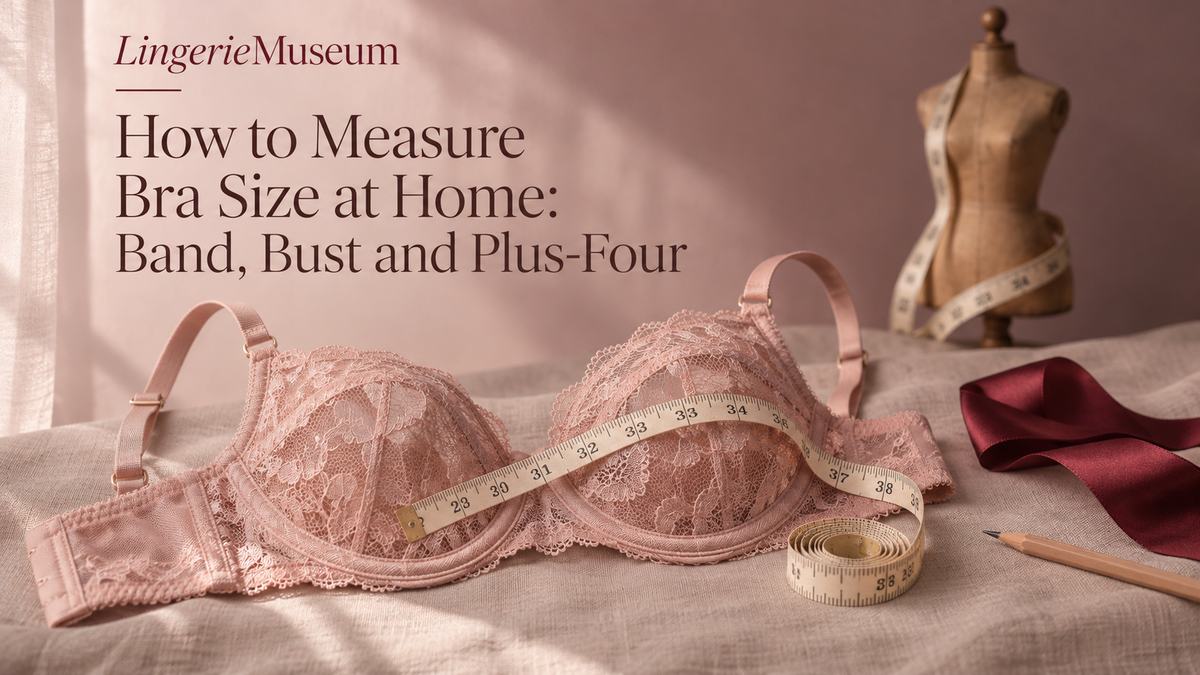
To measure bra size at home, wrap a soft tape snugly around your ribcage just under your breasts for the band, then loosely around the fullest part of your bust. Subtract the band from the bust: each inch of difference is one cup letter. Some US charts add 4 or 5 inches to the band first; most specialist fitters do not.
Those two numbers are a starting point, not a verdict, and two tape methods can hand the same person sizes that look nothing alike.
What to wear and what to have ready
You need a soft tape in inches, a mirror, and ideally a helper. Triumph tells customers to measure in a non-padded bra or bare skin and to avoid thick clothing or heavily padded bras, since both distort the result. Its own advice is that going braless gives the most accurate number. Stand upright, arms relaxed at your sides, and breathe normally.
Step one: the underband measurement
Put the tape around your ribcage directly under the breasts, where the bra band would sit. Keep it level all the way round; the back is where it usually drops. Pull it snug, firm against the body without the tape biting in.
Read the number in inches. Triumph's rule is to round an odd number up to the next even one, so 33 inches becomes a 34 band. Bands come in even steps of 2 inches in UK and US sizing, so a 31 becomes 32 and a 32 stays 32.
Step two: the bust measurement, standing and leaning
Now move the tape up to the fullest part of the bust, usually across the nipples, and keep it level and parallel to the floor. This time the tape should rest gently on the skin without pressing into breast tissue. A tight bust tape gives a smaller number and a smaller cup.
Then take it a second time bending forward at the waist, with the breasts hanging down. Wikipedia's entry on bra measurement suggests exactly this pair: once standing upright, once bent over. If the two numbers differ a lot, note both and try cups for each.
How to turn bust and band into a bra size
Subtract the band size (the rounded underband, or the adjusted one if your chart adds inches) from the bust measurement. Triumph's UK chart reads the difference like this:
| Difference | UK cup |
|---|---|
| 1 inch | A |
| 2 inches | B |
| 3 inches | C |
| 4 inches | D |
| 5 inches | DD |
| 6 inches | E |
| 7 inches | F |
| 8 inches | FF |
| 9 inches | G |
| 10 inches | GG |
Up to D the letters match in the US. After that, labels split: some US makers go DD, DDD, others use UK-style letters, and some print D1 to D5. An underband of 31.5 inches (80 cm) and a bust of 37 inches (94 cm) gives a 32 band and a 5 inch difference, so a 32DD.
Plus four or plus zero: why the band methods disagree
The older system adds inches to the underband before you do anything else. Bali's sizing guide, reproduced on its Target listings, still reads: if your underbust is an odd number, add 5; if it is even, add 4. Then subtract that band from the bust.
Run one body through both methods. Underbust 30 inches, bust 36. Plus-four gives a 34 band and a 2 inch difference: 34B. Plus-zero gives a 30 band and a 6 inch difference: 30E in UK letters, often labeled 30DDD in the US. Same woman, same tape.
The plus-four rule dates from bras without much stretch. The Lingerie Addict, writing about vintage bras in 2015, explains that women once added four inches to the band because bras were made without the strong elastic and power mesh that later bands rely on, which is why vintage sizes skew toward bigger bands and smaller cups. A modern band stretches on its own, so the extra inches tend to make it loose.
Researchers have tested it. Jenny White and Joanna Scurr of the University of Portsmouth fitted 45 women, most of whom called themselves a 34DD, and published the results in Ergonomics in 2012. The traditional tape method overestimated band size and underestimated cup size, and got worse as the band got bigger. Triumph's UK guide now calls plus-four an outdated technique and says its own calculator skips the step. Retailers have moved too: Wikipedia records Kohl's using plus-four in 2013 and plus-zero by March 2018.
Why two tapes can give two different sizes
Even with one method, home numbers wander, for four reasons.
- Tension. The underband is soft tissue over bone. Pull a little harder and you drop a band size.
- Shape. The tape reads circumference, not shape. A projected breast and a shallow one with the same bust number need different cups. Deirdre McGhee and Julie Steele at the University of Wollongong measured the breast volume of 104 women by water displacement in 2011 and found several volumes sitting in the same bra size, and the same cup letter holding different volumes on different bands.
- Brand charts. Cup sizes are not standardized between makers, so two 34B bras can fit differently.
- Letters. A UK E and a US DDD are the same 6 inch difference with different names; after D, check which system the label is in.
The tape is a draft, the fitting room decides
White and Scurr ended their paper by recommending that women learn to judge fit themselves rather than chase an absolute size, and that is the practical way to use your numbers. Try the size the tape gives, then the sizes either side. The band should sit level and firm on the loosest hook; the center front of an underwire bra should lie flat on the breastbone; the cups should hold everything without a ridge at the top edge. Our complete bra type guide helps when the size is right and the style is not.
None of this is as old as it looks. Formfit announced three cup volumes, "small", "average" and "full", in each band size in 1932, and the Underpinnings Museum notes that sources still disagree over whether S.H. Camp or Warner's first put the letters A to D on cups. The letters were a sales system before they were a measurement, and the tape has been trying to catch up ever since.
Last updated
Questions
Should I measure my bra size with a bra on or off?
Either bare skin or a thin non-padded bra works. Triumph advises against padded bras and thick clothing because both distort the measurement, and says going braless gives the most accurate result. If you wear a bra, pick an unlined one that fits reasonably well so the breasts sit where a bra would hold them.
Do you add 4 inches to your band size?
Only if the brand's chart tells you to. Older US charts, such as Bali's, add 4 to an even underbust and 5 to an odd one. Triumph and most specialist fitters use the snug underbust measurement as the band, rounded up to an even number. The plus-four rule dates from bras with little stretch in the band.
Why is my measured bra size different from the size I wear?
Home measuring is approximate. Tape tension changes the underband, breast shape changes how a cup fits at the same bust number, brand charts are not standardized, and cup letters after D differ between US and UK labels. A University of Portsmouth study in 2012 found the traditional tape method tended to give bands too big and cups too small.
How often should you measure your bra size?
Measure again whenever your bras start to feel wrong: after weight change, pregnancy or breastfeeding, a new exercise routine, or simply when bands ride up or cups gape. Bodies change over time and bands stretch with wear, so a size that fit a few years ago may no longer be the right starting point.
Sources
- en.wikipedia.org: Brassiere measurement
- en.wikipedia.org: Bra size
- uk.triumph.com: how to measure bra size
- uk.triumph.com: bra size calculator fitting guide
- target.com: A 1012503014
- thelingerieaddict.com
- researchportal.port.ac.uk: evaluation of professional bra fitting criteria for bra selection
- doi.org: 00140139.2011.647096
- emerald.com: Breast volume and bra size
- ro.uow.edu.au: 1085
- underpinningsmuseum.com: exhibition lift separate technology and the bra chapter 4
Discussion
Loading...