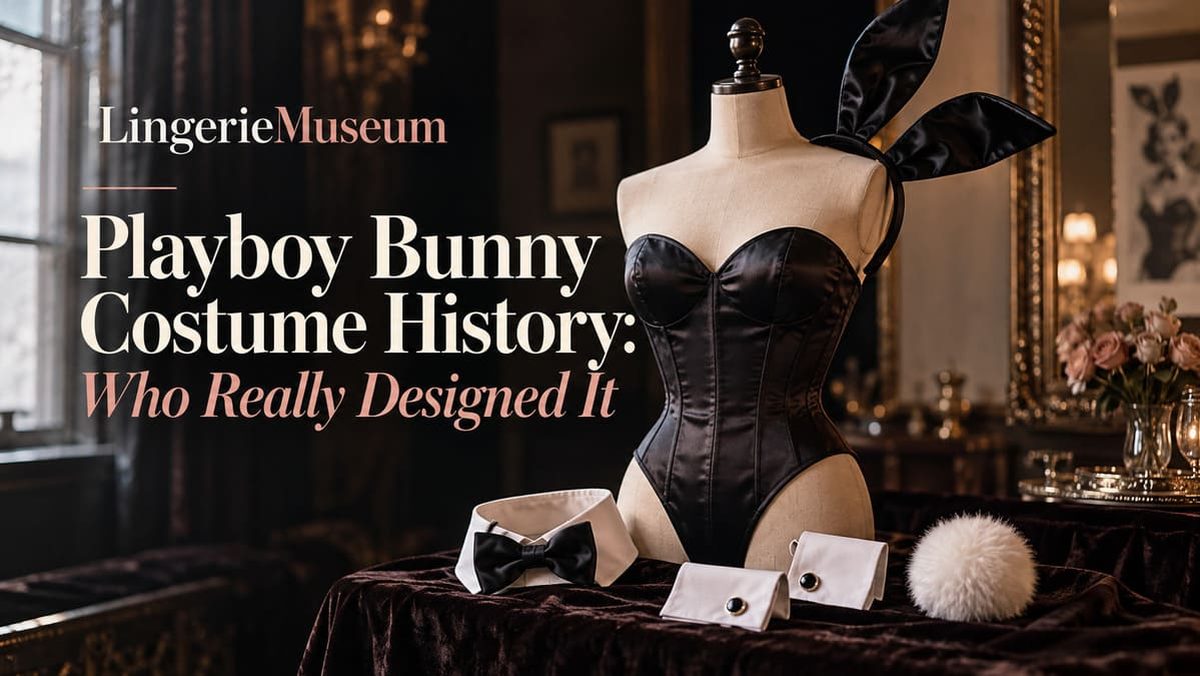
The Playboy Bunny costume was first worn on February 29, 1960, by the waitresses of the original Playboy Club at 116 East Walton Street in Chicago. The idea came from Ilse Taurins, girlfriend of Playboy promotions director Victor Lownes, and her mother, a seamstress, sewed the prototype: a strapless corseted satin bodysuit with rabbit ears and a cottontail.
The New York couturier Zelda Wynn Valdes is often named as its designer; the record supports a narrower claim, that she made Bunny suits for the New York club, which opened in 1962.
Who designed the Playboy Bunny costume?
The Valdes credit has circulated widely since about 2013. BlackPast says Hugh Hefner hired her in 1958 to design the first costumes, on Lownes's recommendation. The FIDM Museum in Los Angeles, which holds a Bunny uniform, reads it differently. Its curators note that the earliest accounts of the suit's development name Taurins, that Lownes himself said "It was my girlfriend's concept," and that its author found the Valdes link to Hefner only in her 2001 New York Times obituary. They suggest her workroom sewed costumes for the New York club and the two jobs merged in the retelling. The Conversation, in October 2023, called the Valdes design story false while confirming her New York work, and in 2022 PLBY Group's Ashley Kechter told Jezebel the same.
None of this diminishes Valdes. Born in Chambersburg, Pennsylvania, in 1905, she opened her own studio on Broadway near West 158th Street in 1948 and dressed Ella Fitzgerald, Josephine Baker and Dorothy Dandridge in close-fitting gowns. From 1970 she designed for the Dance Theatre of Harlem.
Hefner's part was editorial. The tuxedoed rabbit had been the magazine's emblem since December 1953, chosen, he said, "because of the humorous sexual connotation." Taurins proposed dressing the waitresses as that rabbit; Hefner then asked, per the FIDM Museum, for cross-lacing at the hips and for the sides to be cut higher on the thigh. No source found for this article credits him with the ears; they came with the rabbit.
A merry widow under rayon satin
The first version, modeled by Hefner's girlfriend Cynthia Maddox, had ears and a tail but no collar or cuffs. By 1961 the white collar with black bow tie, the cuffs and a satin rosette on the hip carrying the wearer's name were in place. Wikipedia credits the French designer Renee Blot with a 1962 revision that made the ears smaller and added rabbit-head cufflinks.
Underneath, the suit was a corset. The FIDM Museum describes a one-piece rayon satin garment mounted on a merry widow corselet, the boned, strapless long-line foundation of the 1950s, which pulled the figure into an hourglass. Chicago's Kabo Corset Company handled production for the clubs. Fronts were pre-sewn in several cup sizes and matched to each woman, and each Bunny got two suits. Bending forward could split seams or push a bone through the satin. The history of the corset is full of the same trade-off.
Some details changed over time:
- Tights: mesh at first, then from 1962 sheer black Danskin hose worn over flesh-tone tights.
- Tail: a yarn pompom until 1969, then a stuffed faux-fur tail.
- Color: originally a dozen shades of satin, with ears and shoes dyed to match. Colors were drawn by lottery, and black, the most popular, went first.
- Fabric: later suits moved to washable stretch knit.
The rules of the Bunny job
A housemother figure called the Bunny Mother hired, trained and scheduled the staff. Bunnies had to recognize 143 brands of liquor and garnish 20 cocktails, master a serving move called the Bunny Dip and accept demerits for unkempt hair, chewing gum or badly bent ears. Customers could not touch them or date them, and mystery shoppers checked the rules. The club laundered and mended costumes nightly. The cuffs and collar were the only parts a Bunny could take home.
The FIDM Museum's uniform, dated about 1977, was worn at the Dallas club by Melissa Mandolf, hired as one of 80 from 189 finalists. "Many thought it was a glamorous job," she told the museum, "but it was VERY hard work."
Gloria Steinem and "A Bunny's Tale," 1963
In 1963 Gloria Steinem, then 28, was hired at the New York club on East 59th Street under the name Marie Catherine Ochs, giving her age as 24. Her two-part diary ran in Show magazine in May and June 1963.
She was fitted in blue satin and wrote that "the boning in the waist would have made Scarlett O'Hara blanch." The wardrobe staff padded the bodice with plastic dry-cleaning bags, tissues and cut-up tails. Bunnies were promised $200 to $300 a week, Steinem found a base wage of $50, and the women paid $2.50 a day toward costume upkeep. It was reprinted in Outrageous Acts and Everyday Rebellions (1983) and filmed for television in 1985. Kathryn Leigh Scott, a fellow Bunny, later argued in The Bunny Years (1998) that the job also paid decently and offered travel.
A uniform with a registration number
Articles often say the suit was patented. It was registered as a trademark: US registration 762,884, which Playboy describes as the first service uniform registered with the US Patent and Trademark Office. The registration covers "a three dimensional bunny costume worn by a woman" with a corseted bodice, ears, tail, name tag, wrist cuffs and bow tie collar. In October 2020 Playboy sued Fashion Nova in federal court in Los Angeles over lookalike costumes, and the case was dismissed by agreement in November 2021.
Playboy says one suit is in the Smithsonian, and in July 2025 the Chicago History Museum acquired Candace Jordan's complete 1976 Bunny of the Year costume.
How the Bunny became a Halloween costume
The last original American club closed in 1988. By then the costume had a life of its own.
Adult Halloween costumes took off in the 1970s, and the Bunny suit suited the party: a silhouette anyone recognizes, built from a corset and a few accessories. Film helped. The heroine of Bridget Jones's Diary (2001) wears one to a costume party, and Regina George wears a bunny look to the Halloween party in Mean Girls (2004). Ears, a satin or vinyl bodysuit, cuffs and a bow tie became the standard costume kit, sold by mass costume makers and by Playboy itself, whose official version came in sizes up to 3X in 2022.
The trade dress Playboy defends in court lists the same parts the Chicago Bunnies wore by 1961. Only the satin and the tights have changed.
Last updated
Questions
Who designed the original Playboy Bunny costume?
The idea came from Ilse Taurins, girlfriend of Playboy executive Victor Lownes, who suggested dressing the waitresses as the magazine's tuxedoed rabbit. Her mother, a seamstress, sewed the prototype for the Chicago club that opened in 1960. Hugh Hefner asked for a higher cut on the hip, and Zelda Wynn Valdes later made suits for the New York club.
Did Zelda Wynn Valdes design the Playboy Bunny suit?
She is widely credited, and Playboy's licensing company says she designed the suits for the New York Playboy Club, which opened in 1962. The FIDM Museum and The Conversation say the original 1960 Chicago design came from Ilse Taurins and her mother. FIDM found the Valdes link to Hefner only in her 2001 obituary, not in any firsthand account.
What is the Playboy Bunny costume made of?
The first suits were one-piece rayon satin bodysuits built over a boned merry widow corselet, made in about a dozen colors with matching ears. The full uniform added a white collar with bow tie, cuffs, a hip rosette name tag, a cottontail and, from 1962, sheer black hose over flesh-tone tights. Later suits used washable stretch knit.
Is the Playboy Bunny costume trademarked?
Yes. The costume is registered with the US Patent and Trademark Office as trade dress, registration 762,884, which Playboy calls the first service uniform ever registered there. It is often described as patented, but the protection is a trademark. Playboy sued Fashion Nova over lookalike costumes in 2020, and the case was dismissed by agreement in 2021.
Why is the Playboy Bunny such a popular Halloween costume?
Adult Halloween costumes took off in the 1970s, and the Bunny suit is easy to read from across a room: ears, a corseted bodysuit, cuffs and a bow tie. Films such as Bridget Jones's Diary (2001) and Mean Girls (2004) put it on screen, and costume makers and Playboy itself sell versions every October.
Sources
- en.wikipedia.org: Playboy Bunny
- fidmmuseum.org: colony colors iconic playboy bunny
- theconversation.com: how the playboy bunny suit went from uniform to halloween costume 2...
- jezebel.com: playboy bunny halloween costume 1849683128
- en.wikipedia.org: Zelda Wynn Valdes
- blackpast.org: valdes zelda barbour wynn 1901 2001
- dnainfo.com: very first playboy club opened on leap day chicago photos
- biography.com: gloria steinem playboy bunny undercover
- undercover.hosting.nyu.edu: 13088
- aol.com: playboy bunny costume may iconic 203544796
- thefashionlaw.com
- thefashionlaw.com: playboy fashion nova settle trademark suit over allegedly infringin...
Discussion
Loading...